Learning platform
 en
en 


Playing in a 1-4-4-2 formation, their centre-midfield pairing of Casemiro (5) and Bruno Guimarães (8) was often overloaded centrally against Morocco’s 1-4-2-3-1. Against Haiti, they changed their approach to a 1-4-3-3, with Casemiro playing as the defensive-midfield pivot player, and Guimarães and Lucas Paquetá (20) ahead of him.
In this video, FIFA Technical Study Group expert and former Brazil midfielder Gilberto Silva explains why this change in formation brought more stability both in and out of possession. With Casemiro anchoring the midfield, he could orchestrate the game around him.
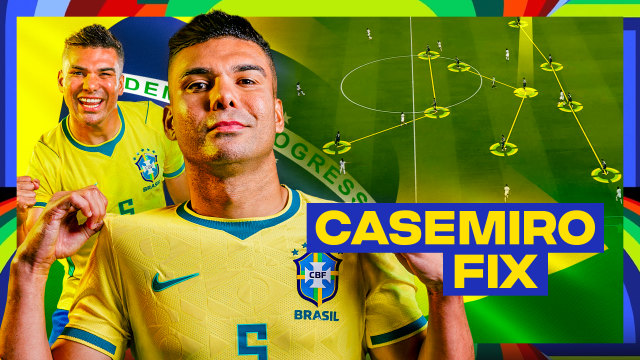
CASEMIRO’S ROLE v. MOROCCO
Whilst operating in a flat midfield two, when either Casemiro (5) or Guimãraes (8) came out to press, the space between Brazil’s midfield and defensive line became vulnerable, especially when Morocco had an attacking midfielder (in their 1-4-2-3-1 system) occupying that space. As can be seen in graphic 2 below, if either centre-midfielder came out to press, the wide midfielder needed to come in narrow, but because the line was flat, it still left clear passing lanes open to the space in front of the centre-backs.

“Morocco kept the ball so well, they passed and moved it so well, so after coming out to press, Casemiro (and/or Paquetá) then had to recover back into the space they vacated, which made their job very hard,” Silva explains.
CASEMIRO’S ROLE v. HAITI
In the game against Haiti, Brazil changed to a 1-4-3-3 with Casemiro (5) acting as the pivot/single defensive midfielder. With Guimarães (8) and Paquetá (20) protecting the space to the right and left ahead of him, it allowed him to hold and marshal the central space. Out of possession, he could orchestrate the press and anticipate opportunities for interceptions. In possession, Casemiro could support the build-up play, allowing his forwards and attacking midfielders to create options ahead of the ball.
His role was also crucial in transitions where he provided safety. In transitions to defend, he was an extra layer of protection. In transitions to attack, he could release forward players early and give them the freedom to commit to the attack, knowing he was taking care of the space behind them.
“This positional change, for me, was key. Being here (in the pivot) position, he knows how to protect the back four and how to keep the game in front of him. When that happens, he can control the game, assess Guimãraes and Paquetá, and guide them. In this position, he gives a masterclass because he does not need to do the running and can protect the space.
“With centre-forward Matheus Cunha (9) also dropping in to help the press, it meant they were never outnumbered in midfield and could transition quickly when they won the ball back,” Silva explains.
Silva on what the pivot player needs
2002 FIFA World Cup ™ winner Gilberto Silva played the defensive midfield and pivot position extensively throughout his Brazil career and became known as “The Invisible Wall” (or Parede Invisíval). He also anchored Arsenal’s midfield during their 2003-04 ‘Invincible’ season alongside Patrick Viera and has plenty of experience playing in both a midfield two and a midfield three. Here, he explains the importance of the work of the players in front of Casemiro.
“This work by Paquetá, Guimarães and Cunha was so important to Casemiro because it allowed him to control the area in front of the defenders and to guide the players ahead of him regarding their positioning. Two of the key moments in this game came from this structure and their positioning — once from Cunha, where he won the ball back and generated the first goal, and the second goal came from Paquetá winning the ball back from this structure and work.
“This structure allowed Brazil to be more fluid, more patient, and have more confidence. The players ahead of Casemiro also had the mentality to suffer and not lose their composition, which was important, because if you lose the composition, you give life to the opponent.”
Casemiro spotlight
Rate your experience