Learning platform
 en
en 


By drifting into different spaces, dropping deep to support the build-up and controlling when Norway accelerated their attacks, Ødegaard helped open passing lanes and create space for his team-mates. His ‘free role’ allowed him to be heavily influential for his team whether they were in or out of possession, and regardless of where he was on the pitch.
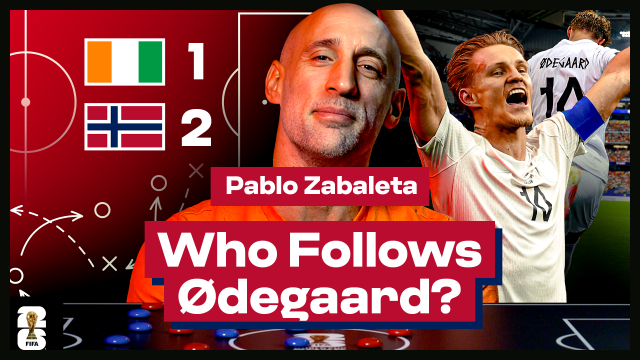
WATCH PABLO ZABALETA’S BREAKDOWN
In possession: Occupying the half spaces
“Ødegaard was pretty much involved in everything in this game for Norway, especially his influence in possession,” Zabaleta explains. “When he gets into those half spaces between the midfield and defensive lines, it was very difficult for Côte d’Ivoire’s defenders. If you leave him free to receive, he can turn and go at defenders; if you step in and mark him, it can open space for (centre-forward) Erling Haaland to run in behind.”
His influence on the game when Norway were in possession is further evidenced by the match data (graphic 2) that shows he was involved in seven sequences of play that ended in an attempt at goal, the most of any player in the game. This highlights the meaningful impact he had when Norway were attacking.

In clip 1 below, Zabaleta highlights Ødegaard’s game intelligence and his ability to see where the space is. His consistent movement creates overloads and opens up passing lanes for, and to, his team-mates. If he receives in space, he can progress the ball either by running with it or playing it to others.
“Ødegaard is a really clever player. He always knows where the space is and likes to move between the lines, especially operating on the right-hand channels. He can drive with the ball and get into the box (penalty area) to be an extra option.”
Dropping deep
When Côte d’Ivoire adjusted their defending strategy by defending more compactly and closing the space between the lines, Ødegaard dropped into deeper positions, helping to create an overload in the build-up phase. By dropping deep alongside his own centre-backs, he sometimes drew a midfielder out from Côte d’Ivoire’s midfield line, opening passing lanes to Patrick Berg (6) or Sander Berge (8), who could push higher when Ødegaard was deep. Vitally, when the space was closed, he knew how and where to move to open it for other players. He was constantly adjusting and adapting to his opponent’s defensive strategy.
In clip 2 below, Zabaleta outlines the ‘free role’ Ødegaard had and how he controlled the tempo of the game from deeper positions.
“Ødegaard is not just good at playing between lines as a number 10. He also has the freedom to be the main man and get on the ball in different parts of the pitch, and has the patience to decide and manage the tempo, knowing when to play forward and when to play backwards. When he gets into those deeper positions, where he is very good at building play from the back, Berg (6) and Berge (8) (and the other centre-midfielders) can push a little forward. His patience can force the opposition team to step out (of their shape), and he can play those through balls to break the lines. You can also see that when he plays those forward passes, he follows the action, getting into positions just outside the penalty area, never hiding and always being an option.”
Positional play: Quick transitions
Ødegaard’s astute positional play did not just affect his team when they had the ball. He was also hugely impactful when Norway lost the ball or were out of possession. His mental engagement with changing and transitional game phases was also crucial. Zabaleta uses clip 3 below to highlight how sharp Ødegaard’s presence of mind and focus are in key moments of transition, as well as his reaction speed when switching from attacking to defensive thinking and back to attacking again.
“This is a clear example of Ødegaard dropping deep to receive the ball. We see again how good he is at getting himself into positions where he can be an option behind the pressing line, receiving behind the players who are jumping (out of the team structure) to press the ball. But you also see his reaction when the opportunity comes to win the ball back and, again, following the team to progress.”
Out of possession: Activating pressure/counter-pressure
Work ethic, work rate and a strong desire to win the ball back are further key qualities of Norway’s captain. His leadership when the team has possession is mirrored when they do not have it. In this match against Côte d’Ivoire, he applied more pressures (37 in total) than any other Norway player, and he did it wherever he was on the pitch.
This selfless hard work for his team really stood out for Zabaleta, who uses clip 4 below to highlight these traits.
“What I also like from Ødegaard is his capacity to counter-press every time Norway lose the ball. He is often the man that starts the press and his work rate off the ball is incredible. You can see how he tracks runners, prevents forward passes, and leads by example.”
Summary
In Zabaleta’s words, Ødegaard’s performance represented what a complete player looks like, always working for their team in all phases of the game.
“That performance against Côte d’Ivoire from Ødegaard was incredible, simply because he was involved in everything. On the ball, he was always the playmaker for them; he always had the personality to get on the ball and make things happen in the game, but also he was committed off the ball. He was always the first to press when they lost the ball, and that was very impressive about his performance.”
Rate your experience