Learning platform
 en
en 


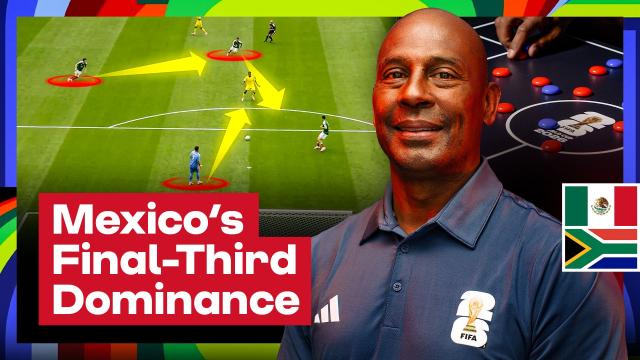
In this tactical article, FIFA Technical Study Group Expert Aron Winter explains the key principles behind Mexico’s approach of creating goalscoring opportunities from high pressing out of possession through quick combination play when in possession. He discusses the synergy, communication and role clarity between Mexico’s forward and midfield players, and how they worked together seamlessly in a 1-4-4-2 (diamond) shape without the ball and in a 1-4-2-3-1 with the ball.
High pressing in a 1-4-4-2 (diamond)
Building up from the back is a key in-possession characteristic of head coach Hugo Broos’ South Africa team, and it was clear from the outset that Mexico were intent on disrupting that build-up with an aggressive, orchestrated high press using a 1-4-4-2 (diamond) structure.

Key principles of Mexico’s high press:
-
Allow the first pass: Two forward players positioned aggressively. The ball-side forward’s role was to get early, direct pressure on the centre-back receiving the ball, while the second forward actively positioned to get immediate pressure on the goalkeeper if the ball was played back to him.
-
Prevent line-breaking passes through the central channel: The players located at the top and bottom of the diamond were responsible for locking on to South Africa’s centre-midfielders, ensuring they could not be viable options to receive in the central channel.
-
Forcing the ball wide: The players on either side of the diamond occupied those spaces for two reasons: first, to provide additional protection in the central channel; and second, to press in the wide channel if the ball was played to the full-back in that area.
-
Dealing with long balls: The back four rested just inside their own half and were connected as a unit. This starting position ensured that if South Africa played long passes at any stage, particularly in the event of the high press being broken, Mexico had some depth to deal with them.
The key roles of Mexico’s forwards and midfielders in initiating pressure is supported by the data provided by FIFA’s Football Performance Insights Team. Both Julián Quiñones (16) and Raúl Jiménez (9), who operated as the front two in the high press, registered the highest volume of individual player pressures applied, while the four players in the diamond formation (Álvaro Fidalgo, Érick Gutiérrez, Roberto Alvarado and Érik Lira) all featured prominently in the rankings.
The mechanisms of the press
In clip 1 below, we see the full intent and mechanism of Mexico’s high press straight from kick-off. As South Africa play the ball backwards all the way to their goalkeeper, Mexico push up the pitch. When set for the build-up phase, Mexico’s 1-4-4-2 (diamond) structure emerges immediately, with players quickly adjusting their positions in line with their individual responsibilities. Fidalgo player-to-player marks Yaya Sithole (13), South Africa’s defensive midfielder, knowing that he is a key part in how they like to build play centrally. Mexico allow the first pass, but that is the trigger for the aggressive press, which quickly cuts off passing options for South Africa’s centre-backs and goalkeeper.
Once the ball is played, Jiménez (9) activates the press with direct pressure, arcing his run to deny a forward pass, while the players on either side of the diamond position so they can press any ball played to South Africa’s full-backs. With no other option available, the ball is played back to the goalkeeper, and now Quiñones (16), the second forward, has moved to a central position, denying a forward pass to defensive midfielder Sithole (13). Crucially, he can also put pressure on the goalkeeper. This forces the keeper to play to Sithole, and Fidalgo anticipates it and intercepts. It was an early indication of Mexico’s intentions right from the outset, and their pressing trap.
Mexico score from high press
In clip 2, we see how the same principles of that high-pressing strategy were applied as they won the ball back and scored, despite not being fully set up structurally. From South Africa’s throw-in, the ball goes back to their goalkeeper and defensive midfielder Lira immediately tries to organise players ahead of him. Recognising that no one is available to mark Sithole (13), he immediately decides to leave his own player to prevent him from turning with the ball. As the goalkeeper sees that his defensive midfielder is free, he plays to him. However, the speed and anticipation of Lira’s pressure from behind allow a possession regain, with Quiñones (16) immediately reacting and becoming available to take the ball and score.
In-possession dominance of the final third
Mexico’s players always worked close to each other, and this characteristic proved beneficial when attacking in the final third. Movements to lock in defenders to create space for runners from deep were a key feature of how the front four players in their 1-4-2-3-1 in-possession structure worked.
In clip 3 below, we see the synergy between the four forward players as soon as Fidalgo (8) wins the ball. Their desire to play forward and support with attacking runs from deep causes chaos for South Africa’s defenders, who become drawn out of position, leaving big gaps across their defensive line. Mexico’s runners from deep exploit those gaps and create a very dangerous goalscoring opportunity.
Movements to gain access to the final third
Mexico were also intentional about attacking movements that would grant access to the final third. In clip 4 below, we see the close working relationships between the forwards, as Jiménez (9) and Gutiérrez (26) execute counter-movements to create and open space.
Jiménez drops into the pocket of space between South Africa’s midfield and defensive lines, drawing the centre-back down with him. This opens space for Gutiérrez to run unopposed on the blindside of his centre-back, beyond the defensive line, and accelerate onto the ball, forcing a tackle from behind and a red-card offence.
Summary
Mexico’s ability to dominate the final third, both with and without the ball, was a direct result of the understanding and role clarity of their players. Despite operating in different structures/formations when in and out of possession, players were clear about their own responsibilities and those of their team-mates. This role clarity allowed players to fill in for each other and rotate positionally without any strategic compromise, therefore underpinning their success in this match.
Rate your experience