Learning platform
 en
en 


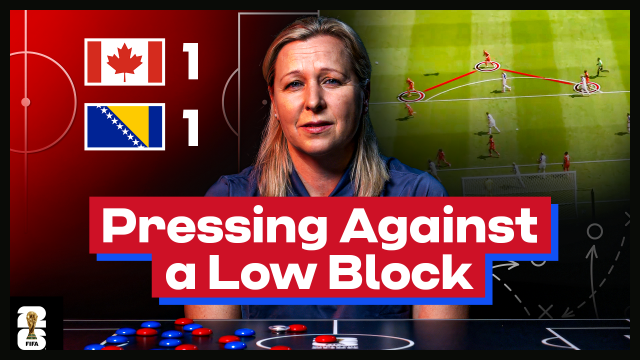
How these strategic approaches unfold is a key area of interest for our Technical Study Group (TSG). In this article, former Arsenal women’s captain, Jayne Ludlow, discusses how two contrasting defensive styles brought this game to life, as co-hosts Canada faced Bosnia and Herzegovina in their Group B opener.
The art of defending came to the fore as one particular game phase stood out. Specifically, it occurred when Bosnia were in the low-block phase, and Canada were attacking around the final third using a very high defensive line as a rest defence. Ludlow analyses how Canada used their high line to regain possession and keep Bosnia penned in, and also explores how they dealt with counter-attacks. In addition, she focuses on the compactness of Bosnia’s block, their willingness to deal with crosses, and resilience in blocking, intercepting and courageous defending.
Canada’s high line and rest defence
When Canada were attacking in the final third, they played with an exceptionally high defensive line, with one deeper-lying, ball-side defender and three players framing the edge of Bosnia and Herzegovina’s penalty area. This setup had two purposes:
-
The three players on the edge of the penalty area were positioned intentionally to support the attack when in possession and to regain possession from any attempted clearances, allowing them to restart attacks quickly and keep their opponent penned in.
-
The ball-side, deeper-lying defender played a similar role, but also acted as an extra layer of support should clearances go further than the unit of three. This player moved in relation to the ball.

In this match, Canada’s average defensive line height when they were attacking the final third was 62 metres from their own goal line, but this can be attributed to the positioning of the deeper support player. Their rest defence unit of three players was regularly stationed much higher than that.
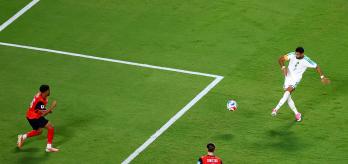
In clip 1 below, we see this rest defence and high defensive line in action. As their attacking phase progresses up the pitch, Canada’s defensive line advances proactively, compressing the space ahead of them. The players in this unit act as support players for keeping possession and sustaining the attack. As the ball goes deeper into the final third, the 1+3 structure — with the ball-side defender hanging back — emerges clearly. As soon as the cross comes in and is cleared, we see their immediate focus switch to regaining possession, with the support structure dropping together to protect the space before sending the ball back into the penalty area.
Preventing counter-attacks
Playing such a high line in a structured attacking scenario involves an amount of risk, but Canada were also comfortable keeping to the same principles in less structured situations in the final third, which carried more risk. This was due to their ability to execute collective, high-speed recovery runs to stop counter-attacks and regain possession.
In clip 2 below, we see how high they are positioned in the second phase of an attacking set-play scenario. Bosnia’s clearance falls to a player in the space between Canada’s lines and immediately initiates a fast counter-attack.
However, the speed of, and intention behind, each of the Canadian players’ recovery runs shows their confidence and coordinated approach to defending these high-risk situations. The three players closest to the ball direct their runs to delay or dispossess the player on the ball, while other players focus their recoveries on the central channel to protect the space. Within five seconds, Canada have successfully recovered the ball and transitioned to attack.
Bosnia and Herzegovina – 1-4-4-2 low block
In contrast to Canada’s setup was Bosnia and Herzegovina’s aggressive low-block approach to defending their penalty area. Their disciplined structure displayed a different approach to risk-taking. The side’s 1-4-4-2 block was extremely compact, with very short distances between their units, and focused on defending the central space in numbers.
In clip 3 below, we see how their defensive block evolves as the ball gets closer to the penalty area and when it enters it. The nearest player to the ball carrier applies pressure while other players close the gaps, ensuring there is little to no space to play through.
Defending the penalty area
Once the ball had entered the penalty area, Bosnia’s approach was aggressive, backed fully by their confidence to secure first contacts and clear the ball. By matchday 3, they were the highest-ranked team for defensive blocks per 30 minutes out of possession, with 44 — three more than Curaçao managed in their 7-1 defeat to Germany.
At times, they seemed less concerned with stopping crosses coming into the penalty area, especially if they could not get good pressure on the ball, instead opting to have confidence to win or clear those balls into the area. Of Canada’s 30 crosses into the penalty area in this match, Bosnia secured first contacts on 23 (77%) of them.
Finally, in clip 4, Ludlow highlights an example of Bosnia’s defensive mindset and ability to win key defensive battles close to their own goal. As the ball enters the penalty area, the block structure is clear. However, when Canada breach their defensive line, Bosnia’s centrally positioned defenders immediately recognise that their focus must switch from defending the area to defending the goal. As soon as Sead Kolašinac (5) sees that his goalkeeper is set at the front post for the incoming attempt at goal, the left-back leaves the player he is marking to protect the back-post area of his goal and makes a sensational clearance.
Summary
The art of defending can present itself in many forms and in different parts of the pitch. Canada’s approach to a high defensive line and committed recovery runs contrasted with Bosnia and Herzegovina’s low block and determination to win first contacts. The different strategies taken by both teams in one part of the pitch demonstrated how risk-taking and courage can look different, but be equally effective.
Rate your experience