Learning platform
 en
en 


At the top level of the game, it’s not enough just to have a game strategy for every match. Coaches must be able to spot what is working, see what is not working, and be capable of adjusting mid-game.
During FIFA World Cup 2026™, it has been clear that coaches must be able to adapt in-game, and in this article, FIFA Technical Study Group expert Jayne Ludlow dissects a series of strategic and tactical changes that occurred during the 1-1 draw between Japan and Sweden in Round 3 of Group F.
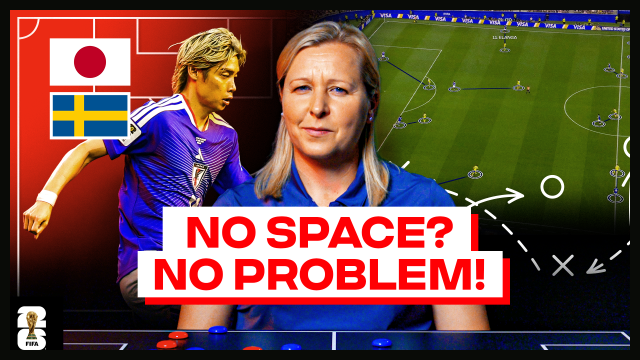
Japan’s approach to overloading the left channel
Sweden’s out-of-possession shape was 1-5-2-3, and it became clear from early in the game that the pocket of space behind right forward Anthony Elanga and in front of their right wing-back was the key area Japan were targeting.
They did this by releasing their left centre-back, Hiroki Itō (21), who was a real threat and provided overloads in this area. By overlapping or underlapping, he became an unexpected player in the final third and gave Japan numerical supremacy. As they were playing with a back three, Japan maintained a secure rest-defence structure by keeping a centre-midfielder back with their central and right-sided centre-back when Itō ventured forward.

In clips 1 and 2 below, we see examples of how left centre-back Itō (21) combined with left wing-back Keito Nakamura (13), either on the inside or the outside, to create overloads and break lines in the final third.
Sweden’s defensive adjustment
In the second half, Sweden adjusted by dropping Elanga deeper, alongside the two centre-midfielders when out of possession, into a 1-5-3-2 shape, with a stronger focus on protecting that vulnerable space and denying access to Itō (21).
As Ludlow explains, this tactical adjustment from Sweden head coach Graham Potter prevented Itō from receiving the ball in advanced locations.
“What Japan found was that the space was no longer available, and it was far more restrictive in the second half. The height of Itō’s receptions of the ball in the second half changed, and he’s floating more around the middle third of the pitch than in the top third.”
In clip 3 below, we see the impact of Elanga’s deeper positioning in the second half, the connection it facilitated with his team-mates, and how it allowed Sweden to close the space Itō (21) wanted to access.
Japan’s attacking variation
As the space down the left was no longer available, Japan used switches of play in their build-up to try to open gaps elsewhere.
“In doing this, Japan are probing, using the right-sided wing-back to provide width and then the movements of the front three, who were very mobile and used lots of rotations to stretch the backline and create space in front of it.”
Finally, in clip 4 below, we see how they build to the left, drawing Sweden across and then, with no space available, they switch play to the right, forcing Sweden to shift across. It’s during this second switch that space starts to open centrally, and that’s when Japan spot the opportunity to play through. Forwards Ritsu Dōan (10) and Ayase Ueda (18) combine centrally in the space between Sweden’s midfield and defensive lines before the ball is played in behind to Daizen Maeda (11), whose forward run stretches the game and creates a goalscoring opportunity.
COACHING ADAPTABILITY
Ludlow: “As a coach, you approach every game with a specific strategy to try to protect your own goal and attack the opponent’s goal. But how important is it to be adaptable? In this day and age, it is hugely important to be able to adapt (mid-game), whether that’s offensively or defensively.
“If we talk about offensive strategies, simplistically, it comes down to creating and exploiting space, so when you get on the pitch, and that strategy is not necessarily doing that, you have to be able to change. Skilled coaches, who are working at the top level of the game, now and in the future, are so adaptable. They are seeing the game at such a high level and breaking it down in all aspects, through all units.
“They are constantly looking at their opponents to see where space is opening up and think about how people on the pitch can potentially exploit those spaces, but also the next level is considering how they use the players on the bench to come into the game and exploit those spaces? It’s about where the space is potentially going to be created and how you can exploit it, and from a defensive perspective, how do you do the opposite and protect those spaces?
“Nowadays, it’s very much a game of multiple plans.”
Rate your experience