Learning platform
 en
en 


Penalties are often described as moments of stillness within chaos – brief pockets of time where execution and psychology collide. In Qatar 2022, Lionel Messi demonstrated to the world his ability to master these moments. Across seven attempts, from the group stage to the final shoot-out, he showed adaptability in both technique and temperament.
Before even kicking off Argentina’s historic campaign, Albiceleste’s number 10 had already taken over 100 career penalties, converting close to 80% of them. Yet his record at international cup competitions told a more complex story: a successful strike in Brazil 2014, a costly miss in the 2016 Copa América final, and questions about whether he could fully dominate from the spot in the tensest of moments.
Comparing Messi’s two techniques: Side-foot v. in-step
In Qatar, Lionel Messi demonstrated two distinct techniques: a composed, deceptive side‑foot finish and a more forceful strike using his in‑step. Five of his successful attempts came from the former, and one came from the latter. Below we take a look at six components comprising the two techniques, revealing the similarities and differences.

Reviewing Messi’s 7 penalties in Qatar
In Qatar, Argentina were awarded five penalties, the most ever by a team in a single edition of the FIFA World Cup. Messi took them all, in addition to two during shoot-outs. He missed the second of his seven spot-kicks. But that one miss was a poignant lesson learnt for Argentina captain: a reminder of the effectiveness of disguise, rhythm and composure during these moments of the game.
Below we recount each of Messi’s seven penalties and analyse the visual focus, run-ups, body positions and influence on the goalkeeper in more detail.
Minute: 10’ | Result: Scored
Execution: Low to the keeper’s right
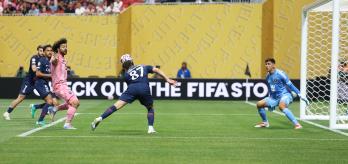
Argentina started brightly, and Messi stepped up early against Mohammed Al-Owais (who committed early towards the opposite side). Calmly striking low to the right, he gave Argentina the lead and scored his first goal of the tournament.
Minute: 38’ | Result: Missed (saved)
Execution: High to the left with power, saved by Szczęsny
VAR-awarded penalty added tension to an already balanced match. Facing Wojciech Szczęsny who had already stopped a Messi penalty in 2017 for Juventus against Barcelona, read him perfectly and made a stunning save.
This miss marked a turning point in Messi’s technique. From here, Messi would reembrace deception over power in high-pressure moments.
Minute: 73’ | Result: Scored
Execution: Placed just inside the right post
With Argentina leading 1–0, Messi seized his moment. Facing Andries Noppert, a 2.03-metre debutant, he placed his spot-kick to the right after gauging that the goalkeeper’s feet were positioned for a dive in the other direction.
This penalty marked a return to the analytical run-up and open ball-striking position.
Shoot-out Penalty #1 | Result: Scored
Execution: Rolled slowly, wrong-footing Noppert
Moments after a dramatic Dutch equalizer in the same game, Messi was Argentina’s first taker in the shoot-out. His run was slow, his touch even gentler than his previous penalty in the same match.
Composure again. It wasn’t just a goal; it was a captain’s message to his team-mates to stay calm during arguably the tournament’s most heated encounter.
Minute: 34’ | Result: Scored
Execution: Roof of the net
Facing Croatia’s Dominik Livaković – already a penalty hero in Qatar – Messi reverted his technique, opting for power and height. His strike rocketed into the top corner.
This time there was no disguise or hesitation, just pure conviction. It pulled off.
Minute: 23’ | Result: Scored
Execution: Slow, low, wrong-footing Lloris
The World Cup final brought maximum pressure. Facing Hugo Lloris, an experienced penalty saver, Messi reimbraced his disguised technique instead of power.
It was the essence of control – technique distilled into composure.
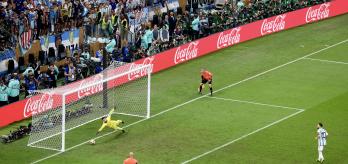
Shootout Penalty #1 | Result: Scored
Execution: Stutter, soft chip down the middle
After France’s dramatic comeback, the final shoot-out began. Messi approached with a stutter, then chipped delicately down the centre. Lloris froze – out-psyched by simplicity.
This was the culmination of Messi’s evolution in Qatar: from security to precision, from power to total poise. At the FIFA World Cup 2022, the tenser the moment, the more composure the Argentine magician seemed to exhibit.
Legacy
In Qatar 2022, Messi turned repetition into ritual. He overcame his miss from his second spot-kick of the tournament to convert five more in increasingly pressurised moments, varying his technique along the way. What had once been doubt became design, a mastery forged through experience and refined under pressure.
This FIFA World Cup was not just his triumph, but the completion of an idea: that greatness is built on understanding, not domination. His composure at the spot mirrored the philosophy that defined his career.
“I always tried to go first in penalty shootouts, to take the full responsibility… I wasn’t thinking about where to shoot against Lloris, it was about waiting until the last moment. I waited for him, he moved, but I was very calm.”
Rate your experience