Learning platform
 en
en 


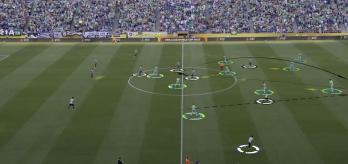
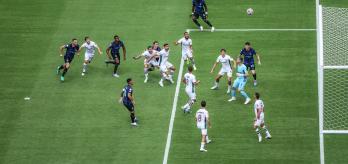
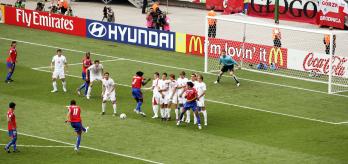
While short-distance free kicks limit the space and time available and long-distance situations almost inevitably require the taker to compromise on control and precision, mid-range scenarios offer a sweet spot and therefore the greatest scope for variability. The taker will tend to target a specific area of the goal and look to make use of height, dip or curl to get the better of the goalkeeper after bypassing the wall. The challenge can be defined by three interacting elements:
-
The wall is positioned to protect a fixed zone, yet vulnerable to height and late dip
-
The goalkeeper must decide between maintaining their sight lines (trusting the wall and protecting their side) or adopting a more central position and potentially seeing the ball late
-
The trajectory must overcome two obstacles successively: first the wall and then the goalkeeper
This article explores how various trajectories emerge as solutions to this problem, showing how players adapt their execution to manipulate both defensive structure and goalkeeper positioning.
Solution 1: Over the wall
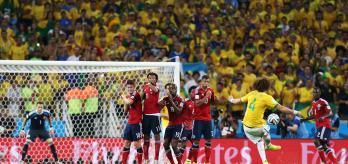
One of the most common options is to direct the free kick over the wall, using controlled sidespin to bend the ball into the space beyond the defensive line. Rather than relying on power, the taker shapes the trajectory through rotation, combining lateral movement with late dip to clear the wall and force the goalkeeper to shift across goal while tracking the flight of the ball.
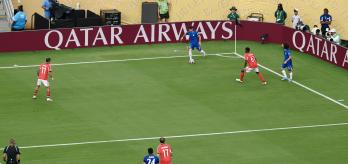
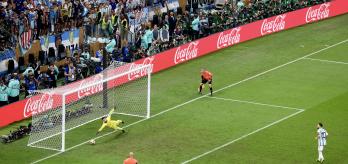
In focus – Aleksandar Kolarov (Costa Rica v. Serbia, 2018 FIFA World Cup™)
Kolarov’s technique reflects a repeatable, training-based approach: a left-footed profile built on precision and minimal curve, where execution appears driven by rehearsed patterns rather than in-moment variation.

Solution 2: Around the wall
In contrast to the over-the-wall solution, this trajectory avoids the wall entirely, prioritising the angle and timing of the strike over vertical clearance. The ball is guided around the outside of the wall with a flatter path and a greater emphasis on pace, in the process reducing the goalkeeper’s preparation and reaction time. This makes it more challenging for the goalkeeper to get a hand on the ball and changes their focus from vertical adjustment to lateral movement.
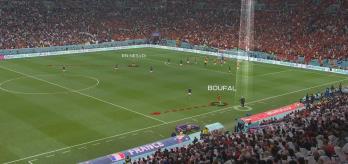
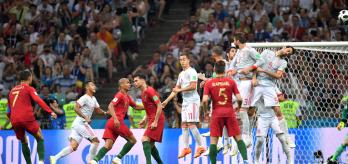
In focus – Cristiano Ronaldo (Portugal v. Spain, 2018 FIFA World Cup™)
Cristiano Ronaldo’s hat-trick-completing equaliser against Spain in Sochi is a shining example. The strike illustrates how a top-class operator can beat both the wall and the goalkeeper with a compact, controlled trajectory.
Solution 3: Goalkeeper’s side
In contrast to solutions focused on manipulating the ball’s trajectory, this option exploits the goalkeeper’s positioning and anticipation. As the wall protects one side of the goal, the goalkeeper often shifts to cover the perceived “vacated” area behind it, creating an opportunity on the other side of goal.
The key factor is the element of surprise: the attacker breaks established shooting patterns to wrong-foot the goalkeeper, particularly at elite level where keepers are well prepared for attackers’ preferred solutions. This finish can also suit certain game contexts, as it avoids the complexity of clearing the wall. Since it is simpler for the taker to execute than other techniques, this is a higher-percentage option in terms of hitting the target.
In focus – Zico (Brazil v. Scotland, 1982 FIFA World Cup™)
This effort from Zico, an icon of set-play mastery, exemplifies a less common solution that relies on timing over power – effective in the Brazilian legend’s era and still applicable today.
KEY CONSIDERATIONS
Direct free kicks from mid-range are defined less by striking quality per se and more by how the taker reckons with the wall and the goalkeeper. Rather than execution alone, what sets specialists apart is a knack for selecting the most appropriate option for the situation.
Rate your experience