Learning platform
 en
en 


Taking the idea that defending teams can turn defence into attack following a corner by establishing well-defined attacking outlets as our starting point, this article explores how a defending side can change the narrative entirely, by leaving one or multiple players high up the pitch. This strategy serves to transform these scenarios from passive, reactive phases into proactive opportunities that influence opposition behaviour, stretch defensive structures and lay the foundations for purposeful counter-attacks.
SINGLE ATTACKING OUTLET HIGH UP THE PITCH
When defending a corner, leaving a single attacker high up the pitch can prove to be an effective tactic for teams looking to mount post-corner counter-attacks.
- The strategy works particularly well for sides with a forward who has good pace and physicality but limited defensive ability, enabling the team to maximise the forward’s strengths rather than potentially expose their weaknesses.
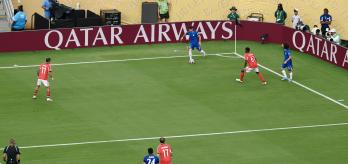
Senegal v. Netherlands: Qatar 2022™ (group stage)
The Dutch showcase how positioning a lone attacking outlet high up the pitch reduces the opposition’s ability to pack the penalty area and can generate instant counter-attacking opportunities.

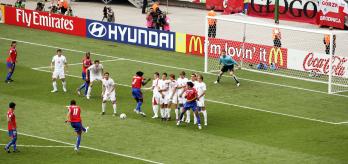
Romania v. Argentina: 1994 FIFA World Cup USA™ (round of 16)
If we rewind to Romania’s third goal in their epic last-16 showdown with Argentina at the 1994 edition of the FIFA World Cup™, it becomes instantly apparent that there is nothing new about leaving players high up the pitch and adopting a direct attacking approach following a corner. The footage highlights that the success of a post-corner counter-attack when leaving a player high up the pitch depends not only on the player’s positioning, but also on their ability to dictate the tempo of the counter-attack.
LEAVING MULTIPLE PLAYERS HIGH UP THE PITCH
When it comes to trying to change the narrative on defensive corners, a bolder approach to the one examined in the previous section involves leaving more than one player high up the pitch. This set-up not only reduces the opposition’s attacking intent to a greater extent than the system featuring a lone attacking outlet, but it also provides the team with more options when transitioning from defence to attack.
- Leaving multiple players high up the pitch places greater psychological and tactical strain on the attacking team, forcing them to reconsider their rest-defence structure and how many players they commit forward.
- Having more than one attacking outlet increases the potential for the defending team to mount a successful counter-attack, as having a number of players in advanced positions means there are more supporting runners and a better range of passing options.
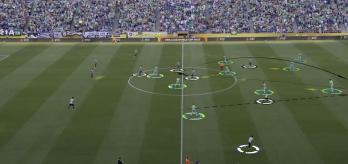
Belgium v. Japan: 2018 FIFA World Cup Russia™ (round of 16)
Belgium demonstrate how deploying two attacking outlets in staggered positions can influence an entire counter-attack without either player even touching the ball.
Canada v. Morocco: Qatar 2022 (group stage)
Canada show how positioning two attackers in the inside channels enables these players to both provide defensive cover if the opposition take a short corner and act as attacking outlets to launch rapid and effective transitions.
France v. Morocco: Qatar 2022 (semi-final)
Morocco prove how leaving two players high up the pitch when defending corners can disrupt the opposition’s attacking set-up in both psychological and structural terms. France held a 1-0 lead when both of the corners featured below were taken.
Key take-aways
Turning defensive corners into attacking opportunities requires more than just a brave approach; it demands structure, clarity and collective intent. The principles laid out below reflect how leaving one or multiple players high up the pitch, regardless of their positioning, can influence both the opposition’s set-up and the attacking transition.
- Disrupts the opposition’s structure: forces adjustments to marking responsibilities and reduces the number of attackers in the box, particularly useful at a time when attacking teams increasingly crowd the six-yard box to restrict goalkeeper movement and dominate first-contact zones.
- Increases psychological pressure and momentum: sustains a counter-attacking threat, impacting confidence, unsettling rhythm and potentially shifting game momentum.
- Improves counter-attacking options: provides clear and flexible options to launch transitions, from securing first contact to exploiting depth, width or space in central areas
- Maximises individual strengths: enables teams to exploit the attacking qualities of key players rather than exposing their defensive weaknesses
- Game model alignment: reinforces a team’s broader playing philosophy by embedding counter-attacking intent within defensive set-play organisation.
As the game evolves, a defending team’s performance on corners may increasingly be defined not by whether they prevent the opposition from scoring, but by the attacking threat that they pose following these set-play scenarios.
Rate your experience