Learning platform
 en
en 


Compared with free kicks from medium or long range, the reduced time and space from short range allow far less scope for harnessing ball flight or late movement as methods for overcoming the opposition wall and goalkeeper. With limited vertical and horizontal space around the wall, opportunities for dip or curl are also reduced, requiring attackers to create advantage through three interrelated solutions: power, disguise and precision.

This article examines how these solutions are applied in practice, how subtle technical adjustments, such as body orientation, planting foot position and point of contact underpin different outcomes, and how emerging solutions reflect the ongoing tactical and technical adaptation between attackers and defenders.
Solution 1: Using power to exploit the reaction window
At short range, a direct free kick can reach the goal in well under one second, leaving the goalkeeper with a severely constrained reaction window. Even when the strike is read correctly, ball speed limits the goalkeeper’s ability to adjust effectively. Their inability to react is often compounded by the defensive (or attacking) wall, which can obscure the moment of contact and delay the goalkeeper’s first clear view of the ball. As a result, goalkeepers are frequently forced to commit early and rely on anticipation rather than pure reaction.
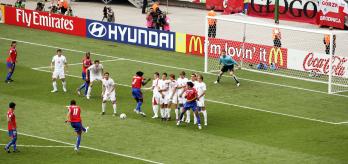
In focus – Robin van Persie (Netherlands v. Côte d’Ivoire, 2006 FIFA World Cup™)
Van Persie’s execution reflects a clear commitment to power from the very beginning of the action. His extended run-up, progressive acceleration and aggressive intent all signal a deliberate choice to prioritise force, while his technique provides enough structure and control to make his intention effective.
Solution 2: Using disguised technique to outwit defensive anticipation
When goalkeepers are forced to commit early, anticipation becomes a dominant factor. Disguise allows the free‑kick taker to exploit this by shaping expectations through approach path, body shape or familiar striking patterns, increasing the likelihood of early commitment and opening exploitable space.
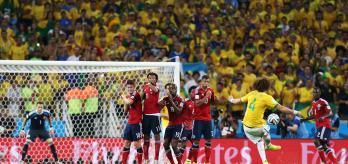
In focus – Juan Fernando Quintero (Colombia v. Japan, 2018 FIFA World Cup)
Quintero’s free kick reflects intelligence as much as technique. His approach suggests a player who has anticipated defensive behaviour in advance, reading the likely reaction of both wall and goalkeeper before execution, then exploiting that reaction with disguised technique and precise contact.
Solution 3: Using precision to exploit defensive positioning
If power exploits time and disguise exploits anticipation, precision targets defensive positioning and space. At short range, the goalkeeper’s starting position and the wall’s alignment can reveal narrow shooting lanes. Precision allows the taker to access these lanes through controlled contact, using different points of contact with the foot.
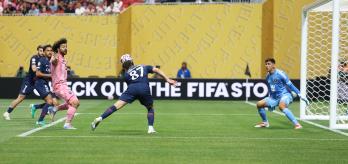
In focus – Luis Suárez (Uruguay v. Russia, 2018 FIFA World Cup)
Suárez’s execution is particularly striking because it does not come from the profile of a pure short-range free-kick specialist. As a goalscorer first, his solution reflects practicality, identifying the defensive picture, selecting an efficient option and executing it with conviction.
Coaching points
At short distance, free kicks can feel dangerous for defenders yet restrictive for attackers. The coaching points below are designed to help the taker recognise those constraints and choose the most effective solution under pressure.
Rate your experience