Learning platform
 en
en 


We emphasise both bilateral (double-leg) and unilateral (single-leg) exercises to provide a spectrum of explosive loading stimuli and to cater to varying levels of athletic maturity and competence. All movements are practical, highly accessible bodyweight variations designed to develop the foundational qualities required to absorb and transmit the dynamic forces demanded by elite gameplay.
Building upon previous content
When training for explosivity, intensity is generally governed by the loading requirement of the exercise, such as the degree of force transferred from jump to jump and whether the movement is bilateral or unilateral. Therefore, our focus is on varying loading factors rather than traditional progression. We have classified the six new exercises as low-, medium- or high-loading variants. We have also deliberately divided the exercises between bilateral and unilateral variations to provide multiple options for different levels of athletic ability or stages of development.

Target development areas
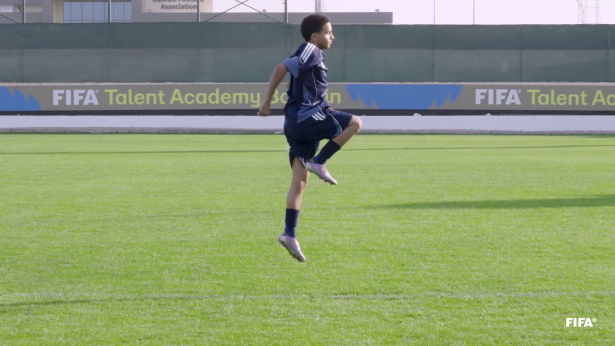
1. Static power (concentric only) – this targets maximum force from a dead stop. This trains players to maximise brain-to-muscle drive, contributing to a powerful and quick first step. Because they do not involve momentum or jumping drops, these exercises place a much lower structural load on the spine and joints, especially when performed bilaterally.
2. Reactive force (short contact/submaximal) – this targets fast, repeated footwork using rapid counter-movements. The focus is on achieving a quick muscular response to short, repeated, low-impact loads. It builds highly controlled, sharp foot quickness and coordination on the pitch without exhausting the player.
3. Elastic power (the stretch-shortening cycle (SSC)) – the target is to achieve maximum explosive force by using the body’s natural spring. The emphasis is on a rapid breaking or landing phase (eccentric loading), immediately followed by an explosive take-off phase (concentric). It trains the body to act like a coiled spring, storing energy from landing and instantly firing it back out to propel the player in any direction the game demands.
Multi-directional power and efficiency
Our exercises cover vertical, horizontal, lateral and (as explained previously in part 6), rotational movements for height, distance and direction. We also include combination patterns, such as vertical jumps followed by a forward or lateral push, or a maximum-height jump followed by rapid, reactive footwork. This multi-layered methodology condenses loading into high-value, efficient and compact doses to ensure athleticism complements a player’s technical development rather than conflicting with it; after all, the overall objective is to develop physical qualities without detracting from the technical journey.
Exercise details
Load type and level
- Static and low
1 set includes:
- 2 to 3 single max. reps
Focus
- This bilateral variation emphasises collective triple extension (ankle, knee and hip) to develop explosive force from a static, concentric, uncoiled position.
Execution
- Sit tall, with a long, strong spine, keep your head up and the feet shoulder-width apart. Lift your feet two to four inches off the floor, drive them instantly back into the floor, and power up vertically, using an explosive arm swing for momentum.
Load type and level
-
Static to elastic and medium
1 set includes:
-
1 x vertical to lateral left
1 x vertical to lateral right
Focus
-
This variation adds a reactive countermovement into the equation. Upon landing from the initial vertical jump, players must instantaneously absorb the force and jump laterally (sideways) for height and distance.
Execution
-
Upon landing, try to use the force from the vertical jump to instantly recoil and drive laterally in one continuous movement.
Load type and level
-
Static to elastic and medium
1 set includes:
-
2 x executions of the sequence
Focus
-
This variation adds a forward horizontal jump upon landing from the initial vertical jump, training the body to produce power seamlessly in different directions.
Execution
-
Upon landing from the vertical jump, instantly drive forward using the explosive power of both legs and arms. Try to control the landing cleanly and finish in a stable, set position.
Load type and level
-
Elastic and high
1 set includes:
-
2 continuous reps to the left and right
Focus
-
This is a demanding, high-loading single-leg variation that requires a sharp transfer of force from a lateral jump for distance directly into a vertical jump for height off the landing leg.
Execution
-
Upon impact from the lateral jump, instantaneously use the landing load to recoil and drive upwards vertically off the single leg. Land cleanly, hold your balance and repeat the sequence on the opposite side.
Load type and level
-
Elastic to reactive and medium to high
1 set includes:
-
2 to 3 continuous reps to the left and right
Focus
-
This variation trains the capacity to instantly transition from a big, powerful movement into fast, reactive foot speed. The objective is to push off explosively into a wide lateral (side) jump on one leg, control that landing cleanly and immediately transition into high-frequency forward and backward footwork.
Execution
-
From the lateral jump, the moment the foot hits the ground, instantly absorb the force and transition into sharp, high-frequency, small forward and backward quick-feet jumps. Keep your head up, maintain a strong core and focus on foot speed before resetting to repeat the sequence on the other side.
Load type and level
-
Reactive and low to medium
1 set includes:
-
4 to 6 continuous reactive ground contacts
Focus
-
This variation combines bilateral and unilateral mechanics to train lower-limb reactivity and landing stability. It can be used as a sharp primer to wake up the nervous system before heavier loading or as a light, high-frequency finisher. It trains the lower limbs to quickly absorb and redirect force with minimal ground contact time.
Execution
-
Execute a quick, spring-like, double-leg jump and land on the box using a single leg. Stabilise briefly, then drop off the box, landing with your legs relatively straight to absorb and rebound quickly. The objective is to transfer quickly from landing into the next jumps. Try to focus on rapid rebound rather than jumping height.
Implementation
The objective is to incorporate these new exercises as targeted variations or progressions. It is not a case of adding load to the existing programme, but rather of selecting a total of six to eight movements from across our entire content library that are appropriate for individual needs, training history and athletic literacy. In order to take a balanced approach to movement types and loading exposure, players should use a variety of exercises across all three target areas: static, reactive and elastic. The strategy is to select at least one exercise from each area, for a highly focused session comprising three to four exercises in total. The three to four unused exercises should be implemented on a rotational basis to provide comprehensive variety in loading and movement.
For a more in-depth understanding of explosiveness and its relationship to athletic development in youth football, please refer to part 6 in this series. For quick reference, however, a summary of the essential points for the safe and effective implementation of explosive training is provided below.
- For activation/potentiation work, one pre-football training session lasting between five and ten minutes should be scheduled each week. Each session should comprise between one and two sets of three exercises, using the stated number of repetitions for each exercise. This block should be completed after a microdose of dynamic mobility work and before football training begins.
- In terms of weekly development work, one block lasting between ten and 15 minutes should be scheduled during the early part of football training. The block should comprise between two and three sets of four exercises, using the stated number of repetitions for each exercise. This work should be completed after the warm-up period, during the early part of the football session.
The individual player’s foundational athletic competence and the age-appropriateness of the methodologies used should be taken into account when training to develop power. The focus must remain on maximum-velocity exercises, utilising very low repetitions (three to four ) coupled with long recovery periods. Sessions should be implemented as either microdoses or as compact, low-volume loads, performed in a non-fatigued state – for example, immediately before or during the early part of football training.
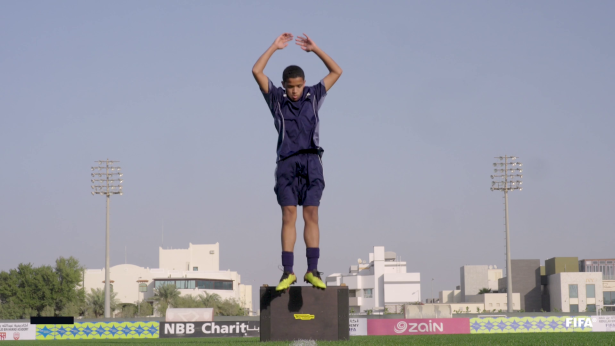
Before progressing to medium-to-high loads, players must master foundational movement qualities: stable bilateral strength for two-legged jumps and full-ROM (range of motion) mobility and control in unilateral patterns for single-leg variations. Ideally, young players should prove their competence in a controlled single-leg squat – lowering the knee of the rear leg to the floor with complete stability – before attempting high-load, repeated, single-leg power work.
This structured approach respects the critical factors required for safe and beneficial power training in youth participants:
1. Force absorption capacity: This helps to ensure that players have developed both a solid foundation for force production and the structural capacity to absorb high-impact landing forces safely.
2. Neuromuscular readiness: Training occurs when the central nervous system is in a heightened state of excitation (fresh and ready for action). This state facilitates maximum power output, supporting high-quality training and optimal performance adaptations.
3. System safeguards and technical priority: Low-volume sessions with low repetitions and full recovery provide the optimal exposure to high power loads. This format takes account of the inherent capabilities and limitations of a young, developing musculoskeletal system, while maintaining a clear training emphasis that is heavily biased towards the technical and tactical demands required to excel on one’s footballing journey.
Rate your experience