Learning platform
 en
en 


If you were to ask any coach operating in the elite game about the most important physical attribute that they look for when identifying talent, the answer would nearly always be “power”, which is a central component of the athleticism required to shine on the pitch.
Many dynamic movements, such as climbing, jumping, quick changes of direction and sprinting, benefit greatly from a solid base of mobility and good core and lower-body strength, with these pillars enabling powerful actions to be performed safely, economically and with great purpose. However, the ability to convert purpose into real force is what hands a player the edge, and explosivity training is fundamental in that regard. The focus of explosivity training is on velocity, with the emphasis on teaching the neuromuscular system to generate maximum force in the shortest period, which develops the speed required for a player to move or overcome external resistance. The overall objective is to transfer adaptations derived from power training to the player’s skill set.
Explosivity and speed training is heavily limited by a genetic ceiling, often referred to as the “innate hardware” that restricts potential regardless of training effort. The ratio of fast- and slow-twitch muscle fibre types is, to a certain extent, hereditary and largely determined at birth, with the fast-twitch fibres activated for short bursts and the number of them determining the level of potential. That said, athletes in most sports benefit from performing power training, which serves to raise their level of explosiveness to their innate potential, thereby enhancing their physical competitiveness.
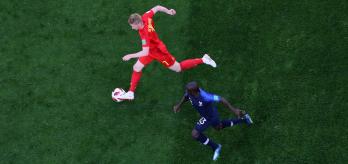
A player’s ability to generate maximum force quickly can give them a significant advantage in countless match scenarios. Being first to a loose ball, in 1v1 duels, acceleration to deceleration and changes of direction to evade an opponent are situations in which being able to generate force quickly can prove to be a decisive factor. Additionally, players with high-power potential perform low-power output tasks more economically and with greater physical reserve. There is also a psychological edge: if a player knows that they possess the power to beat an opponent, it can boost their confidence and mental fortitude, leading to more assertive on-field decision-making.
Exercise details
Muscle group activation
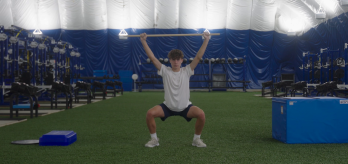
- Ankle extensors and flexors; hip extensors and flexors; knee extensors and flexors.
Execution
- The priority is on the quality of the linear movement. Drive through with the arms and hold briefly at the end or range position.
Progression options
-
Sprinter jumps with powerful arms; Bulgarian split jumps.
Muscle group activation
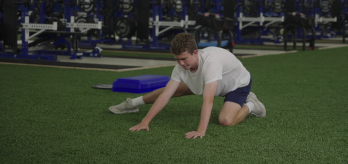
- Ankle extensors and flexors; hip extensors and flexors; knee extensors and flexors.
Execution
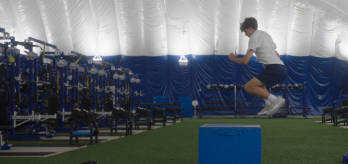
- As in the video, start in the set position, drive up onto the box with only a slight countermovement and briefly hold the landing position.
Progression options
-
Increase height. Reduce height and perform with single leg.
Muscle group activation
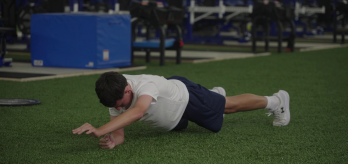
- Ankle extensors and flexors; hip extensors and flexors; knee extensors and flexors. Plus, hip abductors, adductors & rotators. Spinal flexors, extensors & rotators.
Execution
- As in the video, start in the set position, drive up onto the box with only a slight countermovement and briefly hold the landing position now also place the emphasis on rotation.
Progression options
-
Increase height. Reduce height and perform with single leg.
Muscle group activation
-
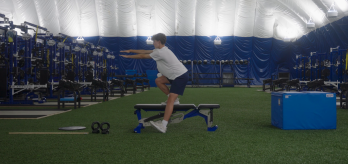
Ankle flexors & extensors; knee flexors & extensors; hip flexors & extensors.
Execution
- As in the video, start in the set position, power forward with a view to achieving maximum distance, perform a quick backward countermovement before driving forward for one to two sets of continuous repetitions.
Progression options
-
Two to three single-leg broad jumps; Two to three single-leg broad jumps with backward countermovement jumps.
Muscle group activation
-
Ankle flexors & extensors; knee flexors & extensors; hip flexors & extensors plus, hip abductors, adductors & rotators, spinal flexors, extensors & rotators.
Execution
- As in the video, start in the set position. Drive laterally inside with a view to achieving maximum distance before performing a quick backward countermovement to return to the start position. Carry out a specific number of continuous repetitions.
Progression options
-
Progression dependent on the quality of execution, i.e. distance covered, stability of landing and quick countermovement. Small load increments possible with high-quality execution and adaptation.
Muscle group activation
-
Ankle flexors & extensors; knee flexors & extensors; hip flexors & extensors plus, hip abductors, adductors & rotators, spinal flexors, extensors & rotators now with the emphasis on spinal flexors, extensors and rotators.
Execution
- As in the video, start in the set position. Drive laterally inside with a view to achieving maximum distance before performing a quick backward countermovement to return to the start position, but now with the emphasis on moving the arms beyond the landing line to place additional rotational load on the landing stabilisers before performing the countermovement rotation back to the start position. Perform for a specific number of continuous repetitions.
Progression options
-
Progression dependent on the quality of execution, i.e. distance covered, stability of landing and quick countermovement. Small load increments possible with high-quality execution and adaptation, as well as possible increased rotation provided that the quality of execution is maintained.
Muscle group activation
-
Ankle flexors and extensors; hip flexors and extensors; knee flexors and extensors, as well as hip abductors, adductors and rotators; spinal flexors, extensors and rotators, now with the emphasis on spinal flexors, extensors and rotators now with the emphasis on speed of landing and lateral movement.
Execution
- Drive laterally inside with a view to achieving maximum distance before performing a quick backward countermovement to return to the start position, but now with the emphasis on moving the arms beyond the landing line to place additional rotational load on the landing stabilisers before performing the countermovement rotation back to the start position. Carry out a specific number of continuous repetitions.
Progression options
-
Faster countermovement.
Implementation
The methodologies used in power training must take into consideration age appropriateness and the player’s athletic foundations. The focus is on maximal velocity exercises and very low repetitions (between three and four) with long recovery periods. Sessions should be implemented as either microdose or compact (low-volume) loads that are performed in a non-fatigue state, for example, before the start, or during the early part, of a training session.
The approach to power training must into account the following points, which are key to ensuring that it is safe and beneficial for players:
- Players have solid foundations to generate force and the capacity to absorb high-impact forces.
- Training takes place when the neuromuscular system is in a heightened state of excitation (fresh and ready for action), which results in a high-power output that translates to higher quality training and performance adaptations.
- Low-volume sessions, with low repetition exercises that involve adequate rest periods between sets, provide almost optimal exposure to high-power loads, while safeguarding the inherent capabilities and limitations of a young, developing neuromusculoskeletal system. In addition, the training programme features a heavy bias towards exposure to the technical and tactical elements of the game.
Simplicity is key, and with that in mind, we provide a basic menu of exercises that encourage maximal intent, thereby challenging the stretch shortening cycle to generate maximal force through the lower-body kinetic chain. The emphasis is on bodyweight exercises that require minimal equipment and are therefore accessible to all. All exercises must be performed nearly to perfection before proceeding to a gradual progression.

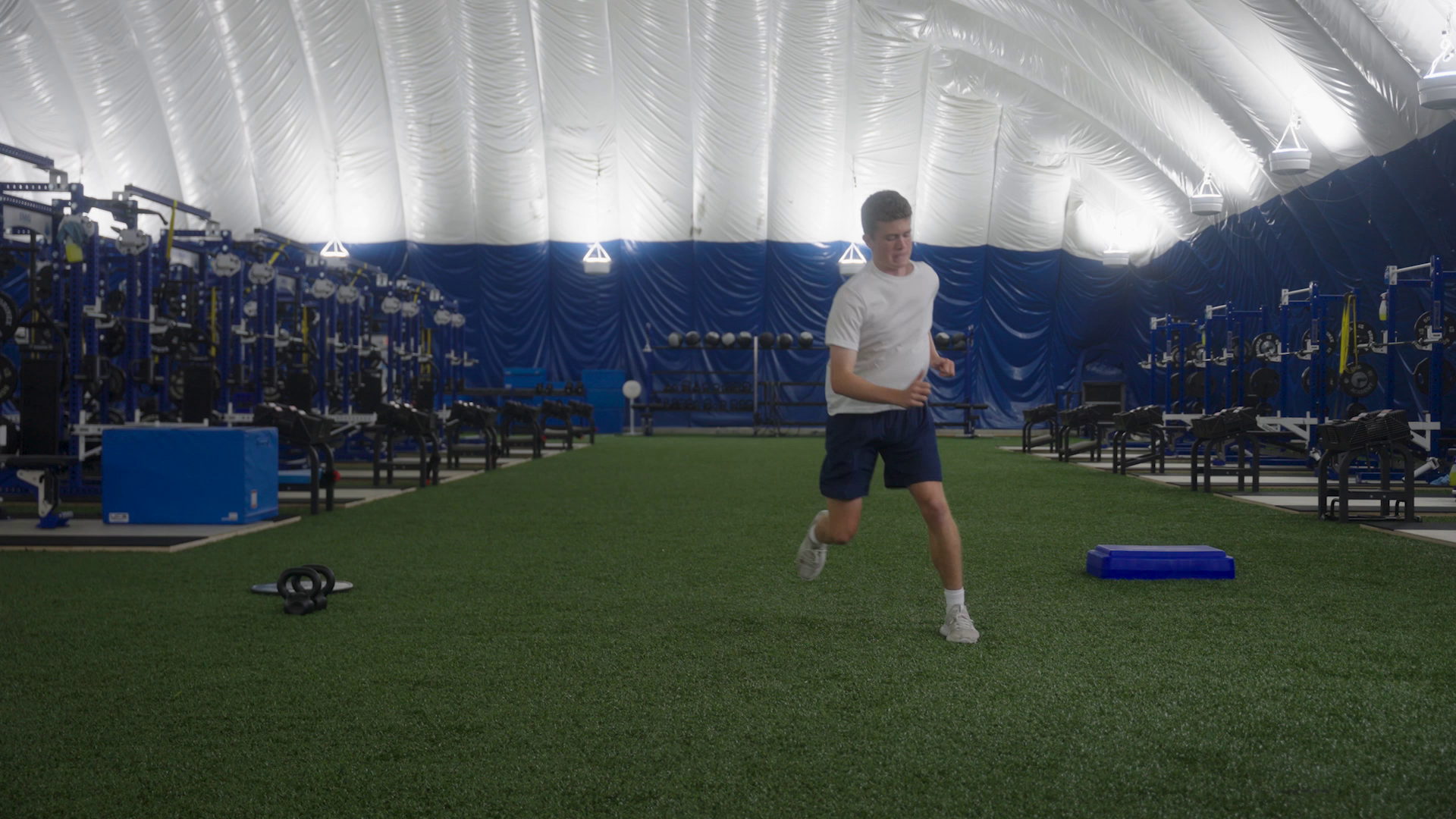
For best results, power work should be scheduled as part of short dynamic football sessions rather than arduous training days and implemented as a microdose load (five to ten minutes) for pre-training potentiation, i.e. dynamically readying players for the football training to come or as a compact development load (ten to 15 minutes) slotted in during the early part of the football session.
The objective is to undertake each of the following power training sessions once a week:
- For the activation-potentiation session before football training, schedule around five to ten minutes with one to two sets of three exercises consisting of three to four repetitions, unless otherwise stated. This block should take place following a microdose of dynamic mobility and before football training.
- For the weekly development session in the early part of football training, schedule around ten to five minutes with two to three sets of four exercises consisting of three to four repetitions. This block should be delivered after the warm-up period as an intervention during the early part of the football session.
Summary
All dynamic movements benefit from solid athletic foundations; however, power is the key attribute to gaining the edge in many sports. Although power capability is ultimately influenced by genetics, dedicated power training can help to fulfil explosive potential, thereby increasing physical competitiveness for participants across many sports. In the football context, the ability to generate force quickly can prove to be a decisive factor in a whole host of scenarios. Additionally, a high-power reserve facilitates great movement efficiency and can hand a player the psychological upper hand that comes with knowing that they have the beating of their opponent. In terms of youth development, there are a number of important considerations that ensure that power training is safe and beneficial, including good capacity to absorb high-impact forces and a smart training approach that involves the scheduling of compact, low-volume sessions to be carried out when players are in a non-fatigue state and as part of short, dynamic football training sessions.
Rate your experience