Learning platform
 en
en 


Often described as the fulcrum of strength, the core refers to the muscles surrounding the trunk and hips and which stabilise the spine and pelvis. The core is the epicentre for transferring movement throughout the body. As a fundamental component of athleticism, a strong core is essential to produce power and to control or absorb external forces on the body.
Given all the pushing, pulling, twisting, turning and rotational changes of direction at speed, players need a strong core both to enhance performance and prevent injury. The core provides the kinetic link to transfer force with maximum efficiency between the upper and lower body and helps absorb the great amount of stress placed on the musculoskeletal system by the demanding physicality of the game.
A highly functional core can be likened to the interconnectedness of a spider’s web, where each thread is vital to the strength and integrity of the overall structure. Interconnected strength between core muscles is crucial in football as it underpins stability and improves mobility, both of which help facilitate efficient movement and much-needed dynamism on the pitch.
It is important to master simple core exercises and their natural progressions with near-perfect execution. This provides the fundamental stability and control that is needed before gradually attempting more dynamic exercises. It is also worth noting that many of the mobility exercises in the previous article require good core stability to be performed optimally. This demonstrates how high-value exercises can have multiple purposes and work collectively to improve footballing athleticism.
Exercise details
Target
- Abdominal, transverse abdominal, obliques, hip flexors
Execution
- Engage the core muscles while holding the plank position. Aim to keep a straight line from head to toe.
Progression options
- Exercise 2 (plank, alternating arm reach) is the natural progression. Only progress to that exercise once excellent control and technique has been achieved for an extended period in exercise 1.
Target
- Abdominal, transverse abdominal, obliques, hip flexors, shoulder flexors, spinal extensors and rotators
Execution
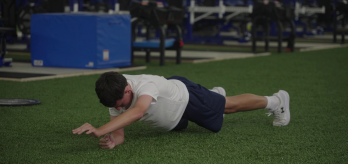
- Try not to rotate towards the extended arm side as you alternate. Maintain horizontal alignment.
Progression options
- Exercise 3 (alternating superman) is the natural progression. Only progress to that exercise once excellent control and technique has been achieved for multiple repetitions of exercise 2.
Target
- Abdominal, transverse abdominal, obliques, hip flexors and extensors, shoulder flexors, spinal extensors and rotators
Execution
- Maintain horizontal alignment as you alternate between legs. Engage the glute and spinal muscles of the non-raised leg to support stability.
Progression options
- Hold each single-leg, single-arm reach for a short period (one to three seconds) before changing to the opposite side.
Target
- Hip and spinal extensors, transverse abdominal, obliques, hip flexors
Execution
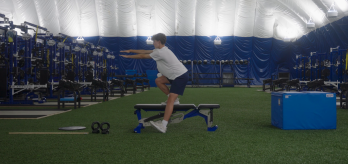
- Strong extension of the bent leg with simultaneous flexion of the straight leg. Hold briefly at the end of each raise.
Progression options
- Place the foot of the working (bent) leg on a bench or chair or use an unstable surface such as a physio ball.
Target
- Abdominal, transverse abdominal, obliques, hip flexors, ankle, knee and hip and spinal stabilisers
Execution
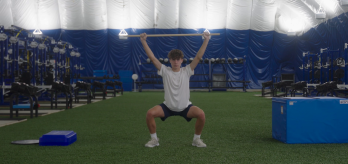
- Strong engagement of core to maintain the pole steady in a horizontal position while marching.
Progression options
- Walking march. Alternate left-right kneeling lunge into walking march. Increase the resistance by using a kettlebell, dumbbell or weight plate overhead.
Target
- Hip abductors, spinal extensors and stabilisers, transverse abdominal, obliques
Execution
- Strong engagement of core, hips forward and keep a straight posture to maintain a neutral spine position. Keep the feet in dorsiflexion, (toes pointed towards shins).
Progression options
- Legs apart is the natural progression
Target
- Hip abductors, spinal extensors and stabilisers, transverse abdominal, obliques with increased loading of wide leg position
Execution
- Strong engagement of upper-leg hip abductors. Deeper core engagement for stability.
Progression options
- Side plank with legs together, then lift a leg into a wide position, with a brief hold at the top of the lift (alternating). As above but with hip flexion, raising the knee to the elbow and lowering the elbow to the knee.
Target
- Hip flexors, abdominal, transverse abdominal, obliques, spinal extensors and stabilisers
Execution
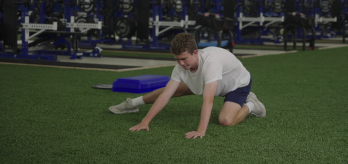
- Keep the back straight, head up, chest out and use the arms to support posture. Lift each leg while keeping it straight, with a brief hold at the end of each raise.
Progression options
- Reduce the level of support from the arms. Lift through a longer range of motion. Remove the support from the arms if you can lift the legs while maintaining a straight back with aligned posture.
Target
- Hip adductors, abdominal, transverse abdominal, obliques, spinal extensors and stabilisers
Execution
- Strong engagement of core and adductors while maintaining a horizonal position. Keep the lower leg flexed from the hip with the foot under the knee of the upper leg.
Progression options
- Copenhagen lowering and lift-up repetitions. Lower and lift the hips, with the free arm reaching underneath the torso when lowering then reaching high-up and straight above the torso when lifting.
Implementation
In this series, we provide a number of simple start-up exercises targeting the core. Some of them are to be used during an activation to prepare players for training, while others focus on development by maintaining and improving core strength. The exercises focus on using one’s own body as resistance in various planes of movement. They are simple, functional exercises that engage deep core muscles to stabilise the body and resist against external force, as well as generating their own force.
The focus is on the strength and stability of the pelvis area, including the abdominal and lumbar spinal muscles, and aided by the hip musculature, all of which help coordinate and control movements in the upper and lower limbs. All exercises are high value, available to everyone, practical and easy to implement.
The objective is to undertake one or two pre-training core sessions per week and one post-training development session per week.
- For activation–potentiation work before football training, schedule 1 or 2 short core sessions per week. Each should last up to 15 minutes (10 once players are proficient) and consist of 1 set of 4 to 6 exercises, with 6 repetitions or 10 to 15-second holds. This block is performed after a brief dynamic mobility microdose and immediately before football training.
- The weekly development session is completed after football training or as stand-alone work. It should last no more than 30 minutes, reducing towards 20 as players become familiar with the drills, and include 2 sets of 6 exercises with 8 to 12 repetitions or 15 to 30-second holds.
Summary
Highly functional core strength is a vital requirement. Viewed as a fulcrum of strength, the core acts as the body’s powerhouse for athleticism, provides fundamental stability to transmit force and serves as a protective barrier to counter or absorb the physical strains that come with playing the game.
A programme of high-value exercises that target the key muscles in the abdominal, lumbar and pelvis areas across several planes of movement can help develop a solid foundation of core strength and stability.
A strong core is important in many practical ways for football:
- Stability and balance – essential for dynamic and coordinated actions, i.e. quick stops, starts and changes of direction, as seen during transitions
- Efficiency and power – needed to fend off an opponent when challenging for the ball or to transfer force to the limbs when passing, shooting or throwing
- Protection against injuries – helps maintain posture and spinal structures and distribute load evenly, which can reduce the risk of injuring the back, pelvis and lower extremities
Rate your experience