Learning platform
 en
en 


This essential attribute for athleticism transfers forces up the kinetic chain (specifically the ankle, knee and hip muscles and joints), which is vital to producing powerful locomotion in dynamic situations and for physical competitiveness in the modern sporting arena.
Remarkable displays of athletic prowess exhibited by the likes of dancers, gymnasts and skaters, to name a few, are made possible by the evolution of neuromuscular foundations built upon through regular exposure to certain movements over many years and starting from a very young age. The systematic development of key physical attributes is fundamental to this and underpins the functionality required for exceptional athleticism. Highly coordinated strength throughout the kinetic chain in the lower body is also crucial, as it enhances the ability to transfer energy dynamically from the legs to the rest of the body. Combining this with well-developed mobility and core strength and stability provides a platform for great athleticism. These attributes work in harmony to benefit performance in the relevant sport, interchangeably interacting to produce the necessary functionality. Mobility facilitates ease and efficiency of movement, while a strong core absorbs and stabilises against force as well as redirecting it from the lower- to upper-body limbs. Lower-body strength therefore enables an athlete to shift their bodies dynamically and efficiently.
Challenges for the ball, holding off an opponent, acceleration to deceleration and changes of direction are all examples of simple actions that benefit from a solid base of lower-body strength. A strong and highly coordinated kinetic chain in the lower body also aids performance in several other ways, including thanks to efficient energy expenditure while darting around the pitch and resistance against common intrinsic lower-body injuries, such as those to the hamstring, groin or quadricep.
Exercise details
Muscle group activation
- Predominantly quadriceps, glutes and hamstrings, as well as deep abdominals, spine, hip adductors and calf muscles for stability during execution
Execution
- Keep the head up and chest out, maintain the back in a neutral position. Touch the knee lightly against the floor and drive through glutes and quads upon return.
Progression options
- Increase the resistance, but only once the exercise has been performed perfectly. Alternately use a small step to elevate the front leg, thereby requiring increased strength and coordination through a greater range of motion when lowering the rear leg.
Muscle group activation
- Predominantly quadriceps, glutes and hamstrings, as well as deep abdominals, spine, hip adductors and calf muscles for stability during execution, now requiring increased stability and core activation
Execution
- Same as above, now requiring more strength and greater coordination of the forward leg, as well as increased core and overall stability.
Progression options
- Increase the resistance, but only once the exercise has been performed perfectly. Alternately raise the kettlebell and hold it at shoulder height with elbows high, which will increase the engagement of the core and demand greater stability to improve technique.
Muscle group activation
- Predominantly quadriceps, glutes and hamstrings, as well as deep abdominals, spine, hip adductors and calf muscles for stability during execution, now with upper torso and thoracic spine muscle activation
Execution
- Same as above, with an emphasis on strength and coordination and stability between the legs and core as the rear foot touches the floor and the body braces for the drive backwards.
Progression options
-
Increase the resistance, but only once the exercise has been performed perfectly. Alternately perform a single-arm overhead reach with a kettlebell or dumbbell, which will require greater strength and stability. Change arms for a second set.
Muscle group activation
- Same as exercises Kettlebell split squats, lunge and Kettlebell alternating reverse split squats, lunge, now with an increased unilateral focus and requiring more strength, better coordination and greater stability
Execution
- Same as above, now requiring far greater unilateral strength. Tilt slightly forwards as you lower and drive back upwards. This will increase the function of the exercise through forward propulsion.
Progression options
- Increase the resistance, but only once the exercise has been performed perfectly.
Muscle group activation
-
As above, now requiring greater strength and coordination through the kinetic chain, i.e. leg strength, core stability and spinal mobility to execute the exercise
Execution
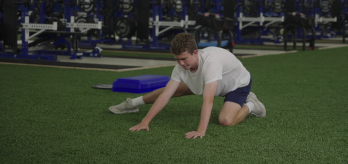
- Same as above, now requiring complete unilateral strength. It is important to use a box, step or other elevated platform at the correct height in order to reach the so-called biting point (the point at which you would lose control if you went any lower). The objective is to develop great technique and control before attempting any increased range of motion on one leg.
Progression options
- Gradually lower the height of the box, step or other elevated platform based on the target end range. Only increase the range of motion once the exercise has been performed perfectly. Only add extra resistance once the squat can be performed perfectly and repeatedly all the way to the floor. Raising the front leg on a step or box will increase the range of motion.
Muscle group activation
- As above, now requiring greater collective coordination of multiple muscles to execute the exercise
Execution
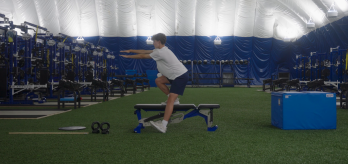
- Keep the head up and arms out straight. Try to hold the free leg straight out in front of you and off the floor, with the ankle dorsiflexed (toes pointing to shin). If this is too difficult, start with the free leg reaching forwards and the heal lightly touching the floor.
Progression options
- Gradually lower the height of the bench, step or other elevated platform based on the target end range. Try to prevent the free leg from touching the floor. Only increase the range of motion once the exercise has been performed perfectly.
Muscle group activation
-
As above, now with an alternating stimulus, placing greater emphasis on the single leg and requiring less stability and mobility of the free leg
Execution
-
Keep the head up and arms out straight. Try to keep the spine neutral while lowering the free leg to lightly touch the floor.
Progression options
-
Gradually extend the free leg further forwards to touch the floor or slide it further forwards upon contact with floor. Only increase the range of motion once the exercise has been performed perfectly.
Muscle group activation
-
Movement in the lateral plane, greater contribution from the leg abductors and adductors
Execution
-
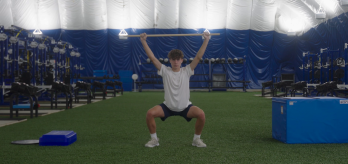
Keep the chest out, head up and elbows high while holding the kettlebell or weight plate. Keep a neutral spine when lowering to end range.
Progression options
-
Increase the resistance, but only once the exercise has been performed perfectly. Perform with straight arms while holding extra weight to increase the amount of core strength required.
Implementation
The objective is to implement a programme of foundational exercises that target the kinetic chain (ankle, knee, hip) and the core musculature of the lumbar and abdominal regions. The quality of movement is challenged while working through a full range of motion. The focus is on neuromuscular coordination between the muscles and joints involved. The goal is to engage targeted muscles in the right order and at the right time to produce strong, collective and efficient transitional force in multidirectional athletic movements.
Unilateral or single-leg exercises are prioritised, as they impose a far greater challenge to coordinated strength in conjunction with stability and mobility. This means that they are high-value multidimensional exercises. They should therefore make up the backbone of any LBS programme for youth development, as this leads to a highly coordinated LBS platform that can improve functionality.
We provide a menu of LBS exercises to be implemented in one of two ways. Firstly, they may be used as part of a pre-training microdose of LBS work that also acts as an activation and potentiation to prepare players for football training. Secondly, they may form part of a post-training development load to maintain or develop functional LBS. The focus is on high-value exercises that challenge coordinated strength through the kinetic chain, with an emphasis on unilateral single-leg exercises that impose an intrinsic load (of one’s own body weight) during execution. This ensures that the exercises are highly practical, with most requiring minimal equipment and therefore being easy to implement and available to everyone.

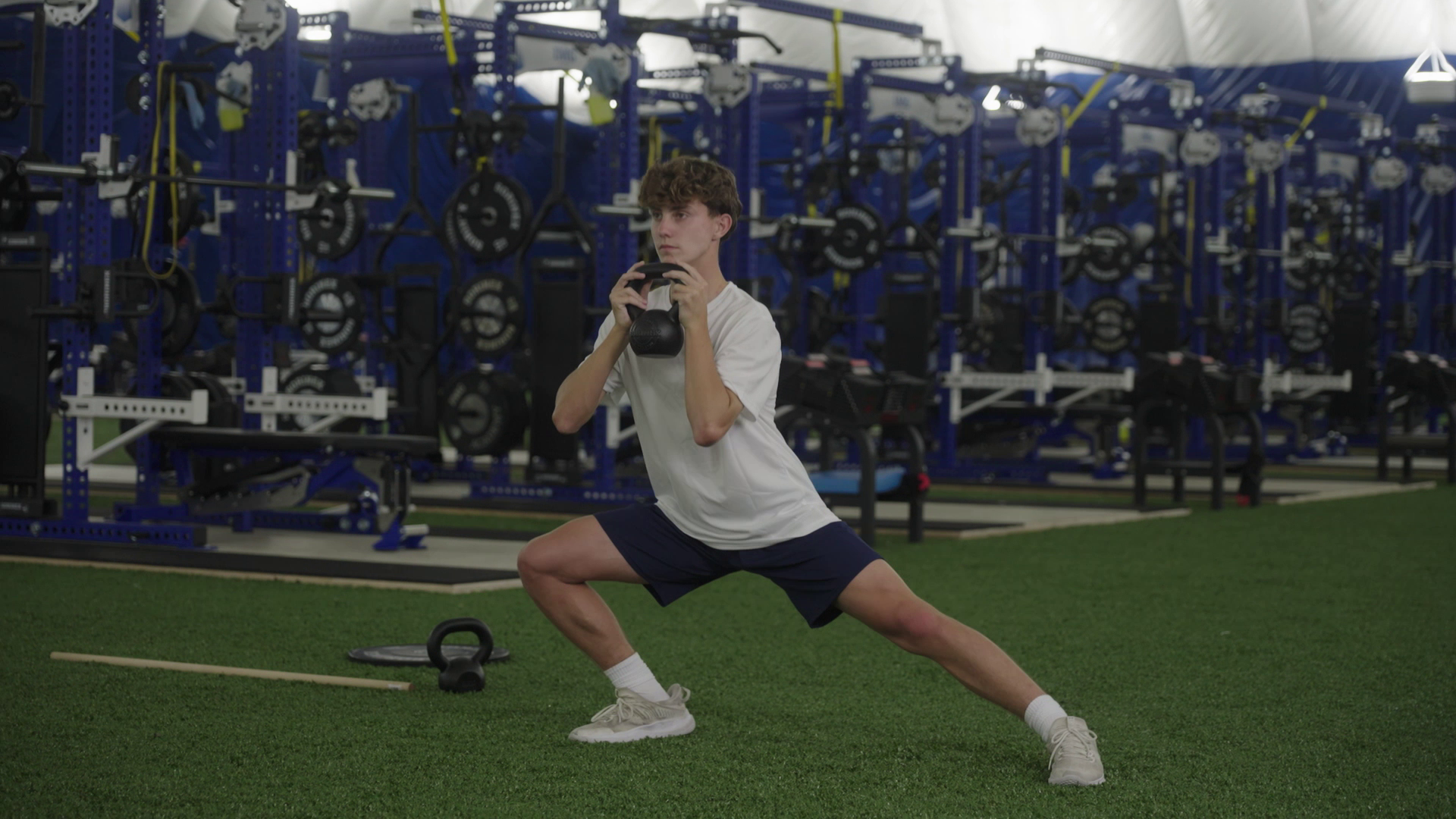
It is essential to work towards perfect execution through a full range of motion to ascertain high-quality movement before attempting any natural progressions. It is also worth highlighting that physical adaptations derived from implementing the mobility and core-strength exercises shown in previous articles will help players to execute the exercises shown here. This is an example of high-value multidimensional exercises working collectively in pursuit of athleticism for football.
The objective is to undertake one of each of the following weekly training sessions:
-
For activation-potentiation work before football training, schedule around 15 minutes with a set of three to five exercises consisting of four to six repetitions. This block should be preceded by a microdose of dynamic mobility.
-
For the weekly development session after football training or as stand-alone work, schedule around 30 minutes with two sets of five to six exercises consisting of four to six repetitions.
Summary
Remarkable athleticism depends on the evolution of neuromuscular foundations built over many years and from a very young age. Highly coordinated strength through the kinetic chain in the lower body is key to development, as this enables sporting movements to be performed both dynamically and efficiently. To develop lower-body strength in youth football, high-value unilateral (single-leg) exercises performed in multiple directions should be prioritised, which helps to build a platform of LBS that can be transferred into key functions in football.
Examples of how a strong and well-functioning kinetic chain in the lower body is important for football in practical ways:
- Dynamic movement – wrestling the ball away from an opponent, resisting a challenge for the ball or jumping with force when competing in the air
- Efficiency of movement – quick changes of direction to create space or get away from an opponent, quickly pressing an opponent and resistance to fatigue due to efficient and economical distribution of force
- Protection against intrinsic injuries – efficient movement mechanics enabled by a strong and coordinated lower body reduces the stress on joints and muscles, thus preventing muscle injuries, i.e. hamstring, groin and quadriceps
Rate your experience