Learning platform
 en
en 


We kick things off by revisiting the area of core strength with seven new exercises that build on those that feature in previously published content. Once again, the exercises are practical and accessible, involving simple bodyweight exercises that challenge the strength and coordination of the deep core muscles that are tasked with resisting and transmitting force during vigorous physical activities.
Building on foundations
The first batch of exercises presented in the article on core strength, which mainly involve static holds with progressive variations, were intended to provide a foundation for core strength and stability. The set of exercises that feature in this article places greater emphasis on core muscle stabilising against rotational movements of the extremities. Performing these exercises with good posture and control challenges a player’s mobility and stability. This owes to the unilateral focus of the exercises, i.e. single leg or arms working collectively with core muscles to stabilise one side of the body while the other side performs various controlled functions over a full range of motion. Multidimensional exercises, such as those presented here, greatly help young players to develop the postural integrity, strength and mobility that can ultimately result in improved on-field dynamism.
Exercise details
Muscle group activation
- Abdominal; transverse abdominal; obliques; hip flexors and extensors; shoulder flexors; and spinal extensors and rotators
Execution
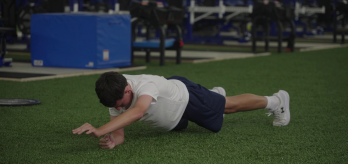
- Starting from the elbow front plank position, strongly engage your core muscles, aiming to keep a straight horizontal alignment from head to feet without rotating the pelvis area as you alternately flex between left and right legs by bringing your elbow to your knee.
Progression or new exercise
-
This new exercise is a progression of the many plank variations. It requires a high degree of mobility and stability.
Muscle group activation
-
Hip abductors; spinal extensors, stabilisers and rotators; transverse abdominal; and obliques
Execution
-
Engaging your core strongly, position your hips forwards and adopt a straight posture that keeps your spine in a neutral position. Keep your feet in a dorsiflexed position (toes pointing towards the shins) and bring your arm from under your body in a big arc to a fully extended straight-arm, high-reach position.
Progression or new exercise
-
This exercise is a rotational progression of the side plank hold and involves keeping the feet together. It requires good strength and stability, especially when it comes to the lumbar and thoracic rotators of the back, which fight the rotational forces.
Muscle group activation
- Hip abductors; adductor; flexors; extensors; spinal extensors stabilisers and rotators; transverse abdominal; and obliques
Execution
- Adopt a straight and elongated high-lift posture as you bring your elbow to your knee and then your knee to your elbow before extending to a fully straight position with your legs held wide apart.
Progression or new exercise
-
This new progression of the side plank demands very strong coordination of the core and hip muscles to perform the exercise with the required stability.
Muscle group activation
-
Hip abductors; adductors; rotators; spinal extensors, stabilisers and rotators; transverse abdominals; and obliques
Execution
-
As you twist your lower hips towards the floor and raise your hand to support your body with one arm, hold this position briefly to challenge the strength and stability of your core and hip muscles. Perform controlled rotations to both the left and right, and do not hold your breath.
Progression or new exercise
-
This is a new rotational exercise that places great emphasis on core strength, hip and lumbar rotational mobility and unilateral
strength and stability.
Muscle group activation
-
Hip extensors, rotators and stabilisers; deep abdominals; transverse abdominals; obliques; and lumbar extensors and stabilisers
Execution
-
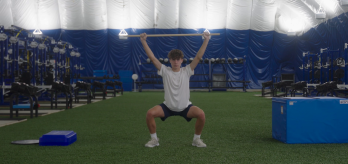
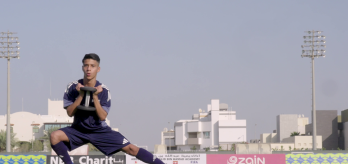
From the starting position, slowly lower your body in a controlled manner, touching the floor lightly with your hip muscles, then driving up as you thrust your hips forwards while holding a hand weight in a stable position.
Progression or new exercise
-
This new exercise targets hip mobility and co-contraction of the core muscles in the pelvic area.
Muscle group activation
-
Same as the previous exercise, with increased activation of the lumbar rotators
Execution
-
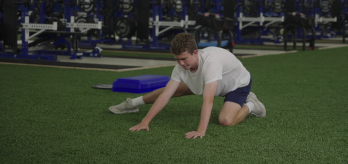
As you rotate 90-90 to the left and right, you must drive up quickly at the end of the rotation. Try to maintain a straight lumbar spine and keep your chest out and your head up as you rotate to each side.
Progression or new exercise
-
This exercise involves a similar movement pattern to the previous one but requires greater rotational core strength, as well as hip and lumbar mobility
Muscle group activation
-
Hip adductors; abdominal; transverse abdominal; obliques; and spinal extensors and stabilisers
Execution
-
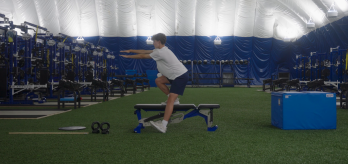
Engaging your core and adductors strongly whilst maintaining a horizonal position, flex your lower leg from the hip, with your foot just below the knee of your upper leg. Then, slowly lower your lower hip to the floor before driving up to the starting point. Aim to keep a straight posture, with your chest out and your hips forward.
Progression or new exercise
-
This exercise is a progression of the Copenhagen plank. It focuses on strength through a full range of motion, which challenges the groin and pelvic girdle muscles to remain stable, enabling you to maintain a strong posture.
Implementation
The objective is to incorporate these new exercises individually within the core programme (see article three) as progressions or variations to be performed when players achieve a very high level of competence in any given exercise. It is at this stage that players are ready to up the demands placed on the core musculature. The goal is to continue the development of the core with exercises that are pitched at the right level, i.e. they are not too easy and not too hard.
- For activation/potentiation work before football training, one or two sessions, lasting around 15 minutes, should be scheduled per week, with the session duration to be reduced to ten minutes once players are able to perform the exercises efficiently. Each session should comprise a set of between four and six exercises, with six repetitions per exercise. This block should be carried out after a microdose of dynamic mobility work and before the start of football training.
- For the weekly development session after football training or as stand-alone work, a weekly session of around 30 minutes should be scheduled. The session duration should be reduced to 20 minutes once players are able to perform the exercises efficiently. Each session should comprise two sets of six exercises, with between eight and 12 repetitions per exercise. It can be completed after football training/any other athletic training or assigned as homework.
Rate your experience