Learning platform
 en
en 


The exercises involve full-body movements that challenge mobility, strength and coordination within the kinetic chain. Both practical and accessible, these high-value bodyweight exercises involve additional load when appropriate and help develop strength and movement qualities that are essential for transmitting and absorbing the kinds of dynamic forces demanded by the game.
Building on foundations
The focus in this article is on unilateral full-body movements, i.e those involving one limb, that transmit rotational force from lower- to upper-body extremities. With speed of transition becoming an increasingly central element in match outcomes, rotational strength and agility are critical components within football athleticism and are key to the development of young players.
In this regard, unilateral athletic movements involving rotation are highly effective due to the extremely high level of intrinsic coordination required to execute them with good technique whilst transmitting rotational force. Exercises of this nature not only help to develop lower-body strength and mobility, but they also foster strong core engagement and challenge stabiliser muscles to maintain body alignment when performing the rotational movement. The exercises target the rotational strength and mobility of the hip and pelvis, which help to produce fast force transmission and accelerated neuromuscular coordination that can result in greater on-field dynamism.
Articles three, four and five in this series provide an insight into the role that dynamic mobility, core strength and lower-body strength play in the development of athleticism in youth players.
Exercise details
Muscle group activation
-
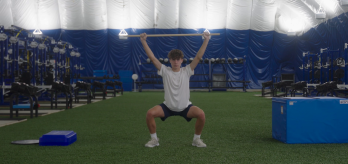
There are too many muscle contributors involved in this movement to list them all. The exercise primarily targets the knee and hip extensors and flexors. There is strong focus on the hip abductors of the curtsy leg. The lunging element involves a significant contribution of the leg abductors and adductor muscles. Stabilising an external load while performing this exercise requires deep core and lumbar muscle activation and strength.
Execution
-
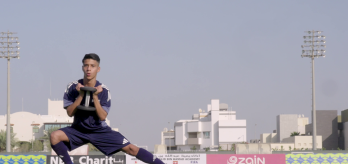
Take a big step out to one side while keeping the other leg straight. Push your hips back and bend the knee of your stepping leg as you lower into a squat position while keeping the opposite leg extended. Cross the back leg behind the stationary leg, while lowering your knee towards the floor with good control, balancing on the ball of your foot before driving up into the side lunge. Apply appropriate resistance at chest height in a bent arm position.
Progression or new exercise
-
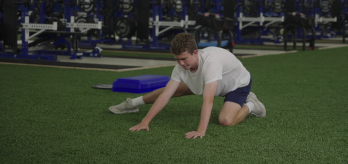
This new progressive exercise, which combines the alternate side lunge and spilt squat lunge (see article five), requires a high level of coordinated athletic functionality, i.e. strength, mobility and stability, in order to be performed with good technique. The exercise involves core work, with the resistance to be held at bent arm’s length. It targets the medial gluteal muscle that plays a key role in changes of direction.
Muscle group activation
-
Predominantly quadriceps, glutes, hamstrings, deep abdominals, lumbar rotators and stabilisers, hip adductors and abductors, as well as calf muscles. All muscles work together to execute the movement and keep the body stable during the rotational element of the exercise.
Execution
-
Keep your head up and chest out as you maintain your back in a neutral position. Rotate with bent arms, holding the resistance at chest height while turning your head as you rotate. Touch the knee lightly against the floor and drive through your glutes, quads and core rotators upon return.
Progression or new exercise
-
This exercise is a rotational variation/ progression of the kettlebell split squat and forward lunge (see article five).The rotational twist requires good strength, mobility and stability, challenging the lower-body kinetic chain and deep lumbar and abdominal core muscles in particular.
Muscle group activation
-
Hip flexors and extensors, lumbar extensors, shoulder flexors, core and lumbar stabilisers.
Execution
-
Pivot from your hips while keeping a flat lumbar spine as you extend the rear leg out straight behind you. Drive up in a single movement, bringing your arms to your chest before driving through to full extension. Weight should only be increased in small increments and only once you are able to perform the full movement while maintaining stability and with good control and alignment from start to finish.
Progression or new exercise
-
This new full-body exercise demands a good level of mobility and stability to provide the stable platform needed to transmit the necessary force and thrust. The fact that the exercise is performed with a single leg elevates the coordination aspect, with a particular focus on lumbar and hamstring mobility, along with lower-body and core stability.
Muscle group activation
-
Predominantly quadriceps; glutes; hamstrings; deep abdominal, lumbar and thoracic rotators and stabilisers; and hip adductors and abductors. All of the muscles work together to lower and rotate the body before driving up and stabilising during a strong rotational twist with a high reach and external resistance.
Execution
-
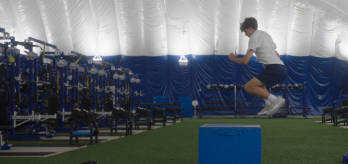
Ensure that the starting position is at the right distance from the high box (or other stable object used to perform the high step-up), so that you do not overextend when placing your foot on the object. Before attempting this exercise, you must be able to perform exercise two. For details of execution, see exercise two. Add a strong driving movement from the hip and knee of your rear leg as you step high and ensure that you have a strong rotational high reach at full extension.
Progression or new exercise
-
This exercise, which is a new, progressive full-body variation of the lunge exercises (see article five), requires a high level of coordination and unilateral control in order to perform the strong acceleration to deceleration from the lower to upper body through a rotational range of motion.
Muscle group activation
-
Hip and spinal extensors, transverse abdominal, obliques and hip flexors.
Execution
-
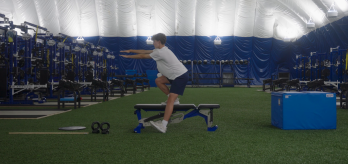
Fully extend the working leg while flexing the hip of the free leg, holding briefly at the end of the range. Place the additional resistance across the hip of the working leg.
Progression or new exercise
-
This is a new variation of the glute-hamstring lift (see article 4) and is performed in a horizontal position. The exercise involves the gluteal muscles being lowered and additional resistance placed anteriorly across the hip area to increase loading where appropriate.
Muscle group activation
-
Upper-body horizontal flexors and extensors; thoracic extensors; lumbar rotators; abdominal rotators; stabilisers; hip flexors and extensors; abductors; adductors; and rotators. All of these muscles work together to drive up and rotate into a high reach before descending in a controlled movement.
Execution
-
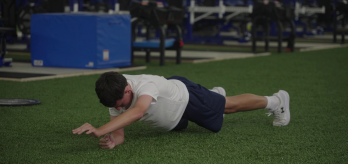
The rotational press-up should be performed with good lower-upper body alignment. When executing the rotational element, extend the reaching arm in a big arch as you brace the core to maintain a straight back. Control the descent and do not allow the weight to drop when returning to the starting position.
Progression or new exercise
-
This is a new progressive full-body variation of the press-up and plank exercises (see article four). The rotational element should not initially involve any resistance. Once you are able to keep your back straight when rotating to achieve a high reach and control the descent to the starting position, small hand weights can be added.
NB: The external resistance used in any of the exercises can be provided by a weight plate, dumbbell or kettlebell, etc. External resistance should only be applied when the player is able to perform the exercise with very good technique.
Implementation

.png)
The objective is to incorporate these new or progressive exercises individually within the lower-body strength or dynamic mobility programmes as progressions. Players should only attempt the more challenging aspects of these exercises if they are able to perform them with good technique and control through a full range of motion.
For players who are able to perform all six exercises with good movement quality, they can form the basis of a very efficient stand-alone pre-football training programme that lasts under 15 minutes and features a microdose of strength and mobility work with a stability element. As always, the objective is to ensure that the player is challenged, i.e. the exercises should not be too easy or too hard.
- For activation/potentiation work before football training, one or two sessions lasting up to 15 minutes should be scheduled per week, with the duration reduced to around ten minutes once players are able to perform the exercises proficiently. Each session should comprise a set of between four and six exercises, with six repetitions per exercise. This block should be completed after a microdose of dynamic mobility work and before the start of football training.
- In terms of weekly development work, one post-training session lasting up to 30 minutes should be scheduled, with the duration reduced to around 20 minutes once players are able to perform the exercises proficiently. The session, to be completed after football training, should comprise two sets of six exercises, with between six and ten repetitions per exercise.
Weekly training schedule
As with the lower-body strength programme, the objective is to undertake one pre-training microdose session per week and one post-training compact development session per week.
Rate your experience