Learning platform
 en
en 


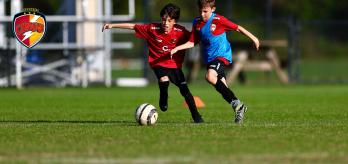
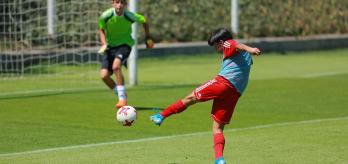
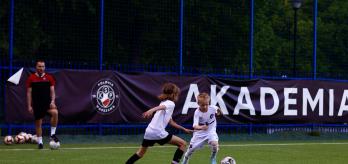
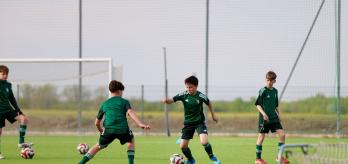
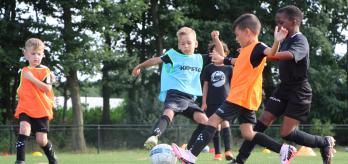
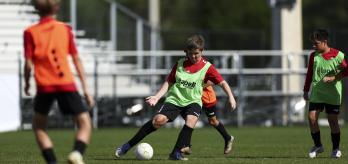
At Polonia Warsaw, one of Poland’s most traditional clubs, youth football in the youngest age groups is not about tables, titles or early selection. Every child is welcomed regardless of their starting point, and the focus is on creating an environment where players enjoy the game and build their footballing foundations step by step. Sessions follow a clear structure, beginning with general movement and coordination work before moving into technical content and 1v1 situations, with a game-based exercise always to finish. Coaches see themselves not as loud directors but as calm companions, creating an atmosphere where children feel confident to try things, make mistakes and find their own solutions.
Session overview
Key coaching points
-
Receive on the front foot and attack with speed.
-
Use effective feints, changes of direction and changes of pace.
-
Take the ball beyond the defender with the first touch.
-
Defend side-on, stay compact and show attackers away from goal.
-
React quickly when possession changes: finish, counter or recover.
-
Create space through width, depth, support, movement and communication.
Part 1: Lightning tag

The session starts with lightning tag – a fun chasing game to warm up the players. It encourages quick reactions, changes of direction and clear communication, while keeping everyone active and engaged.
-
Mark out a 10x10m area.
-
Designate 2 players who are “it”.
-
The remaining players spread out across the area.
-
The players who are it try to tag as many players as possible within one minute.
-
Once a player is tagged, they are struck by lightning and “zapped”, meaning they cannot move.
-
Other players can un-zap their team-mates by tapping their hands.
-
After each round, designate 2 new chasers.
-
Keep the rounds short and intense.
-
Start the new rounds quickly to maximise active movement time.
-
Encourage the players to change direction quickly.
-
Insist on clear communication with one another.
Part 2: The square of ball mastery
The second exercise of the session focuses on dribbling, creativity and feinting techniques. Players are encouraged to perform a variety of moves when approaching team-mates or cones, while short juggling breaks using both feet add variety and keep them active.
-
Mark out a 20x20m area.
-
Place 8 to 10 cones randomly across the area.
-
Position the players in the area, each with a ball.
-
On a signal, all players start dribbling.
-
Every time they encounter a team-mate or a cone, they perform a feint of their choice and dribble past the ‘opponent’.
-
Introduce different feints, e.g. stepovers, scissors, the Rivelino (Elástico), and drag-backs.
-
The coach now moves around the area as a defender and tries to win balls from the players.
-
Pay attention to clean and technically correct executions of the feints.
-
Include juggling the ball alternately with the left and right foot as an active break from time to time.
Part 3: Team relay race
The next exercise is a fun and competitive parcours race. The players first complete the course without a ball before progressing to dribbling challenges, making the exercise more difficult. Speed, teamwork, and competitiveness are encouraged throughout.
-
Set up 3 starting cones and 3 turning cones (10m apart), as shown in the diagram.
-
Divide the players evenly across the 3 starting cones.
-
On a signal, the first player at each cone sprints to the turning cone, runs around it once and sprints backwards to the starting cone.
-
They high-five the next player, who then starts their turn.
-
Each player completes two sprints.
-
The group that returns to their starting position first wins.
-
In the next round, the players perform the same routine, but this time with a ball at their feet, dribbling around the cone.
-
Two cones are added to each course. The players must now dribble through the additional cones, around the far cone, and back through the same two cones before passing the ball to the next player in line.
-
Demand maximum speed.
-
Motivate the children with positive feedback.
Part 4: 1v1 towards goal
This 1v1 exercise focuses on the attacker’s ability to beat a defender and finish on goal, while encouraging the defender to win possession and counter through the cone gate. The practice develops dribbling, changes of direction, finishing and defending in a realistic game situation.
-
Set up a 16x14m area for every 6 players, with one youth goal that has a goalkeeper in it, and one 5m-wide cone gate, as shown in the diagram.
-
Position 3 attackers at the cone gate and 3 defenders next to the youth goal.
-
The coach stands outside the area with a supply of balls and passes to the attacker.
-
The attacker tries to beat the defender in a 1v1 and score in the youth goal.
-
If the defender wins the ball, they can counter and dribble through the cone gate.
-
If the ball goes out of play, the coach plays another ball to ensure every player gets enough time in the 1v1 situation.
-
After each action, attacker and defender switch sides and roles.
-
Receive the ball on the front foot and attack the defender with speed.
-
Use changes of direction, body feints and changes of pace to beat the defender.
-
Take the ball beyond the defender with the first touch after the dribble.
-
Defend under control, stay side-on and show the attacker away from goal.
-
React quickly after winning or losing possession: counter through the cone gate or recover immediately.
Part 5: 2v2 towards goal
The session now progresses to a 2v2 under the same rules as in part 4. Players must work together as a team, creating more options in possession and taking on more defensive responsibilities.
-
Extend the field from part 3 to a 20x14m field and position the players in the corners of the playing area, as shown in the graphic above.
-
Use the same procedure as in part 4, but this time the new element is a 2v2 situation with a goal, a goalkeeper and a cone gate for the defender.
-
The coach plays a second and, sometimes, a third ball to ensure that every player gets enough time in the exercise. This also gives the original defenders the chance to attack in the drill.
-
Attack with speed and use width and depth to create space.
-
Support the player on the ball with good timing and distance.
-
Use combinations, such as overlaps, wall passes and movements to receive behind the defenders.
-
Communicate clearly and make purposeful runs to create scoring opportunities.
-
Defend as a pair: stay compact, communicate and provide cover.
-
React quickly when possession changes by finishing the attack or countering through the gate.
Part 6: 5v5 game
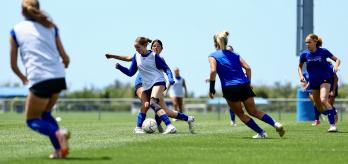
This exercise allows players to apply the key principles from the session in a free-game environment. The main focus is on enjoyment and allowing players to play without restrictions.
-
Extend the playing area from the previous exercise and add a second youth goal.
-
Place a goalkeeper in each goal.
-
Organise two teams of five players, including the goalkeepers.
-
Play a free 5v5 game.
-
The aim is for players to transfer the key principles from the session into the game and apply them effectively under pressure from the opposition.
-
Apply the key elements of the session under game pressure while creating a fun environment.
Coach reflection
Rate your experience






.variant64x64.jpg)

.variant348x164.jpg)