Learning platform
 en
en 


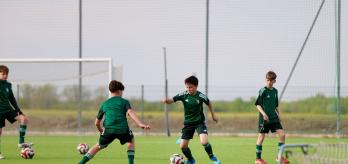
In this session, Holocher delivers a session to a young group of boys that focuses on ball work, controlling the ball and spaces within a conditioned scenario — ‘back to build’. The session begins with some activation ball work, followed by a rondo across four quadrants. The third exercise consists of a technical activation drill that leads into a 3v3 plus 2 directional ball-possession game. The session ends with a 3v3 plus 2 game that focuses on the fundamentals practised in the form of a build-up scenario.
Session overview
Key coaching points
-
Coordinate the body to make effective technical actions on and off the ball, such as being on the toes and using an open body posture.
-
Scan frequently to observe and identify space to receive or use to help team-mates progress the ball.
-
Create passing angles constantly by focusing on positional depth and width.
-
Use verbal and non-verbal communication to help support a team-mate and show them where the pass can go.
-
Make firm and accurate passes to help make ball progression more effective.
-
Establish a strong structural build-up positioning and repositioning so that the ball can be ‘secured’ more efficiently.
Part 1: Activation and juggling game

This first exercise works on developing technical control and physical coordination around the ball. Two ball-juggling exercises are used to help players practise controlling the ball when it is in the air, and players must stay active in between by making movements around the ball.
-
Mark out 9 cones, 5m apart along the length of the pitch.
-
Position a player 5m either side of each cone (18 players in total).
-
Each pair of players has a ball.
-
Activation exercise: Before each exercise, the players must make movements in front of the ball.
-
These movements include short sprints, side shuffles, mimicking a pass and mimicking controlling the ball in the air.
-
Cooperative juggling: Each pair of players must keep the ball up between them.
-
They must try to keep it up for as long as possible and can use multiple touches to do so.
-
The players must count the number of passes made in the keep-ups.
-
Juggling 1, 2, 3: One player starts by bouncing the ball into the air toward their team-mate.
-
The receiving player must keep the ball in the air with two touches and return the ball to their team-mate.
-
As they make the last touch, they must call out “1”, “2” or “3”.
-
Their team-mate must juggle the ball the communicated number of times and return it on the touch that matches the number called.
-
Each time the ball is returned, the player must call out “1”, “2” or “3”.
-
No headers are allowed.
-
The exercise runs for 90 seconds.
-
When complete, the player with the least amount of mistakes moves up to the next station, and the player who made the most mistakes moves down to the next station.
-
Coordinate the body around the ball efficiently and be prepared for balls that can go over the head.
-
Be on the toes to anticipate the required sharp movements so that the ball can be controlled in the air effectively.
-
Indicate the number clearly, as this reinforces strong communication and direction on the pitch.
Part 2: Four-quadrant rondo
The second drill presents a dynamic rondo that looks to enhance a player’s ability to scan, orientate play effectively, make correct decisions on and off the ball, and position themselves to receive in spaces that can eliminate opponents.
-
Mark out a 20×20 m area.
-
Split the area into four 10×10 m areas.
-
On two sides of the 20×20 m area, position two mini‑goals so that each quadrant has one.
-
Split the players into eight blue players, eight orange players and two jokers.
-
Inside each quadrant, position two blue players and one orange player.
-
The remaining orange players wait on the outside of the area and serve balls into play.
-
Position the two jokers close to the centre of the 20×20 m area.
-
In each quadrant, the two blue players must keep the ball.
-
If they can make eight consecutive passes, they win one point.
-
They can use one of the two jokers in the centre of the area.
-
The orange player must try to win the ball.
-
If the orange player wins the ball and scores in the mini‑goal, they win five points.
-
Rotate defenders with the orange players waiting on the edge of the area.
-
Play 90‑second rounds to encourage high intensity.
-
Rotate players so they play all roles.
-
Scan frequently to notice potential space and passing routes to move the ball into before receiving.
-
Recognise when team-mates are in a position to receive. If jokers are combining in another quadrant, decide whether to delay or reject the pass.
-
Constantly adjust position and body orientation to support the team-mate and show where the pass can be played.
-
Firm and accurate passes will help eliminate the defender.
Part 3: Technical activation
This ball circulation activity focuses on a player’s technical execution when combining and moving the ball. Players must practise passing, turning, receiving and repositioning and can use movement on and off the ball that helps to enhance the execution of these actions.
-
Mark out a 30×25 m area.
-
Split the players into groups of three and two.
-
Each group has a ball.
-
Between each group, the players must pass to one another.
-
Players must move around the area and practise technical elements such as turning on the ball and first-time return passes.
-
Players must vary their play and avoid other balls and players when passing or moving.
-
Frequently scan before and after each pass to recognise the best space to receive the ball in.
-
Make clear verbal and non-verbal communication to show team-mates where they can play into.
-
Adapt positioning and body posture to support the ball carrier.
-
Firm passes that are under control will allow for smoother combinations and technical actions.
Part 4: 3v3 plus 2 positional game
This 3v3 plus 2 game focuses on ball progression and transitional excellence when building up play. The players advance the ball from one designated player to another.
-
Mark out a 30 × 15 m area, with 5 m end zones at each end of the field.
-
Split the players into two teams of three and two neutral players.
-
The two teams start on the field, while the two neutral players are positioned on each side of the playing area.
-
The team in possession must circulate the ball inside the central zone.
-
The objective for the team in possession is to move the ball from one neutral player to the other.
-
The team out of possession must try to win the ball.
-
If they win the ball, they must circulate it in the same manner.
-
Establish a strong positional structure using quick actions, such as the back‑pedal, to optimise space and passing angles.
-
By optimising depth and width, the ball can be advanced more effectively.
-
Constantly repositioning underneath the ball or between the lines and using different vertical channels helps create multiple options for the ball carrier.
-
Scanning frequently and using effective body orientation and signals helps promote forward play with speed.
Part 5: 3v3 plus 2 conditioned game
The final exercise introduces a conditioned 3v3 plus 2 game in which the focus is on improving build-up play and structuring the positioning in transition. The players must progress the ball from one designated objective player to another.
-
Mark out a 30×15 m area, with 5 m end zones at each end of the field.
-
At each end of the area, position two mini‑goals.
-
Split the players into two teams of three and two neutral players.
-
The two teams start on the field, while the two neutral players are positioned on each side of the playing area.
-
One team must score on one side of the area, and the other team on the opposite side.
-
The team in possession uses the neutral players in order to score.
-
The defending team must try to win the ball and secure it in the same manner.
-
Limit the jokers to one or two touches.
-
Jokers can play to one another, and the defending team can press them.
-
Constant communication is crucial, and the two jokers must always provide an outlet for the team in possession.
-
Maximise space by using the full depth and width of the pitch to create passing angles and routes to the opposite side.
-
Constantly look to open passing lanes so ball carriers always have support.
-
Use technical skills such as receiving on the turn and effective body orientation to eliminate opponents.
-
Create density in front of the ball and compactness when defending to make it more challenging for the team in possession.

Rate your experience






.variant64x64.jpg)

.variant348x164.jpg)