Learning platform
 en
en 


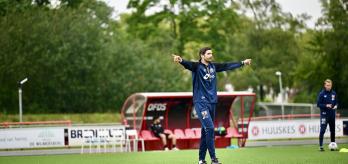
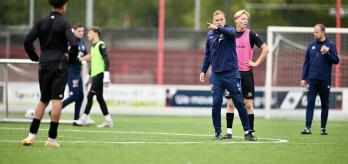
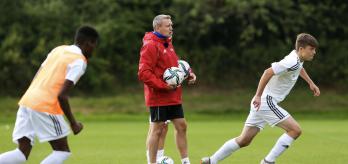
At NEC Nijmegen, training starts from the game itself. With academy teams playing on Saturdays, Monday sessions focus on improving the decisions and actions players faced the previous weekend. Under Leiwakabessy, each session is built around the three pillars of communication, decision-making and execution, with a specific football action as the focal point. Starting with smaller-game forms and sharp technical coaching after the warm-up, the session increases progressively in team size and field dimensions, shifting the coaching focus from technical execution to the “how” of decision-making in realistic game situations.
Session overview
Key coaching points
-
Communicate non-verbally with football environment
-
Take the first touch away from pressure and find the target with the second action.
-
Time your run to get in behind the defensive line.
-
Pass the ball behind the opposing back line as directly as possible and only as indirectly as necessary.
-
Pass the ball behind the opposing back line as quickly as possible and only as slowly as necessary.
-
Finish confidently from typical game positions.
-
Execute decisions on the wing as quickly as possible and only as slowly as necessary.
-
Defend the line and step up collectively.
-
Apply high pressure immediately after losing the ball and stay compact as a unit.
Part 1: Reaction competition

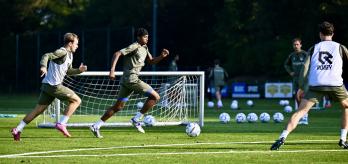
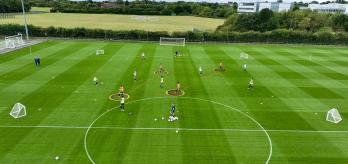
Following the warm-up with the athletic coach, this reaction competition serves as the opening exercise of the session, combining athleticism with football-specific skills. Players are challenged to blend explosive sprinting with a composed finish under competitive pressure. The race format keeps energy and motivation high right from the start of the session.
-
Set up 3 courses as shown in the diagram, each with 1 mini-goal, a shooting line (here, the penalty-box line) and 3 cones to mark.
-
Divide the players into 3 groups of 6 each and position them with balls, as shown in the diagram.
-
On a coach’s command (“White” or “Blue” cone), the players sprint around the corresponding cone and then pass into the goal.
-
The player who scores first earns 1 point.
-
Competition: Which team reaches 10 points first?
-
React explosively to the coach’s command.
-
Accelerate quickly and stay low around the cone.
-
Stay composed when finishing under pressure.
-
Create a fun and competitive environment.
Part 2: Getting in behind
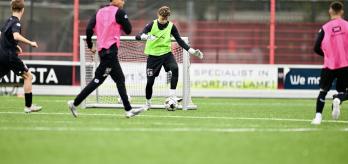
This progressive exercise focuses on getting in behind the last defensive line, building from unnopposed finishing runs to a competitive 4v5 game situation with offside. The three-phase structure challenges attackers to time their runs behind the defence, win aerial duels and collect second balls, while defenders must hold their line and transition quickly towards the mini-goals.
-
Mark out a 25x40m field and 1 full-size goal, with a goalkeeper and 3 mini-goals.
-
Divide into 2 teams of 4 players each, as shown in the diagram, and position a second goalkeeper to the side of the halfway line.
-
Set up ball depots between the mini-goals and next to the full-size goal.
-
The coach passes to the left attacker, who dribbles diagonally towards the goal and shoots.
-
The same pattern then follows for the central and right attackers.
-
The defenders act passively.
-
Goalkeeper 1 then plays a long ball towards the halfway line to Goalkeeper 2.
-
The defenders step up a few metres.
-
Goalkeeper 2 plays a high ball into the playing area. 3v5 with offside.
-
The defenders should either clear the ball out of the playing area or attack towards the mini-goals.
-
After a goal or if the ball goes out of play, the coach passes to the attacker who has not yet been involved.
-
4v5 with offside
-
After a goal or the ball goes out of play, restart.
-
Time your run to get in behind the defensive line.
-
Finish confidently from typical game positions after the dribble or run.
-
Pass the ball behind the opposing back line as quickly as possible and only as slowly as necessary.
-
Win the aerial duel and collect second balls.
-
Defend the line and step up collectively.
-
Transition quickly towards the mini-goals after winning the ball.
Part 3: Escape the pressure
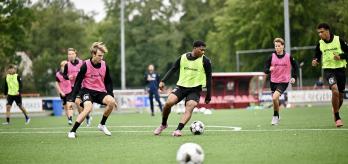
In this 1v2 exercise, the central player must receive under pressure and decide quickly against two defenders. The five mini-goals force constant scanning to take in information about space, defenders, and finishing options. Communication is the higher-order skill because the player both receives and sends information through verbal and non-verbal cues to coordinate actions.
-
Mark out a 12x20m field with 5 mini-goals, as shown in the diagram.
-
Designate 2 defenders (orange in video) and position the attackers (grey) around the field, with one player positioned centrally.
-
The players pass to each other regardless of their roles.
-
On a coach’s command, the central player calls for any ball from one of the attackers.
-
The central player then attempts to finish in one of the mini-goals in a 1v2 situation.
-
After a goal, the ball going out of play, or a loss of possession, the “passing around” begins again.
-
After several rounds, rotate the roles.
- Communicate non-verbally with football environment.
- Scan and orientate before receiving the ball.
-
React quickly to the coach’s command.
-
First touch away from pressure.
-
Find the target with the second action.
Part 4: 10v11
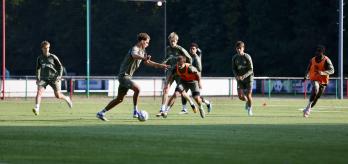
This 10v11 exercise brings the session’s key theme into a larger game format, challenging the attacking team to quickly shift the ball wide and exploit the space between the defenders with well-timed runs in behind. Playing against a compact 1-5-3-2 defensive structure, the attackers must make sharp decisions on the wing of whether to cut inside, play a pass, or release the runner in behind.
-
Mark out one half of the pitch with 1 full-size goal, with a goalkeeper and 4 mini-goals.
-
Divide into 2 teams of 10 players each.
-
Set up 1 ball depot, with the assistant coach at the halfway line.
-
The attackers (blue in video) play in a 3-4-3 and the defenders (grey) in a 1-5-3-2.
-
The assistant coach starts play with a pass to the attackers.
-
10v11 free play.
-
After a goal or the ball goes out of play, restart with the assistant coach.
-
Play wide quickly to stretch the defensive block.
-
Time your run between the full-back and the centre-back.
-
Winger decides whether to cut inside, pass or release the runner.
-
Get in behind the defensive line with forward runs.
-
Defend compactly and hold the 1-5-3-2 shape.
Part 5: 11v11
This 11v11 on the full pitch gives players the opportunity to apply everything practised in the session in a realistic game environment. The high press from the defending team creates constant pressure, challenging the attacking side to stay composed, play quickly and find runs in behind the defensive line.
-
Use the full pitch, including both goals.
-
Form 2 teams of 11 players, including goalkeepers, and position each team in a 1-4-3-3.
-
Distribute balls around the pitch and in the goals to ensure a high net playing time.
-
11v11 full-sized game.
-
After the ball goes out of play at the goal line, the goalkeeper restarts play immediately; when the ball goes out on the sideline, a new ball is thrown in.
-
The defending team plays a high press.
-
Counter-press immediately after losing the ball.
-
Play quickly to break through or bypass the press.
-
Runs in behind to exploit space over the top.
-
Goalkeeper restarts play immediately to maintain high tempo.
-
Stay compact and connected as a pressing unit.
Coach reflection

Rate your experience