Learning platform
 en
en 


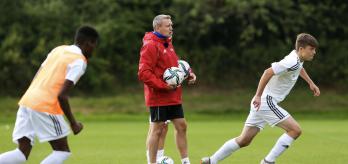
Eredivisie clubs FC Twente and Heracles Almelo share one joint academy – a set-up that makes their U-21 environment unique. It comes with its own challenges: aligning expectations across two clubs, coordinating processes and communication, while still creating a clear pathway and day-to-day structure for the U-21 group. Maletić’s interview took place on a Thursday, during a week featuring two matches – a period demanding detailed planning and monitoring of training loads. The U-21’s schedule during this week can be found below.

Training schedule and German coach education
Stefan, you applied for the UEFA Pro Licence course in Germany. Why do you want to do it in Germany and not in the Netherlands?
Stefan Maletić: I live in Germany because my wife is from there. I speak German and meet the requirements to be admitted to the course there. I already know the Dutch education system from previous courses. I know what is taught there and what the focus is on. That’s why I hope to gain further impressions at the DFB [German Football Association]. I want to get to know the German vision so I can compare it with the Dutch one and combine the best of both for myself. I believe this is the best way for me to become the best possible coach for my potential.
Why is a high net playing time particularly important to you, and how do you achieve it?
We want to get the players into relevant situations more often in training sessions – today, for example, breaking the first line. That means we first have to ensure they have as many actions on the ball as possible. A high net playing time is an important component of that.
To achieve it, we focus especially on organisational processes: breaks between exercises should not last longer than 90 seconds. The boys are instructed to drink quickly and be ready fast for the next task. There’s no time for private conversations. In the practices themselves, as long as they don’t have a tactical focus and there aren’t longer stoppages for coaching by the trainer, the next ball must be in play within five seconds. We want to see this quick switching from our team in weekend matches as well, which is why we demand it during the week.
This week you have had both a weekend and midweek fixture. How does this impact your training?
In a regular week, training on Thursday is not only tactical – we also set a conditioning stimulus. Since we already played on Tuesday and trained again directly on Wednesday, the conditioning component is removed. The players with a lot of minutes only did regeneration the day before, but the others made up the load in a kind of replacement training session, so everyone has a high pre-load.
What is your process for session planning?
The content of our training comes from two things: on the one hand, which aspects we noticed in the last match that need improvement, and on the other hand, what we expect in the upcoming game and how we want to prepare for it.
At the beginning of the week, the coaching staff sit down together and consider which topics should be addressed on which day. We prepare the sessions themselves the day before. The last ten percent we discuss on the day, once we know exactly how many players are available, etc.
For training, how do you delegate responsibilities amongst your coaching staff?
We have a clear structure within our team: I have three assistant coaches: one responsible for defenders, one for midfielders and one for attackers. At the moment, one of the assistants is supporting the U-19 coaching staff, so another takes responsibility for all attacking players. As head coach, I lead the sessions and oversee the big picture. The coaching for the individual positions is handled by the respective experts on our staff.
Our experience with this approach is positive because it ensures effective collaboration. It creates clear responsibilities and ensures that during an exercise and in the breaks all coaches can actively coach, without confusing the players with three different instructions from three different people in a short time.
The rest of the organisation has become well established and happens automatically: during an exercise, everyone chooses the best position for themselves. We spread out around the pitch and can optimally organise things such as serving balls in monitoring offside.
Joint academy and session design
How does having a join academy affect your work? What has been your experience with this model so far?
Players from two professional teams join our training. However, this doesn’t go beyond the usual changes to the training group due to injuries, etc. Experience has shown that good communication is decisive. We have clear processes for when which information has to be passed on to whom. This enables good preparation. Towards the players, transparency and honesty are the be-all and end-all. But those are things that are crucial in every club and every team.
The biggest advantage for us is that we can more easily achieve our goal of offering talents a perspective after their youth years – because they have the opportunity to make the jump to two professional first teams instead of one
Before the actual start of the session, your assistant coaches have already worked with “their” position groups. Does this position-specific training take place before every session?
The assistant coaches conduct a development training in small groups at least once a week before a session. On Fridays, we then bring the processes we’ve worked on together in a larger sequence that involves all positions.
What content was covered in today’s session?
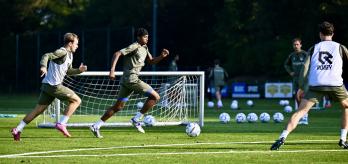
Our next opponent plays a lot of long balls to the strikers. We wanted to give the defenders a feel for how they have to act against that: which player from the defensive line attacks the ball? Who provides cover? How do we need to communicate?
The task for the midfielders was connecting play. We intend to lure the opponent to one side with passes first and then find the way out to the other side. We see the greatest development potential for our attackers in their runs and box occupation. That’s why they played several crosses and finished them in the penalty area.
What was the main focus of today’s session?
In the morning we analysed the upcoming opponent. We incorporate part of this analysis into training: we expect our centre-backs to be pressed by the opponent’s number 9 and number 10, and as a result one of our players will be free centrally behind them. We want to use this player with our strikers – either directly or via a third-man combination.
How did you achieve this focus during the session?
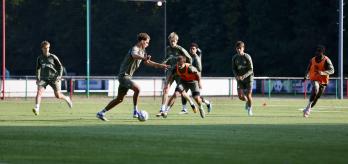
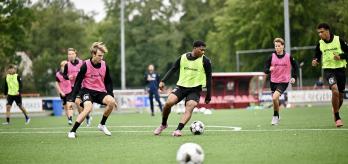
The topic should be present from the warm-up onwards. That’s why we use a passing exercise with a third man. In the subsequent positional game, the goal is to switch play into the other grid against two pressing opponents. Finishing is only possible via the third-man play.
In the following tactical practices, we again reproduced the pressing strikers and a free midfielder behind them, whom we want to reach either directly or through the third man. The second practice becomes even closer to the game by adding goals with goalkeepers.
At the end, we always play on a smaller pitch and largely freely. The common thread remains because, with the neutral player, we create a numerical advantage here too – just as was the case in all the previous practices.
Session to follow next week.
Rate your experience