Learning platform
 en
en 


Developing young talents for two professional clubs comes with unique benefits, as well as challenges, to which both clubs and the academy staff have developed bespoke solutions. The academy is aimed at delivering the best possible development environment for talented young players and coaches alike. In this article, the academy’s Head of Football Development, Bas van Baar, provides an insight into this unique institution.

Two clubs, one academy
The towns of Enschede and Almelo are around 30km apart in the Dutch province of Overijssel. In such a sparsely populated region, it makes little sense for two clubs to each run their own academy. That is what prompted the clubs to join forces five years ago and consolidate their efforts in youth football. The academy is now located in Hengelo, which is between Enschede and Almelo, keeping travel time to a minimum. This cooperation has gone so well in the first few years that the clubs extended their agreement to 2035. The academy develops players for the first teams at both clubs.
The youngsters are free to make their own decision and choose whether to play for Twente or Heracles.
If both teams are interested in signing a particular player, they raise this issue during a weekly meeting between the technical directors and the head of the academy, Bas van Baar. Further talks then take place between both parties, where just one rule applies: money is not mentioned, and discussions are restricted to sporting matters. After a decision has been made, a second meeting is scheduled for the contract negotiations.
Shared mission
There is a tangible benefit to combining the budgets for two youth development sections. Of course, this also means that both clubs have a say in how the academy is run. However, this only really applies from a big-picture perspective: the academy staff make most of their own decisions, for example when it comes to selecting which young players they want to sign for their teams. That does mean that more communication is required, as the academy has to take the opinions of two technical directors into account, for example.
On the other hand, the staff strive to ensure that they are guided by the demands of the first-team coaches, as they may have completely different approaches (and priorities). The academy focuses on its mission, which combines the interests of all participants. Being able to put talented youngsters directly in the shop window for two clubs makes it easier for the academy to fulfil this objective. It is a unique system that is yielding great results, with the academy having established itself as one of the best in the Netherlands on the strength of a sound training programme and a dedicated team of high-quality coaches.
Transitioning into two first teams
In the academy’s case, the already complex situation for promising U-19 players is even more complicated. They could already have appeared for the U-21s while playing and training for the U-19s, they may be called up for the national team, and the coaches at Twente and Heracles might invite them to join training sessions with the professionals. Each athlete may thus be involved in up to five different systems at the same time, each of which confronts them with completely different situations. The player is expected to assume a leading role in the U-19s, but has to deal with being (usually) the youngest member of the first-team set-up.
In the national team, they might be the sole representative from the region, surrounded by players from Ajax or PSV Eindhoven, who are often more in their element because of the number of club-mates alongside them. However, the academy views this as a crucial stage for its own success and the U-19 players themselves, as they are taking the most important, and the most challenging, step from youth to professional football. That is why it focuses closely on helping talented young players to cross that threshold.
High-potential prospects
The academy refers to talented youngsters that it considers most likely to turn professional as potential or “high-potential prospects”. There are a few indicators that guide the staff’s selection decisions. However, it is not all about objective data: the opinions of the youth coaches and the technical directors are taken into account. A regularly updated internal list exists of the most promising talents at the academy, to which the players do not have access. This currently includes four high-potential prospects and 11 potential prospects across the U-17, U-19 and U-21 age groups. Part of the special support for high-potential prospects includes always playing them in their best positions. The U-21 team can only feature first-team players from Twente and Heracles who have been trained at the academy. However, if they play in the same position as a U-21 high-potential prospect, the latter will always be selected. This level of support has helped 32 players make the transition from the academy to professional football in the last five years.
Connection coach
The “connection coach” has an important part to play. This coach focuses exclusively on individual work with young talents. They are employed on a full-time basis and support the U-17s, U-19s and U-21s, sitting on the bench during matches and then preparing video analysis for specific players. The connection coach holds dedicated sessions with the identified prospects as a supplement to team training. To ensure that the internal list of prospects remains confidential, this targeted training takes place in a group (for example, five central defenders), but the coaching focuses on one player in particular. As well as providing this support, the connection coach also acts as a companion.
If a youngster is invited to join a first-team session, the connection coach will be there to provide support.
If a youngster is invited to join a first-team session, the connection coach will be there to provide support. No matter how impressed the first-team coach is by young players, they are often no more than an afterthought (albeit a welcome one), making up the numbers in training exercises. However, these are critical developmental situations for the youngsters, they should not be left to fend for themselves. For that same reason, an academy employee always travels with the national team.
Midweek football
Six times per season, the academy arranges a top-level midweek away match against third-tier Dutch teams or comparable international opponents. A team is selected from the best youngsters in the U-17, U-19 and U-21 age groups, together with first-team players. For example, they faced Wolfsburg in November 2025, performing commendably in a 2-1 defeat. The idea behind always playing these matches away from home is to recreate the stresses and strains of midweek travel.
The staff try to make sure that everything is planned as professionally as possible: pre-match meal, video analysis, travelling with the first-team bus, recovery work, etc. These midweek matches allow the academy to simulate situations that the youngsters will experience as professionals. They need to get used to the particular mental and physical demands to ensure that they will be perfectly prepared to deal with these when they progress to proper competitive football.
Guiding principles for weekly training
The academy’s coaches are allowed plenty of freedom in their work. Nonetheless, the higher-ups’ objective is to ensure that everyone is pulling in the same direction. That is why they have established six criteria as guiding principles, which are used to organise the training sessions for a week:
-
Who does the training belong to (coach or players)?
-
Are the principles individual- or team-based?
-
Are instructions implicit or explicit?
-
What size are the training formats (small, medium, large)?
-
What is the intended physical load (underload or overload)?
-
What is the training volume (gross and net training time)?
Physical indicators
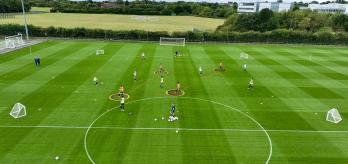
The first task is to define physical parameters for each session. For example, will large or small playing formats be used, and will an underload or an overload be generated? The amount of actual playing time is also defined. That is more than 90% on some days, which challenges the coaches to progress play at pace and keep the breaks as short as possible.
Involving the players
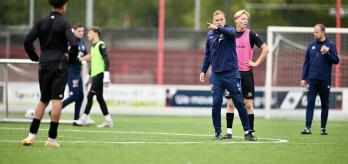
The academy has clearly defined whom each session is geared towards. Focus switches to the coaches on Thursdays only, which are all about conveying clear tactical instructions to prepare for the next match. From the U-16s onwards, this involves detailed opposition analysis. The players need to learn to stick to a plan and stay true to the academy’s principles. The game plan defines these guiding principles, while still allowing the players freedom to act.
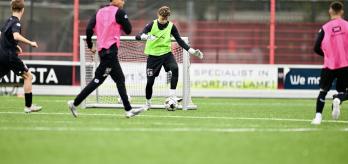
On all the other days, training is player-centric, and the sessions are far less instructional. Training structured this way – with an emphasis on implicit learning – delivers a host of benefits: research confirms that it is easier to recall information learned like this in game-like stressful situations, and football is all about stress. The ball is contested at all times, unlike in volleyball, for example, where you cannot attack the ball when it is on the other side of the net.
This continually leads to new situations that will not be repeated, making it difficult to recall rehearsed patterns of play. It is no use for young players to recite everything like a coach if they cannot reproduce it under pressure during a match. That is why the academy’s sessions are designed to recreate competitive conditions, developing these talented young players to enable them to make and implement their own decisions in those moments.
One-dimensional games
One-dimensional games are playing formats designed to provoke specific problem situations, challenging the players’ ability to find solutions through creativity and decision-making. A range of manipulation options exist to develop these games. A document has been put together for the academy’s coaches with examples for each topic. They can apply these examples on a plug-and-play basis or use them as a springboard for their own ideas.
There are three manipulation options. For example, if the aim is to practise wide build-up play, the session can be designed accordingly (goals count double after switching play), the environment can be adapted (e.g. by playing with two goals in wide positions at each end) or the individual can be influenced in other ways, such as by naming the drill (e.g. the “Virgil van Dijk game”). Players are not told what is expected from them. The format should provoke the desired behaviour, prompting them to recognise what they need to do. The academy’s approach is to coach around principles, rather than specifying fixed patterns of play. These are guiding principles that help the players to problem-solve and provide a framework within which they can and should be able to act with freedom and creativity.
Coach development
The academy leaders have developed a summary of all the data for its coaches, as well as for the players. These contain the responses to five questionnaires that are used to capture information about key values, personality traits, behaviour within the team and mental strength. The results can help to assemble a functional team with a range of skills and personalities. The Ofman core quadrant model provides further support. This outlines personal qualities, pitfalls, allergies and challenges. Coaches are required to obtain 360-degree feedback twice per year. This encompasses assessments from colleagues and players, as well as from the head of the academy, and encourages coaches to think about their own performance.
Meetings are held to examine the development plan, which is agreed upon before the season. All coaches set out their own next steps in this plan and define what to concentrate on to achieve these objectives. The head of the academy also supports one of the academy teams each week, joining them on the pitch for their training sessions and sitting on the bench for a match. If he notices anything in particular, he can add notes. He meets with the functional team that he had been monitoring during the following week, and they analyse the sessions and the match.
Rate your experience