Learning platform
 en
en 


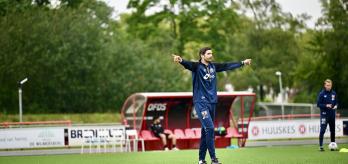
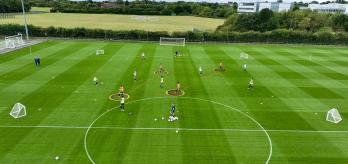
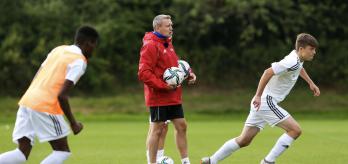
In this matchday -2 session for the joint Dutch academy’s U-16s, focus is on an upcoming game on Saturday. The first step is to analyse the upcoming opponents, but match preparation primarily concentrates on implementing the academy’s ideas, rather than making opposition-specific adjustments.
Session context

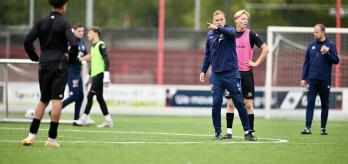
Overgoor: This week’s preparations focus on specific tactics: the opposition’s right winger will run at the central defender, while their right full-back is expected to push on and attack down the flank. The training session will therefore focus on using short passes during build-up to exploit the gaps that the opposition will leave down their right. The only topic of discussion is how the team behave in phase 1 (possession in front of the opposition’s first line of defence).
Phases 2 (the transitional phase once the opposition block has been penetrated) and 3 (possession in and around the opposition penalty area with the aim of scoring a goal) require the application of core principles, regardless of the opponent. This tactical emphasis leads to more frequent coaching interruptions on the pitch, providing the team with solutions that can be implemented. This places limits on players’ freedom to act, with the onus on the coach to deliver clear instructions as part of an explicit learning method.
Conversely, the other sessions are more player-centric, concentrating on playing formats that apply a range of rules and manipulations to provoke the desired reaction. Players are free to find their own solutions and make decisions, with coaches preferring to adopt an implicit approach to imparting knowledge.
Session overview
Key coaching points
-
Improving passing accuracy under pressure
-
Creating targeted overloads around the ball
-
Recognising space early and using it effectively
-
Developing tempo and dynamism in possession
-
Finding solutions to stay in control and escape the press
-
Accurately bypassing the press
Warm-up
To get the warm-up under way, players complete ABC running drills and additional mobility exercises, sometimes using hurdles, before moving on to short sprints to increase intensity.
In the second part of the warm-up, players are divided into two groups and allocated to two lanes that reach the halfway line. They complete several races with gradually increasing intensity, before finishing up by sprinting in pairs: one player starts with a small advantage and must be caught by the other player.
-
Mark out two 16m-long lanes and set up 8 hurdles in the first 5m of each.
-
Allocate a group to each lane.
-
The players complete various ABC running drills, mobility exercises and sprints.
-
Mark out 2 running lanes from the goal line to halfway.
-
Allocate a group to each lane.
-
The players execute 3 runs at increasing speed, trotting back at a gentle pace.
-
For the fourth round, the players go in pairs: A starts 2m ahead of B. On the coach’s signal, they sprint off and B attempts to catch A before they reach halfway.
Exercise 1: 4v2 with changing positions
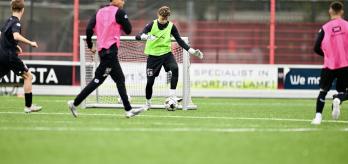
This exercise concentrates on fast passing under pressure, combined with positional interchange after every action. Losing possession immediately leads to a role switch, triggering constant transitions, keeping the tempo high and forcing everyone to stay on their toes.
-
Mark out a 20x10m pitch with a halfway line.
-
Nominate 2 defenders and position them inside the pitch. Distribute the other players across the 4 corners.
-
Set up a supply of balls for the coach on the halfway line.
-
4v2
-
After making a pass, the player runs to the position opposite and the next player enters the pitch.
-
After losing possession, the player responsible swaps positions with the defender who has spent more time in the middle. The coach puts a new ball into play.
-
Making sound decisions quickly when under pressure
-
Using the first touch to set up follow-on actions
-
Finding space and always showing for the pass
-
Readiness and vision
-
Transitioning swiftly after losing possession
Exercise 2: 6v6+2 on an asymmetrical pitch
An asymmetrical pitch allows for the targeted manipulation of the training environment. Introducing the rule that the additional space on the left-hand side can initially only be used by the attacking team ensures that build-up play is largely directed through the left.
Using this simplified format to start with allows players to get used to the extra space that is expected to develop when attacking down the left during Saturday’s game. These manipulations are designed specifically for the upcoming opponent, but general principles are defined for each phase of play and coaches are supplied with specific options to fine-tune the exercise while honing these principles.
Regardless of the phase of play, we define a few key principles and give the coaches clear ways to train them. For example, one objective would be to deliberately create a one-player overload around the ball.
-
Mark out a 35x45m pitch with a 10m-wide channel on one side wing (as shown on the left of the image).
-
On each goal line, position 2 mini-goals centrally within the area outside the wide channel.
-
Set up a supply of balls for the coach in the centre of the pitch.
-
Form 2 teams of 6 players. Position 1 outfield player or 1 goalkeeper as a neutral player at each end, between the mini-goals.
-
Goalkeepers should have already completed their own separate training session before joining team training at the start of this exercise.
-
6v6+2
-
The attacking team can enter the wide channel at any time, while defenders must pass or dribble into it.
-
After a goal is scored or the ball goes out of play, the coach puts another ball into play.
-
Deliberately creating a one-player overload around the ball
-
Quickly creating a passing angle
-
Finding the free player
-
Pushing up dynamically after switching
-
Transitioning immediately after losing possession and quickly closing down space around the ball
Exercise 3: 8v6 on a truncated pitch
The objective of this exercise is to give the team a feeling for the space that will arise during the weekend’s game and to enable them to play with confidence in those areas. However, only a small group of players is available for training, so it is not possible to simulate these spaces in realistic 11v11 situations.
A smaller, “truncated” pitch is used instead. The diagonal boundary blocks off an area that represents the players who would normally be active there. The team therefore focus on the crucial aspect: attacking down the left. Replicating in-game situations like this keeps training as realistic as possible.
-
Mark out a 60x45m pitch, truncated diagonally on the right-hand side (at the opposite end to the full-size goal, as shown in the image), with 1 full-size goal guarded by a goalkeeper and 2 mini-goals.
-
Form a team with 8 players, including a goalkeeper, and another team of 6.
-
Place balls in the full-size goal.
-
Important note: in the video, this exercise was initially an 8v6, but due to an injury mid-session, turned into a 7v6.
-
8v6 (turns into 7v6 in the video due to injury)
-
The goalkeeper starts each attack.
-
The blues attack the mini-goals, while the reds counter-attack towards the full-size goal guarded by the goalkeeper.
-
Creating structured and controlled build-up play, starting from the goalkeeper
-
Generating dynamism down the left with clear follow-on actions
-
Mimicking in-game situations by recognising and using space when attacking on the left
-
Taking the overload to the next level
-
Creating overloads around the ball
-
Switching immediately to counter-pressing after losing possession, or staying compact and closing down
Exercise 4: 6+1v5 with changing ends
This exercise concentrates primarily on intense duels, fast transitions and plenty of shots on goal. The alternating attacks and supplementary runs deliver a high tempo, increasing reaction speeds and adding intensity in the final part.
-
Mark out a 42.5x27.5m pitch, with 1 full-size goal guarded by a goalkeeper and 2 mini-goals.
-
Form 1 team of 6 players, including a goalkeeper, and a second team of five. The goalkeeper plays in the full-size goal.
-
Nominate 1 neutral player.
-
Coaches with a supply of balls should be stationed behind the goal line between the mini-goals and at the halfway point along the left touchline (from the perspective of the team with the goalkeeper).
-
Important note: due to several players needing to withdraw from practice, the exercise in the video is a 6+1v5. This exercise can also be played as a 7+1v6 (as shown in the pitch graphic above).
-
The goalkeeper initiates play and the blue team attack the mini-goals together with the neutral player.
-
The reds counter-attack towards the goal with the goalkeeper.
-
If a goal is scored in either mini-goal, both teams run around them. The teams now switch sides and the coach behind the mini-goals restarts play by passing the ball to the blues, who are now attacking the goal with the goalkeeper.
-
If a goal is scored against the goalkeeper, the coach along the touchline restarts play by passing to the team that conceded the goal (in this case, the blue team).
-
Targeted overloads with the neutral player
-
Spreading out and establishing passing angles around the ball
-
Focused attacks on the mini-goals and full-size goal
-
Transitioning consistently after losing possession and scoring goals
-
High levels of awareness and intensity when play is restarted

Rate your experience