Learning platform
 en
en 


In their upcoming game, head coach Stefan Maletić expects his centre-backs to encounter a persistent two-player press from the opposition. This pressing structure creates space behind the opposition’s first wave of pressure as a byproduct. As a result, parts 2 to 5 of this session feature a plus-one situation and focus on finding the free player in these vacant areas with vertical passing. To ensure continuity between playing out and creating chances, parts 3 to 5 expose players to the progression and attacking situations that follow on from this type of build-up. Several exercises feature insight in the form of a Q&A with coach Maletić.
Session overview
Key coaching points
-
Scan before controlling the ball and take in information such as where the pressure is coming from, the intended direction of the next pass and the space behind the first line.
-
Use an open posture, correct timing and a suitable angle when receiving the ball. Move into the pass and prepare to play forwards.
-
Ensure a high quality of pass when under pressure: precise, well-weighted and to the receiver’s front foot or into the space in front of them.
-
Use the first touch to guide the ball into the direction of play, simultaneously away from pressure and setting up the next action.
-
Stay in proximity of one another when in transition, and counter-press immediately after losing possession, closing passing lanes in the process.
-
Establish rest defence quickly after winning possession back by resetting formation and pushing on.
Part 1: Passing circuit competition

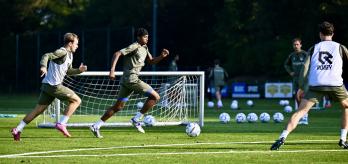
The session begins with a passing circuit competition. Three groups compete against one another in a passing duel, using fast, clean combinations which culminate in a shot on a mini-goal.
-
Mark out a passing circuit for 3 groups with 1 cone gate. Place a mannequin 10m ahead of this, with 1 mini-goal 16m from the mannequin and a shooting line 6m in front of the mini-goal.
-
Distribute the players around the circuit, with a player each at positions B to D and multiple players with a ball at A.
-
As they wait for the start signal, the first player in each group stands in front of the cone gate and stays on their toes by doing “tick tocks” (tapping the ball back and forth between their ankles). The first group to score a goal gets one point.
-
Everyone moves along one position after each round.
-
Competition: Which group can be the first to score five points?
-
Sequence 1: A dribbles around one side of the cone gate. B peels diagonally off the mannequin and into space to receive the pass. B turns, plays a diagonal one-two with C and then finishes into the mini-goal before reaching the shooting line.
-
Sequence 2: A dribbles around one side of the cone gate and plays a diagonal one-two as B peels off the mannequin. A passes into C, who has made a diagonal run into space and then lays the ball off first-time to B. B finishes on the mini-goal before the shooting line.
-
Timing and angle to receive the ball: move towards the pass instead of standing still
-
Passing quality: precise, well-weighted passes
-
Readiness, scan before controlling the ball: next pass/mini-goal/under pressure
-
First touch to keep play moving: in the direction of play, away from the press, setting up the next action
-
Clear and early communication: “lay-off/turn/time”, plus hand signals or eye contact
This activation has a technical focus. Why is this focus still important at U-21 level?
Stefan Maletić: The first part of the session often includes technical exercises to give players a better feel for the ball. This is part of learning to play football in the Netherlands: everything from the warm-up onwards involves the ball. The thinking behind this is that increasing the amount of time spent on the ball can only improve players’ skills. The technical focus in the activation drills is also a key component in terms of preparing the players for the next exercises, ensuring that they are ready to go. If they already understand the passing sequence, the players are more likely to incorporate the third player when under pressure.
Part 2: 4v2 across 2 zones
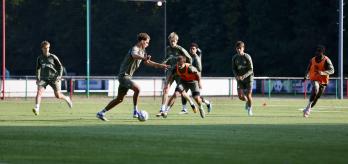
This small-sided game focuses on targeted bypassing of the first line of press. Attackers take the opposition out of the game in the 4v2, switch to the other half and incorporate the lay-off to the “third player” before finishing into the mini-goal.
-
For 8 players, mark out a 10x5m pitch with a halfway line and tip over 2 mini-goals 2m behind the goal lines.
-
Nominate 6 attackers (blue) and 2 defenders (orange) and position them as shown.
-
Set up a supply of balls for the coach on the halfway line.
-
A 4v2 is contested in one half.
-
The attackers attempt to switch play to the other half. After a switch, they have to play a lay-off (to practise using the third player) before they finish into the mini-goal; each goal by the attackers is worth one point.
-
After gaining possession, defenders can immediately score in one of the mini-goals; each goal by the defenders is worth two points. They also score one point if the attackers put the ball out of play.
-
Swap the defenders after 60 seconds. The losing team in each round have to do five press-ups/sit-ups.
-
Play eight rounds.
-
Add width and depth: stretch the pitch as much as possible, providing clear passing lines in both directions
-
Control the tempo, recognise the right moment to switch: draw the opponent in to take them out of the game, then switch quickly and cleanly to the other half
-
Readiness and first touch: scan before controlling the ball, using the first touch to set up an instant pass or switch
-
Use the third player after the switch: push up immediately after the pass, create a triangle and lay off the ball ahead of the player to tee up the shot
-
Pass quality under pressure: low, crisp, accurate, no selling team-mates short with underhit passes
-
Transition after losing possession: stay in touch and close down passing lines immediately, as defenders can finish directly into the mini-goals
Part 3: 4v3 to 5v5
This exercise combines exploiting a 4v3 overload with an immediate transition to a 5v5. This is designed to force the players to find solutions under pressure and to be ready to play after each action.
-
Mark out a 25x25m pitch with 2 mini-goals at each end, behind the goal lines.
-
Form one team of 7 (orange) and one team of 8 (blue) and position them as shown.
-
Coach 1 is positioned centrally at one end of the pitch, just behind the end line, while coach 2 is positioned centrally on the opposite touchline to the players waiting to join the action; both should have a supply of balls.
-
The 4v3 exercise begins when coach 1 passes to the orange team, who attack the mini-goals defended by the blue team.
-
After a goal is scored or the ball goes out of play, blue player B passes to C and both join play, with orange player B to make a 5v5.
-
After a goal is scored or the ball goes out of play in the 5v5, coach 2 plays a pass in to simulate the “third ball”.
-
Swap the waiting players after each complete round. Coach 1 then starts a new round.
-
Regularly swap the teams’ tasks.
-
One player left training before this exercise to complete a running session with the fitness coach.
-
Quickly exploit the 4v3 overload: spot the free player, pass the ball crisply, prepare to finish rather than simply holding possession
-
Play into space behind the first line: draw the opponent in to take them out of the game, then play a forward pass into space or to the third player
-
Open posture and runs in behind: when receiving the ball, take a positive first touch to set up the next pass forward; make runs behind the last line
-
Transition after a goal/ball out of play: the players already on the pitch should get back into shape immediately and the waiting players should sprint onto the pitch to make it 5v5 – there should be no switching off
-
Communication and defined roles when entering play: who closes down, who goes wide, who runs deep, all ensuring that both teams hit the ground running for the 5v5 and that it is well organised
-
Reaction to third phase (when coach 2 plays the ball on): scan quickly, the first action must be spot on, immediately close down after losing the ball and quick link-up options after gaining possession
The striker dropping deeper often took several touches before laying the ball off to the players advancing from behind. Is this an intentional objective?
The striker interprets each situation to decide how many touches to take. In an ideal world, the pass is struck cleanly and the advancing players time their runs perfectly, allowing for an immediate lay-off. However, if the pass is not accurate or the midfield player has not yet pushed up, the striker has to take a few touches before laying the ball off. Each situation is different, so it is important for players to recognise this and adapt their reactions accordingly. Communication and teamwork are essential.
Part 4: 6v6 – 2v1 – 7v8
The aim of this three-phase exercise is to link the free player in the middle with subsequent situations featuring an overload. These are supplemented by fast link-up actions to practise bypassing the first line, playing into the space behind and decision-making under pressure.
-
Mark out a 65x40m pitch, with 2 goals with goalkeepers and 2 penalty areas.
-
Distribute two teams of 7 players, including goalkeepers, across the pitch; 1 attacker and 2 defenders are initially restricted to the penalty area.
-
Position 2 blue players and 1 orange player next to the pitch.
-
Both coaches should have a supply of balls; coach 1 focuses on the 2v1 next to the main pitch, while coach 2 is stationed roughly at the halfway mark of the main touchline.
-
The orange goalkeeper starts each attack.
-
The orange team should set up in a 2-3-1 formation, with the blue team in a 2-2-2 shape.
-
As soon as a player on the attacking team finds some space in the middle and can dribble towards the opposition penalty area, a second ball is introduced into the channel on the wing to create a 2v1.
-
There is now a 3v2 situation playing towards one goal. At the same time, the players next to the pitch turn the 2v1 into a 6v4, playing towards the other goal. After completing their action, the players from the 3v2 situation can join in.
-
Once both actions have been completed, coach 2 plays in a long ball to initiate a 7v8 game.
-
After a goal is scored or the ball goes out of play, all players get back into position and a new sequence begins.
-
Running into space centrally and body positioning: the angle, gap and posture should allow the player in the middle to dribble forwards with the first touch
-
Recognise the breakthrough moment: as soon as the central player is in space, they should increase the tempo and dribble towards the penalty area to draw in the opposition
-
Quality of the pass into space: low, crisp and accurate, timed so that the recipient can continue their forward motion
-
Decisions in the 3v2 format: add width, run in behind at the right moment, set up the finish instead of rushing the shot
-
Deal cleanly with parallel actions: clear role definition in the 2v1 (in possession/supporting), find the free player quickly in the 6v5 format, and use switches/diagonal passes
Players are also frequently instructed to play a chipped pass to the striker and receive detailed coaching for this technique. Why is this passing skill so important?
The opposition often defend 1v1 all over the pitch to counteract build-up play based on short passing. These situations are difficult to deal with and require a more “grown-up” response, or a Plan B. In such scenarios, midfielders can drop back to create more space between themselves and the attackers, paving the way for chipped passes to the striker.
For this to work, the pass must be played ahead of the strikers. They can run on to the ball and the central defenders are unable to head it clear. The midfielders then push up, finding space after the lay-off from the striker and linking up with the fast wide players.
As soon as the striker got involved, a 2v1 situation immediately developed on the wing. Why was this action incorporated into the exercise?
The 2v1 simulates how play continues after space has been opened up in the centre. From that position, the aim is to use the attackers out wide and push up the full-back to create a 2v1.
This second ball was quickly followed by a third. What was the thinking behind that?
Training often includes several consecutive actions, using a second, third or fourth ball. This maximises exposure in terms of time spent working with the ball, adds a dynamic element and hones swift transitions. It delivers an integrated experience and helps to emphasise attacking play, although the session is focusing on the build-up. Playing the third ball in high simulates the challenge of defending against a long ball, a situation that will arise during the game at the weekend.
Part 5: 7v7+1
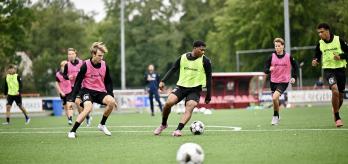
Using the neutral player during the game generates an overload to bypass the first line and set up a finishing opportunity in the penalty area.
-
Split a 40x30m pitch into 3 zones (15m-long zones at each end and a 10m-long zone in the middle) and set up 2 goals with goalkeepers.
-
Form two teams of 7 players, with an additional goalkeeper on each team, and nominate 1 neutral player.
-
Place balls in the goals.
-
7v7+1
-
Both teams adopt a 3-3-1 formation.
-
Goals can only be scored from the end zones (i.e. not from the middle zone).
-
After a goal or if the ball goes out of the play, the goalkeepers continue play (if a team score, they are rewarded by retaining possession, so the next sequence begins with their goalkeeper).
-
Neutral availability: the spare player should always be available at an angle, play with a maximum of two touches and accelerate switches
-
Third player and staggered positioning: create triangles, prepare for using the third player, with clear runs in behind to link up with the target zone
-
Pass in the direction of play: crisp and accurate, allowing the recipient to turn and move forwards or lay the ball off immediately
-
Patience until reaching the penalty area, ruthlessness inside it: after tidy build-up outside the shooting zone, the tempo should be stepped up inside it with a view to clinically getting a shot away
-
Defensive organisation and counter-pressing: quickly pressure the ball after losing possession, simultaneously organising cover in the central zone
The staff and players came together for shared reflection at the end of the exercise. Was there a particular message that needed to be communicated?
To escape the press and reach the goal, players need to consider build-up options like going long or playing deep. If you can link up with the strikers with their backs to goal, they can hold the ball up and bring others into play. Success demands cooperation: midfielders who are being marked have to move sideways to open a passing line to the striker, before pushing up to reach space when the lay-off comes. If the team manage to achieve this, it is important to finish the attack and create chances, rather than recycling possession and starting again.
Did the team understand these points?
The lads are used to this way of working and know how to deal with it. Players quickly realise what the aim is, but this assessment is important nonetheless. Player feedback is always taken into account when the coaching staff subsequently discuss what could have been done better.

Rate your experience