Learning platform
 en
en 


Intelligent movement, such as purposeful overlaps, well-timed box runs, and drifting into pockets between defensive lines, can help a team to create 2v1 or 3v2 scenarios on defences. This can lead to a team making penetrative actions within an organised defence.
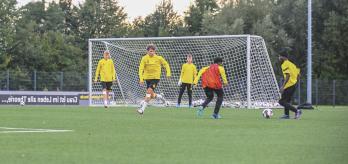
In this session, Newcastle United’s U-15 head coach, Graeme Coulson, presents a series of exercises to help a young group of players think about the movements they should be making to develop effective wide attacking patterns. The session starts with a passing circuit that focuses on activating the sequences ahead of the main exercises and ends with a conditioned game, where the players can put the fundamentals into practice in the form of a real-game scenario.
Session overview
Key coaching points
-
An effective overlap can be set up with the ball carrier attacking the inside of the full-back to throw them off balance and create more space for the overlapping player.
-
Vertical runs alongside the defender can help the overlapping player receive the ball without having to break their run, whilst simultaneously taking a first touch beyond the defender.
-
Attack the space on the back of the full-back’s shoulder to create 2v1s when making underlaps or box runs.
-
Play through central areas to force the opposition into a narrow shape so that the wide players gain more space and 2v1s can be created.
-
Occupy and receive the ball in pockets behind the defensive line, as it can attract players and create space for wide players to take around the back.
Part 1: Passing circuit — overlaps

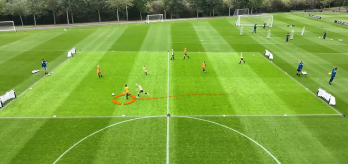
This first exercise is a passing circuit designed to serve as a technical activation that will lead into the main part of the session. The focus of the drill is on the technical requirements needed to make successful overlaps and underlaps.
-
Set up a circuit like shown in the graphic above.
-
Use a quarter pitch, with one full-size goal and a goalkeeper.
-
Place 4 mannequins in a 15×15 m grid.
Stations:
-
A and C: 15 metres wide of the grid (left/right), aligned vertically.
-
D: midway between the mannequins and Station E.
-
E: centre of the 4 mannequins.
-
F: central, 5 metres outside the mannequins.
-
B: 5 metres beside the mannequin nearest the goal.
-
G: 22 metres from goal, facing it.
-
One player per station; extras queue at A and near the goal.
-
The ball starts at Station A.
-
A passes to B, then overlaps.
-
B drives inside toward the second mannequin and, at it, plays A on the overlap.
-
A passes to C.
-
C plays a one-two with D.
-
D receives in the pocket and plays to F, before making a run on the inside of the outside mannequin (representing the opposition full-back) to attack the box.
-
E plays a diagonal ball beyond the mannequin into D’s path.
-
D crosses for F’s run towards goal.
-
F crosses early to the player from Station G.
-
Rotate by moving to the next vacant station ahead.
-
Fix the defender to their position by driving towards the inside areas quickly, decisively and sharply so that more space is created on the outside for the overlap.
-
By targeting the defender’s inside foot with the dribble, it can unbalance them and force them to lean inside so they can’t get out to the overlapping player quickly.
-
The overlapping player should curve their run so that, upon receiving the ball, they can take a first touch across the defender and into the space ahead to eliminate them.
-
Underlapping runs should be made off the shoulder of the full-back so that the closest centre-back does not follow, and a 2v1 can be exploited.
-
Passes should be well‑weighted, and the box run should be timed to arrive onto the ball without breaking stride, allowing the receiver to maintain speed and finish in rhythm.
Part 2: Attacking waves — 2v1s and 3v2s
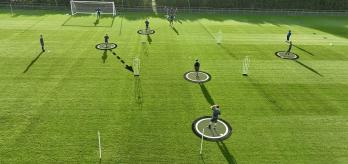
This second exercise develops overlaps and box runs through 2v1 and 3v2 attacking scenarios. The practice begins unopposed and then introduces defenders, challenging players’ decision-making as they execute the movements and exploit their numerical advantage.
-
Use 1 half of a full-size pitch.
-
Position a full-size goal at either end of the pitch.
-
Position a goalkeeper in each goal.
-
Narrow the pitch to 25 metres in width.
-
Split the group into 2 teams of 9 players.
-
1 blue player is positioned 15 metres in front of their goal.
-
2 blue players occupy the wide spaces in the opposite half.
-
2 orange players are positioned on the edge of the area.
-
2 orange players are in the centre of the pitch.
-
All remaining players wait behind their respective goals.
-
The coach plays the ball to the 2 orange players in the centre of the pitch.
-
The 2 orange players initiate a 2v1 attack against the solo blue defender.
-
They must try to score using overlapping runs.
-
Once the attack ends, the blue player carries the ball into the other half to initiate a 3v2 with the 2 other blue players against the 2 orange defenders.
-
The blue team must try to score using overlaps and box runs.
-
After the attack ends, the orange team initiates the second phase: a 2v1 at the opposite end, with one blue player entering the pitch to defend.
-
Players must rotate on and off the pitch so that all players get to attack and defend.
-
Switch the teams so they defend and attack both goals.
-
If a team scores via an overlap or box run, they score 3 points.
-
All other goals equal 1 point.
-
Use overlaps to force the defenders into overcommitting. If the defender tries to cover the overlap, they may leave space for the ball carrier to drive towards the goal and attack the space.
-
Effective box runs can distract defenders so that the wide players on the opposite side have space to receive.
-
Players should remain active after making box runs, even if they don’t receive, as they can move to the back post for a goalscoring chance.
-
Recognise when defenders part when carrying the ball through the centre, as it can be an opportunity to drive with the ball through the space and quickly to goal.
Part 3: 6v6 attack v. defence
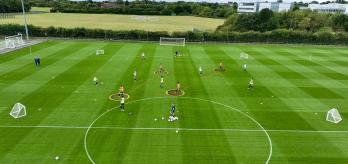
The session progresses into a larger playing area, incorporating both unopposed and opposed playing scenarios. This attack v. defence exercise begins with unopposed attacks to help players sharpen their pass-and-move sequences, and is quickly followed by an opposed game in which players must apply the skills learned to break down the defence.
-
Use a full-size pitch.
-
Position a full-size goal and a goalkeeper at either end.
-
Split the group into 3 teams of 6.
-
In one half of the pitch, set up the blue team in a 4-2 defensive structure.
-
In the same half, set up the orange team in a 3-3 attacking structure.
-
In the other half of the pitch, set up the green team in a 3-3 attacking structure.
-
The green team start with the ball close to the halfway line.
-
They must execute passing sequences and try to score, led by the assistant coach.
-
In the other half of the pitch, the orange team start with the ball close to the halfway line.
-
They must create an unopposed attack using passing sequences.
-
Once they score, a second attack starts close to the halfway line.
-
This time, the blue team must defend and try to stop the attack.
-
If the orange team scores, they get an additional attack to score points.
-
If the blue team wins the ball, they must either make 5 consecutive passes or carry the ball over the cones.
-
Once they do this, the orange team must sprint across to the other side and defend against an attack from the green team.
-
Repeat the conditions.
-
Points are awarded for goals scored using overlaps, box runs and underlaps.
-
Playing through the opposition can pull defenders inside and create space for overlaps or box runs in behind the full-back.
-
Wide players can play on the back of full-backs and make aggressive diagonal runs to attack the space just behind them, should a player receive the ball in the pocket.
-
When playing wide, exploit overloads if the opposition is slow to shift across, attacking down that side rather than circulating the ball to the opposite flank immediately.
Part 4: 9v9 plus goalkeepers
-
Use 1 half of a full-size pitch.
-
Position a full-size goal at either end of the pitch.
-
Split the group into 2 teams of 9.
-
Set the blue team up in a 4-4-1 defensive structure.
-
Set the orange team up in a 3-3-3 shape.
-
The orange team must try to build an attack and score.
-
The blue team must always start in a defensive position.
-
If the blue team wins the ball, they can try to score.
-
If the ball goes out of play, it always reenters the pitch via an orange team’s attack.
-
1 point is awarded should the orange team make a penetrative run.
-
2 points are awarded should the orange team take a shot from a penetrative run.
-
3 points are awarded should the orange team score a goal from a penetrative run.
-
Switch the teams after 8 minutes.
-
The attacking team must quickly recover their attacking structure once they win the ball back.
-
Receive the ball in the pockets between the defensive lines to immediately create 2v1s and put defenders in vulnerable situations.
-
Encourage players to find passing lines inside areas to narrow the opposition and free space out on the wings.
-
Wide players can stay wide and try to pull the full-backs away from the centre-back to isolate them.

Rate your experience