Learning platform
 en
en 


This session focuses on defensive compactness and pressing. After an athletic and ball-oriented warm-up, the exercises build progressively from a 5v4 to an 8v8 situation, developing the team's ability to close central lanes, shift compactly as a unit, and press with timing and intensity. The session concludes by bringing all principles together in a match-realistic context.
Session overview
Key coaching points
-
Press with clear timing and intensity.
-
Stay compact, shift across together and keep the back line connected.
-
Protect the centre by closing central passing lanes and blocking forward passes.
-
Force the opponent wide, backwards or into a decision-making dilemma.
-
After winning possession, counter-attack quickly and directly towards goal.
Warm-up
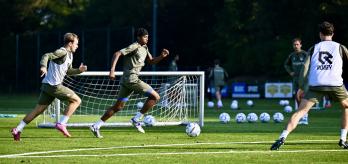
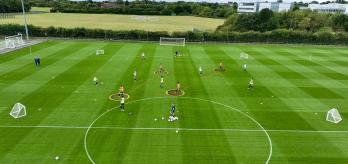
The warm-up consists of several parts. The players start with an athletic warm-up, but most of the warm-up is done with the ball. It includes different techniques such as juggling, various dribbling skills and, finally, a passing sequence.

Part 1: Compactness and pressing in a 3-1 shape
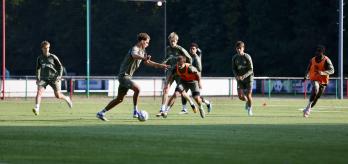
This 5v4 activity trains defensive compactness and pressing out of a 3-1 shape. The defending team closes central lanes, forces play wide and shifts compactly as a unit, while the attacking team looks to pass into one of the four mini-goals. After winning the ball, the defending team transitions immediately and counter-attacks towards goal.
-
Mark out a 40m-long area across the full width of the pitch, with 1 goal, a goalkeeper and 4 mini-goals, as shown in the diagram.
-
Form one team of five (grey in video), including a goalkeeper, and one team of four (orange).
-
Orange play in a 3-1 formation and grey attackers play with a back four.
-
A supply of balls is set up in the goal.
-
The goalkeeper starts play with a goal kick.
-
A 5v4 situation begins.
-
Grey try and pass into one of the mini-goals.
-
Orange remain compact and counter-attack on the full-sized goal should they win possession.
-
After a goal or when the ball goes out of play, play restarts with the goalkeeper.
-
Orange's number 9 forces the centre-back in possession to one side, limiting their passing options.
-
Orange remain compact and shift across with the ball.
-
The defenders close central passing lanes and force play wide.
-
The deeper player (number 10) provides cover and protects the space behind the press.
-
After winning the ball, the team counter-attacks quickly and directly towards the goal.
Part 2: Progressing to an 8v8
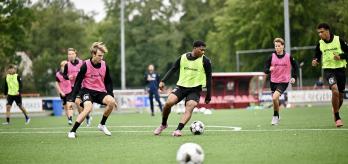
This 8v8 activity trains defensive compactness and pressing out of a 2-1-4-1 shape. The defending team stays compact between the lines, protects central areas and shifts as a connected unit, with the number 10/8 blocking forward passes and pressuring opponents receiving with their back to goal. The attacking team, playing in a 1-4-2-1, looks to pass into one of the four mini-goals.
-
Mark out a 60m-long playing area with 4 mini-goals, 1 full-sized goal and a goalkeeper, as shown in the diagram.
-
Form 2 teams of 8 players each.
-
The defenders (orange in video) play in a 2-1-4-1 formation, and the attackers (grey), including the goalkeeper, play in a 1-4-2-1 formation.
-
Place a supply of balls in the full-sized goal.
-
The goalkeeper starts play with a goal kick.
-
An 8v8 begins.
-
Grey try and pass into one of the mini-goals.
-
Orange counter-attack towards the goal after winning possession.
-
Play restarts with the goalkeeper after a goal or when the ball goes out of play.
-
Orange’s centre-backs may only cross the halfway line when their team is in possession.
-
Orange’s number 10 or 8 blocks the forward pass and applies pressure to the opponent receiving with their back to goal.
-
The team stay compact between the lines and protects the central areas.
-
The back line stays connected and shifts across together with the ball.
-
Players press with clear timing and intensity to force play into predictable areas.
-
After winning possession, the team looks to counter-attack quickly and directly towards the goal.
Part 3: 11v11 game honing compactness, pressing and counter-attacks
This exercise brings together the principles trained in the previous activities. The defending team protects the centre, forces the opponent to play backwards and applies coordinated pressure to create a decision-making dilemma, turning defensive compactness into a tool for winning the ball and launching quick counter-attacks.
-
Use the full-size pitch, including both goals.
-
Form two teams of 11 players with goalkeepers.
-
11v11 game
-
Orange team set up in a 1-4-4-2
-
Grey team set up in a 1-4-2-3-1
-
Apply the principles from the previous exercises.
-
Protect the centre.
-
Force the opponent to play backwards.
-
Force the opponent into a decision-making crisis.
Coach reflection

Rate your experience