Learning platform
 en
en 


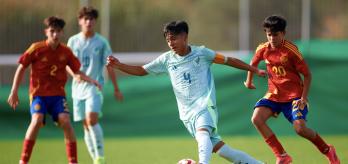
Within a zonal defensive structure, individual defending is about more than simply winning possession. Defenders must recognise when to apply pressure, how to delay attacks, which spaces to protect, and how to limit the opponent’s options. These actions form the foundation of the collective behaviours that underpin effective zonal defending.
Learn more about the progressive zonal defending methodology.
Exercises
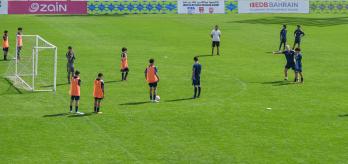
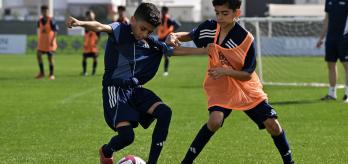
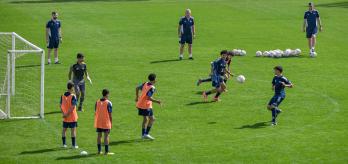
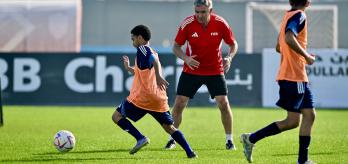
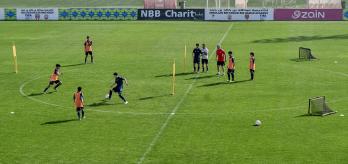
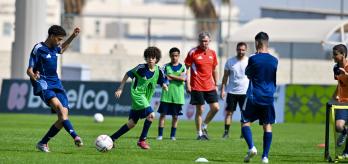
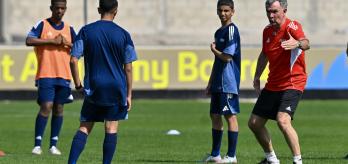
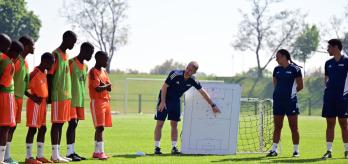
In this first stage of the zonal defending methodology, FIFA Talent Coach Conor Marlin presents four practices that develop the individual defensive behaviours required for effective collective defending. Through a variety of 1v1 situations, players learn how to influence attackers, protect space and regain possession when opportunities arise.
Key coaching points
The four practices focus on helping players:
-
apply immediate pressure to the player in possession to prevent the attacker from gathering momentum;
-
delay the attacker once in close proximity and prevent forward progression;
-
force attackers away from central areas and onto their weaker foot;
-
step across using the hips and arms to force the attacker off the ball when they attempt a take-on;
-
apply pressure quickly when recovering from behind and prevent the attacker from turning;
-
anticipate the timing of passes and identify opportunities to intercept when opponents receive with their back to goal;
-
block the attacker’s inside route and force play towards the outside to protect central areas; and
-
maintain patience when defending from the side and avoid overcommitting beyond the ball.
Exercise 1: 1v1 defending from in front

Exercise 1 focuses on preventing the attacker from taking the ball past the defender by applying the three 1v1 principles: direct, delay and deny.
-
Mark out a 30 x 10m area, with a 5m end zone at each end.
-
Split the players into 2 teams: blue and orange.
-
Position the blue team along the side of the area and at one end, with balls.
-
Position the orange team at the opposite end of the area.
-
Place 1 blue player in an end zone and 1 orange player in the centre of the area.
-
Play starts with a blue player passing to the attacking player in the end zone.
-
As soon as the pass is made, the defender closes down the attacking player.
-
The attacking player must then dribble past the defender and enter the opposite end zone.
-
If the defender wins the ball, they must dribble into the opposite end zone.
-
A team scores 1 point by carrying the ball into the end zone.
-
After a point is scored, or if the ball goes out of play, restart with the same sequence.
Coaching points
Exercise 2: 1v1 defending from behind
This second exercise presents the defender with a 1v1 defending scenario from behind the attacker. The defensive principles differ slightly, as the defender can attempt an interception before the attacker receives the ball and must make close contact as soon as possible in order to control the player in possession and prevent them from turning.
-
Mark out a 30 x 15m area.
-
Mark out a 5m zone at each end of the area.
-
At one end, position 2 mini-goals.
-
Split the group into 2 teams of 5 and position them beside the mini-goals.
-
At the other end, position a coach with balls.
-
Play starts with 1 attacking player stepping into the area and moving towards the coach.
-
A defender follows the attacking player into the area.
-
The coach passes into the attacking player’s feet.
-
The attacking player must take a touch, turn, and try to beat the defender.
-
They then attempt to score in either mini-goal.
-
The defender must try to intercept the pass or win the ball.
-
If the defender wins possession and dribbles into the opposite zone, they score 1 point.
-
If the defender makes a direct interception from the coach’s first pass, they score 2 points.
-
The attacker must return the ball to the coach and look for a quick return.
-
The defender must try to intercept both the return pass and the initial pass.
-
The attacker can now decide whether to take on the defender immediately or play a one-two with the coach.
Coaching points
Exercise 3: 1v1 defending from the side
This next drill focuses on 1v1 approaches when defending from the side. The defender practises defensive fundamentals, such as positioning themselves to cut off the inside dribble and showing the opponent down the touchline, to better control 1v1 situations.
-
Mark out a 20 x 20m area.
-
Set up a mini-goal in one corner inside the penalty area, angled at 60 degrees to face into the area.
-
Place a 5m gate in the opposite corner, in the outside channel, facing the far end.
-
Position the players and coaches as shown in the graphic above.
-
Split the group into 2 teams: blue and orange.
-
The coach starts play by passing to the attacking player.
-
At the same time, a defender applies pressure, aiming to block the route to the mini-goal.
-
The attacking player can either drive towards the mini-goal or pass to their team-mate on the opposite side.
-
If the ball is passed across, the defender must continue to follow with an angled run.
-
The defender must try to show the attacking player down the line and towards the gates.
-
The attacking player must try to score by passing into the mini-goal or dribbling through the gates.
-
If the defender wins the ball and passes back to the coach, they score 1 point.
-
If the attacking player passes into the mini-goal or dribbles through the gates, they score 1 point.
Coaching points
Exercise 4: 1v1 defending in a small-sided game
Despite the introduction of a unit, this final drill continues to work on the main principles of 1v1 defending. The defenders are presented with 1v1 scenarios inside their designated zones and must defend 1v1s from the front, behind, and the side, whilst relying on the fundamentals they have already practised in each of the previous exercises.
-
Mark out a 30 x 30m area.
-
Inside this area, mark out two 10 x 10m zones at either end.
-
The centre should leave a 10 x 20m midfield zone.
-
Split the group into 2 teams of 5 (blue and orange).
-
Position a blue player and an orange player in each zone.
-
Position 2 mini-goals at either end of the area.
-
Position a coach at either end of the area with balls.
-
1 of the coaches will pass to the orange players in the starting zone.
-
The orange players must start close to the mini-goals.
-
The blue players in this zone must start at the end of this zone.
-
As the pass is played to the orange player, the blue player must close them down.
-
The orange player must try to beat the blue player and progress the ball.
-
The orange players must try to score in the mini-goals at the other end.
-
If the blue players win the ball, they must try to score in the opposite direction.
-
Players must stay locked into their zones and can only transfer the ball to another zone with a pass.
-
A one-two with the coach is allowed.
-
Remove the zones and allow players to move freely.
-
Defenders must apply player-to-player marking.
Coaching points
Rate your experience