Learning platform
 en
en 


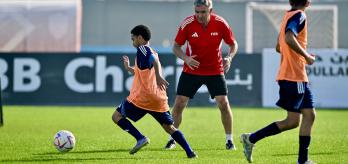
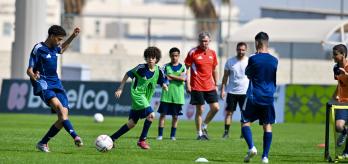
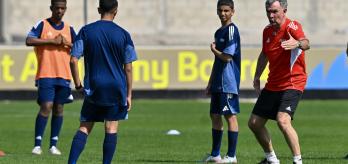
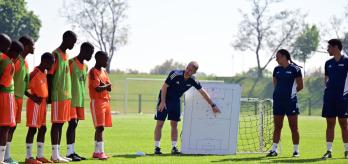
In this session, Wili Ruttensteiner, Technical Lead for FIFA Talent Coach and Academies Programme,presents a framework for build-up play designed to develop the skills and characteristics players need to perform effectively in the role of the “6.”.
This series of training individual actions for central midfielders has many benefits, such as providing a high number of repetitions and allowing players to train isolated actions that involve techniques relevant to the game. It also allows the coach to give detailed, micro-level feedback, which is very important, especially for young players. However, its limitations include the absence of real decision-making and pressure, which is why it must be complemented by the following phases. The next two steps would be training in game situations, followed by training game phases.
The PMDS model (Position, Moment, Direction, and Speed) is a very helpful tool for analysing actions, as it provides clear reference points that enable the coach to assess the execution of an exercise with greater accuracy and confidence. When applying the model, it is essential to consider the player’s position on the pitch, the specific moment of action, the direction of the player’s movement or run, and the speed at which they are able to perform.
Here are some examples of questions to ask yourself within the framework of the PMDS model:
-
Position: Is the player asking for the ball and offering support in the right space?
-
Moment: Is the player making the run to offer support at the right moment?
-
Direction: Is the player taking the first touch in the correct direction for the follow-up action?
-
Speed: Is the player offering for the ball and making his run with the correct speed and timing?
Learn in detail about the different phases of position-specific training and why it is so important.
Exercise overview
Key coaching points
When we look at the key coaching points, we also have to keep the PMDS model (Position, Moment, Direction, and Speed) in mind to ensure we achieve the best training-effect benefits.
-
Choosing the right surface of the foot, prioritising the inside of the foot when appropriate, will help improve the players’ passing accuracy.
-
Other key passing and receiving details, such as body orientation, receiving on the move when possible, and directing the first touch purposefully, will also be important.
-
Receiving side-on, scanning before receiving, and trying to take the first touch forward are key aspects to refine during this practice.
-
Players should develop their timing and game intelligence around when and where to offer support, identifying the right spaces at the right moment.
-
As players become more familiar with the concepts, add complexity by adjusting the level of opposition: passive → semi-active → realistic. At the same time, demand higher levels of precision, speed of action, and decision-making.
Part 1: Ball mastery

In this first exercise, the players focus on individual technical skills that help them to enhance the important positional skills of a midfielder such as clean first touches, excellent ball orientation and quick footwork to receive and return the ball efficiently when operating in tight spaces.
-
Position two mannequins 1 m apart.
-
1 m in front of them, position another two mannequins 2 m apart.
-
The mannequins should replicate a defensive line.
-
1 m behind the first set of mannequins, position a player.
-
On the other side of the mannequins, 3 m away, position a second player or coach with a ball.
-
The action starts with the second player/coach, who must pass between the mannequins that are 1 m apart and into the receiver’s feet.
-
The receiver must take a touch out of their feet and to the side.
-
They must return the pass between the outside and inside mannequin.
-
Continue this passing sequence.
Variation 1:
-
The second player/coach calls out “1” or “2”, which prompts the receiver to use one foot (1) or both feet (2) when touching and returning the ball.
Variation 2:
-
The second player/coach can also call out “inside” or “outside”, prompting the receiver to use the inside or outside of their foot when passing back.
Coaching points
Part 2: Receiving behind pressure
The second drill introduces a specific in-game scenario that a midfielder will typically face during build-up play. The exercise progresses from a situation where the midfielder cannot turn fully after receiving the ball and must find fixed targets, to a more advanced scenario involving moving targets. A further progression is to add a defender, requiring the central midfielder to apply all the elements practised earlier in the exercise under pressure.
-
Use a full-size pitch.
-
On the halfway line, position four mannequins in a 10 x 10 m area.
-
Facing the 10 x 10 m area, position a mini-goal on either side, 20 m away.
-
At one end, position a coach with balls behind each mannequin.
-
At the other end, position the players in a line between the mannequins.
-
One player starts by moving into the area.
-
The coach passes into the area and into the player’s feet.
-
The player must take a touch in the direction they intend to go.
-
They must then pass into the mini-goal.
-
The second player enters the area and repeats the action.
Variation 1:
-
Introduce two full-backs, positioned 20 m on either side of the area.
-
The player moves into the area and receives a pass from the coach.
-
They must take a touch and pass in front of either full-back.
Variation 2:
-
Introduce two defenders, positioned behind the mannequins where the receiving player starts.
-
Once the coach passes to the midfielder, one defender can apply pressure.
-
The full-backs and additional attackers must create passing options.
-
The midfielder must connect with any teammate, attempt to break out of the pressure, and receive the ball in a position where they can advance play to either the coach or finish in one of the mini-goals.
Coaching points
Part 3: Individual action circuit
This exercise presents a build-up phase where a midfielder must use clever movement, scanning and excellent body orientation to receive between and break the lines. The exercise evolves from structures sequence to more dynamic situations where active pressure forces midfielders to adapt their decisions in real time.
-
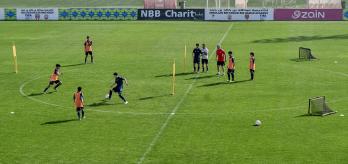
Mark out a 20 x 30 m area.
-
Inside the area, position two mannequins 10 m apart on three separate lines, with 10 m between each line.
-
The three lines represent the defensive, midfield, and attacking lines.
-
At one end of the area, position a mini-goal in each corner.
-
At the other end of the area, position two mini-goals diagonally, 25 m from the corners of the area.
-
Position a player in each corner of the area to act as the centre-backs.
-
Position a player, acting as the midfielder, on one of the mannequins in the midfield line.
-
Position two players to wait for their turn.
-
Position coaches 1 and 2 with balls, 5 m to the side of the mini-goals in the corners of the area.
-
The sequence starts with the left centre-backs passing the ball to each other. At the right time, the midfielder moves off the mannequin and makes a diagonal run between the midfield and defensive mannequins on the opposite side.
-
The centre-back plays a diagonal pass between the two mannequins and into the midfielder’s path.
-
The midfielder must receive, turn, and take the ball out of the space between the mannequins.
-
They then play a pass into the mini-goal in the corner on the same side.
-
The midfielder then moves into the space between the mannequins on the opposite side. They receive a ball from the coach on the near side.
-
The midfielder must then circulate the ball between the two centre-backs and the two coaches while moving between the spaces.
-
Once the opportunity to receive a diagonal pass appears, the midfielder must receive, turn, and play a diagonal pass into the mini-goal outside the area on the opposite side.
-
Add a defender to apply light pressure, encouraging the midfielder to work harder to create space to receive.
Coaching points
Rate your experience