Learning platform
 en
en 


The defenders should understand that to successfully defend zonally, they must apply efficient coordination with one another off the ball. They must show an ability to recognise each other’s actions and responsibilities, which can help them to understand when and who must press, provide cover or balance.
Learn more about the progressive zonal defending methodology and how individual defending provides the foundation for effective collective defending.
Exercises
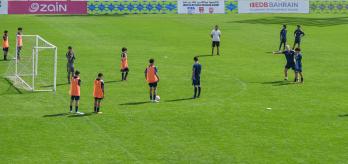
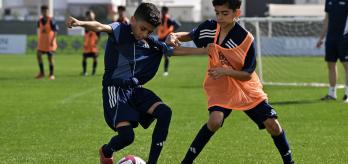
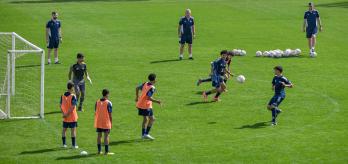
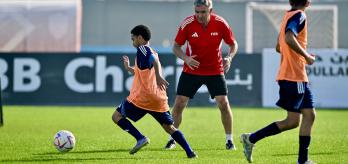
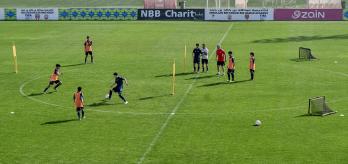
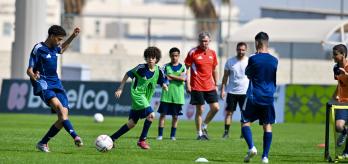
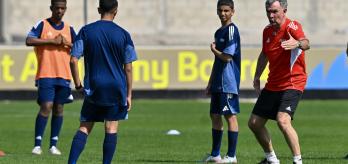
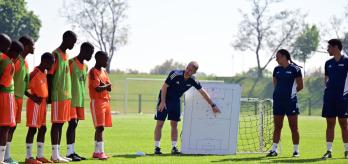
These example practices, presented by FIFA Talent Coach Stuart McLaren, form part of an exercise library that can be used during Stage 2 of the progressive methodology. Through a variation of 2v2, 2v3 and 3v3 scenarios, players develop their ability to defend spaces in small groups while learning when, why and how to press and cover for one another.
Key coaching points
The three practices focus on helping players to:
-
press first when they are the defender closest to the ball carrier, preventing the attacker from playing a pass inside the defensive shape;
-
provide close cover as the second defender, denying through balls and preventing opponents from receiving in dangerous areas close to goal;
-
screen passing angles and protect the space behind the press when recovering and tracking opponents during defensive transitions; and
-
maintain a compact triangular structure when defending in groups of three to cover gaps and limit the spaces available for the opposition to play into;
Exercise 1: 2v2 pressure and cover

In this first exercise, the players practise defending in pairs against two opponents who are attempting to combine and play through them. This in-game situation helps players to alternate between covering and pressing to prevent the opponents from exploiting passing lines between them.
-
Mark out a 30 x 20-metre (m) pitch.
-
Position a medium-sized goal at each end of the pitch, with one goalkeeper in each goal.
-
Split the remaining players into two teams of six: blue and orange.
-
Position three orange players in each corner at one end of the pitch.
-
Position three blue players on each side of the pitch, 10m from the goal at the opposite end.
-
Position the coach on one side of the pitch with a supply of balls.
-
Play starts with one blue player entering the pitch from either side and one orange player entering from either corner, with the coach passing the ball to one of the orange players as they enter.
-
The orange players must combine to score in the goal at the opposite end.
-
The blue players must try to win possession and prevent the orange team from scoring.
-
If the blue players win the ball, they must try to score in the opposite goal.
-
Apply a time limit for the team in possession to score, encouraging them to play with greater intensity.
-
The goalkeepers are limited to a maximum of three touches.
-
Once a goal is scored or the ball goes out of play, all players must leave the pitch. A new set of blue and orange players then enter, and the exercise restarts.
Coaching points
Exercise 2: Defending 3v2 into 1v1
This practice increases the difficulty of covering and pressing by presenting a numerical disadvantage. The defenders face a 2v3 and must identify when to alternate between pressing and covering so that the opponent cannot make use of the spare player.
-
Mark out a 30 x 35m pitch.
-
Position a full-size goal at each end of the pitch, with one goalkeeper in each.
-
Mark out a 10m channel along each side of the pitch.
-
Position a mini-goal at the end of both channels.
-
Split the remaining players into two teams of six: blue and orange.
-
Position four orange players on one side of a full-size goal and two orange players on the other side.
-
At the opposite end of the pitch, position two blue players on either side of the full-size goal.
-
Position the remaining two blue players in the middle of the pitch.
-
The ball starts with the four orange players. One orange player passes to the goalkeeper before entering the pitch, joined by one orange player from the same side and another from the opposite side of the goal. This creates a 2v3.
-
The orange players combine and try to score in the goal at the opposite end, with the offside rule in effect, while the two blue players defend and attempt to win possession. If the blue team wins the ball, they can try to score.
-
Once a goal is scored or the ball goes out of play, one blue player from either side of the goal enters each channel. The coach passes to the blue players from the corresponding side, while the two wide orange players enter one channel each.
-
The blue and orange players then compete in a 1v1 in each channel, attempting to score in the mini-goal they are facing. Apply a time limit to the 1v1s to encourage intensity.
-
Once a goal is scored or the ball goes out of play, the players leave the pitch and a new 2v3 starts.
Coaching points
Exercise 3: 3v3 defensive triangle
This final exercise affords defenders the opportunity to practise using the necessary structure and organisation required when defending as a three. The players must work together using a triangular structure to provide pressure, coverage and balance.
-
Mark out a 20 x 25m area.
-
Position three mini-goals along each side of the area.
-
Split the group into two teams of six: blue and orange.
-
Position one blue player behind each of the three mini-goals.
-
Position the remaining three blue players inside the area, in front of one mini-goal each.
-
Position three orange players behind one mini-goal each on the opposite side.
-
Position the remaining three orange players inside the area, in front of one mini-goal each.
-
The coach passes to one of the three orange players, who must combine to score in any of the three mini-goals they are facing.
-
The blue team must defend and try to win possession. If they regain the ball, they must attack the opposite side and attempt to score in any of the three mini-goals.
-
After a goal, the team that scored restarts with the ball. If the ball goes out of play, the opposing team restarts with possession.
-
After a set number of repetitions, replace the three players from each team with their team-mates waiting behind the mini-goals.
Coaching points
Rate your experience