Learning platform
 en
en 


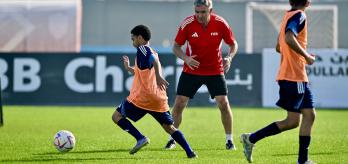
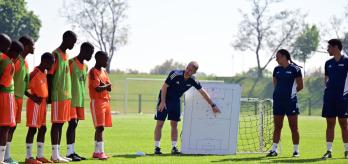
In this session, Willi Ruttensteiner, Technical Lead for FIFA Talent Coach and Academies Programme, outlines a build-up framework aimed at developing the skills and qualities players need to excel in the “6” role.
The series of in-game training for central midfielders acts as a bridge between isolated training and full games, providing multiple advantages. The players can gradually adapt to further requirements, such as cognitive and tactical demands with a focused manner with higher repetitions. They must perceive more information, make decisions under greater pressure and execute actions in tighter spaces.
The method allows the coach to let the game flow a little more but still offer the necessary micro-level feedback. However, it does not provide the full-range of match realities such as wide options or increased involvement. The final stage will be to introduce training game phases.
Learn in detail about the different phases of position-specific training and why it is so important.
Exercise overview
Key coaching points
When we look at the key coaching points, we also have to keep the PMDS model (Position, Moment, Direction, and Speed) in mind to ensure we achieve the best training-effect benefits.
-
Constantly create clear passing lanes in the build-up so the midfielder is always a viable option to help break the first line of pressure.
-
Find and hold the right spaces to receive (in front of, between, or beyond lines) to create solutions that help the team progress.
-
Scan early and often to recognise team-mates’ positions and spot spaces for quick, well-timed passes.
-
Commit and isolate opponents with purposeful carries from central areas—drive at defenders to draw pressure, disrupt their decisions, and create multiple off-ball options around you.
-
Choose the best method to progress: recognise when you can turn and carry into attack, and when releasing with a pass is the higher-percentage option.
Part 1: Building under pressure in central areas

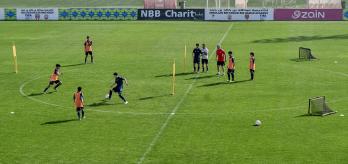
In this first exercise, the players focus on building play under pressure and progressing the ball in tight central areas. This in-game situation helps midfielders to understand how and when to create passing lanes and connect with a pivot player so that they can play from defence into attack.
-
Mark out a 25 x 15 m area.
-
Place two mini-goals at each end of the area.
-
In the centre, mark out a 4 m central zone.
-
Split the group into 4 defenders, 6 attackers, and 2 neutral players.
-
Place one defender in the end zone and one defender in the starting zone.
-
The remaining defenders wait inactive beside the area (rotate in as required).
-
Position the neutral player(s) inside the 4 m central zone.
-
Position two attackers in the starting zone.
-
The remaining attackers start beside the mini-goals.
-
The coach stands beside the area with a supply of balls.
-
The coach starts by passing to one of the two attackers in the starting zone.
-
The two attackers combine to play through to the opposite end zone, using the neutral player to help progress.
-
On entry into the end zone, they finish by scoring in either mini-goal.
-
Defenders are restricted to defending inside their assigned zones. If they win possession, they counter and score into the opposite mini-goals.
-
If the attackers lose the ball, they press immediately to regain it. Offside applies.
-
After a goal, the next pair of attackers at that end steps in and play restarts from the coach; rotate players regularly through all roles.
Coaching points
Part 2: Build and break through centrally
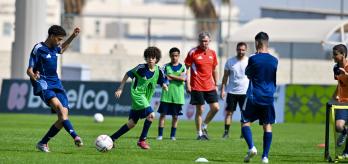
The second exercise progresses into a small-sided game in which the midfielders must focus on their ability to help build play by creating passing lanes or angles so that they can then link or turn and drive with the ball into attack. They must identify the most effective action to take, on and off the ball, so that they can execute the right solution for a fluent attacking progression.
-
Mark out a 40 x 22 m pitch.
-
Place a full-size goal at each end and position a goalkeeper in each.
-
Mark an 18 m central zone across the middle of the pitch.
-
Split the group into 4 attackers, 4 defenders, and 2 neutral players.
-
Attackers can use all zones, but stay in a 2–2 structure.
-
Defenders are split 2 and 2, with each pair restricted to their own half at all times.
-
Neutral players play freely as central midfielders.
-
Play starts with the goalkeeper.
-
In possession, create a 4+2v2 in the build-up, then play through the two neutral midfielders to progress into attack.
-
In the final phase, create another 4+2v2 and finish with a shot on goal.
-
Neutral players always play with the team in possession.
-
If the defending team wins the ball, they counter to score in the opposite goal.
Coaching points
The exercises are designed to promote a range of build-up solutions, with three progression patterns occurring most often. You can see these patterns below in the slider. That said, the exercises can be adapted to encourage and develop other build-up solutions, depending on the coaching objective.
Focused build-up solutions
Rate your experience