Learning platform
 en
en 


One way of achieving this is zonal defending, a collective defensive approach in which players' positioning is guided primarily by the position of the ball, the positioning of their teammates and the spaces they need to protect, rather than following individual opponents as the main reference for positioning.
Rather than requiring players to defend fixed areas, zonal defending is a dynamic process. As the ball moves, players continually adjust their positioning to apply pressure, provide cover and balance, protect space, and maintain compact distances within and between the defensive lines.
In this article, we explore zonal defending in the modern game through examples from teams competing at the FIFA World Cup 2026™ before introducing a practical methodology for developing the key defensive principles.
Zonal defending in the modern game
Presented from a tactical angle, the following video examples from the FIFA World Cup 2026™ highlight moments where teams apply principles of zonal defending across different defensive organisations and phases of the game.
A progressive methodology for zonal defending
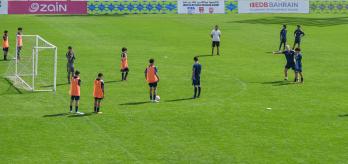
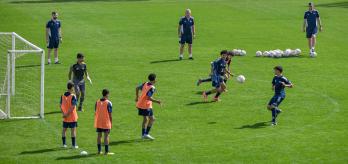
To develop players' understanding of zonal defending, coaches can use a progressive methodology that builds the key principles and concepts in stages:
- begin with the foundations of individual defending;
- progress to pressure, cover and balance in small-group situations;
- apply these principles within one, two and three connected defensive lines.
Although presented progressively, these stages should not be viewed as rigid or isolated steps. They are interconnected and complementary, allowing coaches to move between them according to the age, experience and developmental needs of their players.
Part 1: Individual defending
Before players can operate successfully within a collective defensive structure, they must first understand how to influence the attacker and protect space in 1v1 and 1v2 situations.

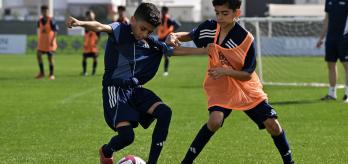
In 1v1 situations, defenders learn how to influence the attacker through effective positioning and decision-making. Players should recognise when to apply pressure, control the distance to the attacker, adopt an effective body position, direct play away from dangerous areas and identify the appropriate moment to tackle.
In 1v2 situations, defenders should learn how to manage numerical disadvantage while protecting space. The focus shifts towards delaying the attack, protecting central spaces, limiting clear passing or dribbling opportunities, and using effective body positioning to influence the actions of both attackers.
This stage allows coaches to:
-
Maximise repetition;
-
Set clear performance criteria and;
-
Refine quality and consistency of execution.
Its limitation is that it doesn't fully recreate the communication and relationships required within a collective defensive structure, which is why it must be complemented by the following stages.
Part 2: Small-group defending
Once players have developed effective individual defensive behaviours, the next stage is to defend in small groups. Working with teammates introduces the relationships and coordination required to defend collectively, providing the foundation for unit and team defending.
Defending in 2v2 situations introduces the relationship between the first and second defender. Players learn the responsibilities of applying pressure and providing cover, with the second defender supporting through appropriate distance and angle. Defenders must coordinate their positioning, maintain compactness and recognise when to delay, step in or prevent progression, while communicating effectively to manage the situation.
Defending in 2v3 situations develops players' ability to manage numerical disadvantages. The focus shifts towards delaying the attack, protecting central spaces and forcing play away from dangerous areas until support arrives. Players must remain composed, make intelligent decisions and recognise when to continue delaying or intervene.
Defending in 3v3 situations introduces the defensive triangle. Players learn how the first defender applies pressure, the second defender provides cover and the third defender provides balance by protecting space and anticipating the next action. The defensive triangle helps players remain connected, adjust collectively and limit or delay forward progression.
This stage allows coaches to develop communication, coordination and awareness between defenders. However, small-group practices may not fully recreate the complexity, the distances and defensive relationships found in the full game.
Part 3: Defending in units and across connected lines
The final stage of the methodology focuses on applying defensive principles within units and across the whole team. As practices become increasingly representative of match situations, players learn how coordinated individual and unit behaviours contribute to an organised and connected team defensive structure.
Defending within one line
Defending within one line introduces players to horizontal compactness and effective distances between teammates. As the ball moves, players learn to shift collectively, prevent gaps from appearing and recognise when the line should hold, step or drop.
Defending across two lines
Defending across two lines develops the relationship between units. Players learn to maintain vertical compactness, coordinate their movement as the ball travels and recognise how the quality of pressure on the ball influences the positioning of the supporting line.
Defending across three lines
Defending across three lines requires the whole team to operate as a connected defensive structure. Players learn to maintain compactness within and between the lines, recognise pressing triggers and adjust the team’s positioning collectively throughout the defensive phase.
Equally important is the team’s response during defensive transitions. When possession is lost, players must quickly assess whether immediate pressure can prevent the opposition from progressing or help regain the ball. If this is not possible, the priority is to recover into a compact defensive shape, regain positions and reconnect the defensive lines.
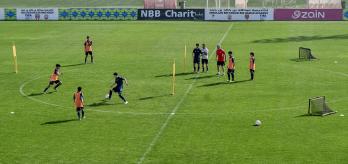
Repetitions of specific defensive situations are reduced, but game realism is increased. Coaches may need to simplify the practice or focus on specific defensive concepts before returning to the full team context.
Conclusion
The three stages of the methodology progressively develop players' understanding of zonal defending by increasing the complexity of the defensive task. Each stage builds on the previous one, enabling players to transfer individual defensive behaviours into increasingly coordinated team actions.
Ultimately, players learn how their positioning and decisions contribute to a collective defensive structure that protects space, maintains compactness and limits opposition progression.
-
One player → applying effective individual defending.
-
Small groups → coordinating pressure, cover and balance.
-
One line → coordination within a unit.
-
Two lines → coordination between units.
-
Three lines → coordination across the whole team.
Future articles in this series will demonstrate how these principles can be developed on the training pitch, progressing from individual defending to small-group defending and ultimately defending within connected team structures.
There was only one real tactical revolution, when football turned from an individual to a collective game. The thought of teaching eleven people to move as a single person is still giving me goosebumps.
Rate your experience