Learning platform
 en
en 


In the final, Brazil overcame Portugal 3-0 to seal an exceptional tournament in Manila, Philippines. The South American side coupled attacking prowess with defensive solidity, scoring 32 goals and conceding just four. Grace and sportsmanship underpinned their performances as they picked up the FIFA Fair Play Award along the way. Below, you can hear directly from Sabóia as he relives the preparation, training design and squad management that shaped Brazil’s campaign.
Pre-tournament: Squad selection, collective importance and the situational method
What did your 12-month lead-up to the tournament look like, and in what ways did your preparation help deal with unforeseen events in the Philippines?
Wilson Sabóia: First of all, I think we spent 36 months preparing. It was three years before that that the CBF really took charge of Brazilian futsal. So, we spent 36 months working with the 2025 World Cup in mind. In the final 12 months, we monitored 48 players: eight goalkeepers and 40 outfield players. Our performance analyst monitored them for ten months, analysing every technical, tactical and physical detail, and any injuries the players had had so that we could get things right when it came to making the final selection decisions.
There were some decisions that we only made in the final week, like whether to take two or three goalkeepers or two or three pivots. There were some things we were unsure about, but in the end, we chose to take two goalkeepers because we knew that with our style of play, we would have the ball most of the time and that we would likely concede only five or six shots on goal in each match.

So, we needed to balance attack and defence carefully. We felt confident we’d made the right choice in picking two outstanding goalkeepers, who are both very capable in goal and with the ball at their feet. That brought tactical variation to our game – variation in our 5v4 play, variation against low blocks and variation against the high press.
We started monitoring the 48 players in February 2025 and carried on through to 24 September, when we named the final squad of 14. Our main concern was with injuries. The risk of injuries was always there, but we didn’t get any serious ones. We took great care with our physical and technical planning, which began on 20 October, to reduce the risk of injury. Out of the 14 players we selected, only one picked up an injury during the tournament, a muscle strain, but our medical team felt she could recover with some physiotherapy, so she stayed with us through to the World Cup final on 7 December.
You mention that you looked at a group of 48 players, which is quite a large pool. What were the criteria for your final squad selection?
The main criteria we followed were technical, tactical, attacking, defensive, physical, behavioural and cognitive, which meant understanding the philosophy encapsulated by the DNA of the Brazilian national team. Most of the players had already been with us for a long time and therefore understood our style of play. Though we were training for 52 days together, we needed players who already embodied these attributes.
Of course, there were questions over certain positions, but experience, maturity and group cohesion were key. It wasn’t just a question of selecting a starting team but building a squad in which every player believed in the work we were doing. We also wanted winners, players who had consistently won titles at club level and with the national team, and who still had that desire to keep on winning. So, that’s what guided us in selecting that squad of 14.
Naturally, if you asked ten coaches to select their Brazil team, you’d probably get ten different squads, but we picked these 14 great players because we felt that was the technical and tactical criteria the Brazil team demanded.
How did you strike the right balance between team organisation and individual freedom?
Our team has a great deal of individual quality, players of the very highest calibre. However, we believe that individual actions must emerge from collective structures. Futsal is a team sport expressed through individual actions. In talking to the players, we realised that, at certain points in matches or training sessions, we would need individuals who could be direct. But it was much more important for us to have players who recognised that team aspect. Individuals can succeed, but only within a collective framework.
We had several phases of play in which individual players made an impact, but as part of collective actions. The last seven goals we scored – four against Spain and three against Portugal – came down to individual actions built on collective behaviours. All four outfield players were involved in the first goal against Portugal. Taty made the block, Amandinha carried the ball and played the pass, Ana Luiza held the ball up to create space between the lines, and Emilly ran in from out wide to finish.
Modern futsal is very much a team sport expressed through individual actions. And it’s important to understand that, although good attacking play can win a match, it takes a strong defence to win a tournament.
Modern futsal is very much a team sport expressed through individual actions. And it’s important to understand that, although good attacking play can win a match, it takes a strong defence to win a tournament. So, we placed enormous emphasis on defence. We had a naturally attacking team, but we needed the players to understand that defending was just as important as attacking. We scored 32 goals and only conceded four throughout the tournament.
We recognised that individual quality is important in futsal. We had to make sure our players understood that, because being a good player is about more than just getting the ball and passing it to a team-mate. The five players on the court have to make the right movements to give this player the chance to get past the opposition’s defence. We needed to make sure the players understood that. That was really important for us, because we were the most closely watched team at this World Cup. Every team watched us and tried to work out how to defend against us, how to double up on us. Every team did that.
But being a strong team has to be an essential part of our DNA. And emerging out of that is our individual talent, with Emilly, Amandinha, Débora, Taty and Ana Luiza. These individuals showed up, but within a collective framework. We kept telling them that good attacking play can win matches, but good defences win tournaments.
Each of the last seven goals we scored – four against Spain in the semi-final and three against Portugal – was a team move involving individual skills. All four outfield players played their role in the first goal against Portugal: Taty made the block, Amandinha carried the ball and played the pass, Ana Luiza held the ball up to create space between the lines, and Emilly made the run from out wide to get the shot off. All four players were involved in the move. We kept talking to them and showed them videos about positioning in training, telling them that the individual would appear at the right moment, but the team had to work as a collective. They had to be clever in attack and defend properly, with the intention of winning the ball back. And they understood that message.
What is the one rule that you never let anyone break?
It’s the rule of the team as a whole, the collective. We have players of the very highest quality, but my team cannot, under any circumstances, lose a player, fall apart or lose their balance. We have attacking principles. We analyse how the opposition set up defensively in certain situations, and we have to have initial structural principles so that we can be smart and know when to break down the opposition’s defence. The rule is to respect the team’s tactical and collective set-up, while giving the individual the freedom to make their contribution.
There will be times when individual players are decisive, but they will have cover in defence. If we lose the ball, we will have cover, not just one person but the whole team. So, that’s the rule: respect our DNA, give the players the freedom to be creative, encourage that creativity, but within a system, within a style of play. And that has been very clear in the Brazil team, where we have two preferred quartets: a more technical one and a more physical one. There will be times in games when things will be more physical and others when we need to be more technical, and we need to balance those quartets.
Our analysis found that the teams that took their chances were the ones that progressed furthest in the tournament. Could you share with us some of the ways in which you trained your team to be efficient in front of goal?
We use what we call the “situational method”, which means taking match situations and working on them in training. We did a lot of activities in a reduced playing area, like 2v2s, 3v3s, 4v3s, 1v1s, 2v1s and attack v. defence drills in a 15-20m area to work on our attacking play and finishing moves. I call it “terminal attack”.
It’s no good keeping the ball in your own half when you can only score in the final 10m. We need to put some moves together that will push the opposition defence back and allow us to finish attacks. So, we work on the situational method with a lot of 2v2s, 3v2s and 3v1s, and we do a lot of passing, breaking the lines and getting shots off. It’s hard to defend against an off-the-ball run. It’s easier to stop someone dribbling than it is to stop someone making a run off the ball.
It’s no good keeping the ball in your own half when you can only score in the final 10m. We need to put some moves together that will push the opposition defence back and allow us to finish attacks.
With some of the goals Brazil scored, the players off the ball were difficult to mark, whereas the player on the ball was easier to defend against. We wanted the players off the ball to move quickly, make runs off the ball, dribble and sidestep opponents to receive the ball in space. That was an essential part of our build-up play as a unit. We always referred to it as the “third element”. The first element is the pass, the second is the player receiving the ball, and the third is an extra element not involved in playing or receiving the pass. This third element normally goes unmarked by the opposition. The opposition usually focuses on defending against the first and second elements, but the third is the surprise element, and we have scored a lot of goals this way.
This was crucial because we organised our attack and, above all, when you organise the attack, you give thought to the defensive system. We work on duels so that our defence learns how to neutralise our attack, which was very strong. When we did duels in training, not many goals were scored because we had a really strong defence. If our defence was doing well, it meant that the attackers needed to find other solutions. We always told them, “We’re going to make it harder in training so that it’s easier in matches.” I make things challenging in training so that when it comes to a match, it’s easier for the players to work out how we’re going to play.
The way I see it is that, when I want to organise my attack, I look at the opposition’s defence. In Brazil, we call this the “mirror view”. By the time I come to organise my defence, I’ll know the opposition’s attacking strengths and tactical approach. With that in mind, we use those videos [of the opposition] to plan training sessions that will give the players the clarity they need to make the best possible decisions.
In-tournament: Squad management, feedback and goalkeeping
Could you share how you managed the team during the tournament?
Our preparations lasted 48 days, from the first training session until the final, on 7 December. The most important thing for me was making sure the spirit was good in the camp. If you create a good spirit, then it keeps the egos under control and stops players from wanting more playing time, wanting to stay on the court for longer in place of someone else.
We had several meetings to try and ensure that the environment and our physical, technical and tactical planning were in harmony with each other. I told the girls that the Brazilian national team’s greatest opponent was the Brazilian national team itself, and if people started to think about themselves rather than the team. That was what really concerned me.
We would meet with the players every three days, individually and in groups – goalkeepers, wings and pivots – to get their feedback and try to monitor what was going on cognitively, how training was going. The main idea, though, was to ensure the spirit was good so that they could complement each other on the court, both in terms of the cognitive aspect of the game and the atmosphere within the group. It’s very difficult to spend 50 days with 14 players at the very highest level of the game and not have any issues, any indiscipline, and that was crucial to us winning the tournament.
I think knowledge and science are very important, but if the spirit in the camp is not good, then you can’t achieve results, and the players were fantastic in that respect. They often put their egos aside to help their team-mates, knowing that the most important thing was the result; not their result on a personal level, but the result for Brazil. The players were brilliant in that sense. They understood our message, the coaching team’s message, the CBF’s message.
Everyone thought that winning the tournament was easy for us, but it wasn’t. I think what the coaching team and I did best was keeping that harmony within the group. We created a very relaxed environment, but one in which they could speak up and offer criticism, always in a respectful manner. That was crucial to us getting to the final and winning the inaugural World Cup.
The challenge is getting players to the point where they feel happy within the group. Would you agree with that?
That’s the big challenge, because in the Brazil team, we called up five or six players who were among the best in the world. Luciléia was one of the best in the world, Amandinha was one of the best in the world, Emilly was one of the best in the world, Camila was one of the best in the world, not to mention the others. Débora, for me, is one of the best in the world. You have six or seven players who are among the best in the world. How am I going to convince a player of that calibre to play for four minutes before I take her off?
They had to understand that, at any given moment, the team on the court was the one best able to execute the plan physically, technically and tactically. They understood this wonderfully well. We had no relationship problems in that sense. Why? Because we created a very relaxed, harmonious environment with players who wanted to win. That was crucial to our work and our eventual success.
You mentioned earlier that among your criteria for selecting these players was the fact that they were winners and were experienced. Could you explain why it was so important for you to have that experience in your team?
As I was saying, for example, Luciléia is 43. She has won everything: the Italian league, the Copa América, the World University Futsal Championship, everything there is to win. Amandinha has been voted the best player in the world eight times and Emilly twice. They’re used to winning. Sometimes players who win a lot become complacent. They start to think, “Wow, I’ve already won everything. I’ve won the Brazilian league, I’ve won the Italian league, I’ve won the Spanish league, the Portuguese league.” So, they can become complacent because they’ve won so much.
We knew these players individually, and we knew they wanted to be FIFA World Cup winners. When we spoke to them, their eyes lit up. They wanted that trophy. It was the one title that was missing from their careers. So, they threw their body and soul into everything – for themselves, of course, but mainly for Brazil. With the feeling that there is in the Brazilian national team – I’ve been with the team for ten years – and knowing the players in the women’s game – I’ve been working with women for 26 years – we know just how capable these players are when they’re focused.
Even after winning everything, they’re capable when they’re focused, and they were brilliant in every aspect of the game. That was crucial to our success.
Could you shed some more light on the importance of the keepers you have at your disposal and their importance in the way the rest of the team plays, both in and out of possession?
We were unsure whether to take two goalkeepers or three. Our view is that modern futsal needs a modern goalkeeper, so I can’t have a goalkeeper who only saves shots. Equally, I can’t have a goalkeeper who is only good with her feet. I have to have a complete goalkeeper. And we saw that in Bianca and Júlia, who were the two we took, that Bianca was the more experienced.
She was my third-choice keeper at the World Women’s Futsal Championship in Guatemala in 2015, and the experience she’s gained over the last ten years has been wonderful. She’s great between the posts, she instils confidence in the other players, and she’s very good with her feet. And Júlia has the same attributes. She’s very good with the ball at her feet, and she’s very tall, which is useful because teams tend to go aerial these days and bombard our goal. So, there were times when we needed to have a very tall keeper.
So, the coaching team and I, together with Alexandre, the goalkeeping coach, felt that these two keepers had all the necessary qualities in terms of being the fifth player, passing the ball, breaking through the defensive line with the ball at their feet, and leadership when we’re defending. Bianca is a leader, and so is Júlia. I believe they both have everything we want from a goalkeeper on and off the pitch, and the rest of the players respected them. Of course, it was a risk because you might lose a keeper to injury, and then we’d be left with only one, but I took that risk and thought it best to take two keepers and a pivot, because we’re a very attacking team. And it worked.
Both keepers did really well, and it worked out very well for us in that regard. We conceded four goals in six games, which is fewer than a goal a game. Of the four goals we conceded, two were deflections, one was from a set piece, and I can’t remember the other one. They were goals that the opposition scored on merit, and our keepers weren’t at fault for any of them.
Futsal is a very fast-paced sport, and momentum can shift quickly. What key feedback do you give your team when you have that precious time to talk to them, whether it’s at half-time or during a time-out?
The final was at 19:00 on the Sunday. We gave a talk to the team the day before, and then we trained on Sunday morning before the final. We call it a “live talk”. We show videos of all the opponent’s movements, strengths and weaknesses, so we can prepare the team. More importantly, all the players take to the court knowing what they have to do, which is crucial. For example, we closely marked the opponent’s fly goalkeeper. We conceded a goal – I think it was against Japan – when we were already 5-0 up. The shot came off the crossbar, hit Júlia on the back and went in. Our marking was very tight. And bear in mind that Portugal played with a fly keeper for 12 whole minutes and Spain for seven, and we didn’t concede a goal against either of them. It’s the quality of the work we do. It’s our defence. We had six players who could defend against the fly goalkeeper.
They already knew what they were going to do. They already knew the opposition’s strengths. What do I point out during a time-out or at half-time? During a time-out, I talk about defence first. I always like time-outs, whether I call them or the opponent calls them, because I can organise my defence, point things out or bring in a player who can offer us more.
I always like time-outs, whether I call them or the opponent calls them, because I can organise my defence, point things out or bring in a player who can offer us more.
Let’s take Portugal, for example. A lot of their play revolves around the pivot. So, we always point out that, when the ball is on the right wing, our player on the opposite wing has to drop back to double up on the opponent’s pivot to prevent the pass. So, we go back over some of the things we’ve worked on in training, and then we talk a little bit about attack. If there’s any criticism to be made, we do it collectively. We don’t criticise any individual players, unless I take that player aside and talk to her one-to-one. I don’t like to expose players in front of the others. When I have criticism to make, I do it at a team level.
If a player struggles during a game or does something we haven’t trained for, we call them over to give them some information. At half-time, I think it’s essential to work on the cognitive aspect, to ask some questions. “The opposition are hitting a lot of aerial balls. How do we cope with it?” Then I point to the player, to Débora, for example: “Coach, we deal with it by closing off the opposite wing.”
Then I ask some questions, but within the group, so that we can reflect on that information, because it’s no use just having the coach talking and the players looking at the floor. I have to include the players in this. So, we ask a few questions, prioritising defence first, and then I organise my attack. I always like to talk about defence first and then attack.
We also had a different set-up for every situation in a game. Let me give you an example. When the other team had a free kick near the area, I had four players organised to defend it. If we had a free kick, I had four specific players organised for it. I had a specific team set up for defending against a fly keeper. As you said in your question, the game is very dynamic. So, if it’s dynamic, I need to have the most dynamic players and team on the court, the one that will be best equipped to perform. And, of course, in training, we visualised this, and the players knew, on the court, who was going to mark the fly keeper and who was going to mark the opposition’s best player. That way, we were able to limit the problems we faced as best we could.
Looking ahead: Setting a legacy for the future
What do you think are the most important lessons for your team coming out of this new competition as champions? Also, following on from that, what are some of the most important lessons for the sport of futsal as a whole?
Wow, if I knew the answer, I’d be a Nobel Prize winner! First of all, I think the most important lesson, as you said, is that we have seven or eight players over the age of 34 or 35. What that means is that only one or two of them might be at the next World Cup in 2029. So, a legacy for us would be to try to create a group of winners to follow on from this wonderful group. It’s a four-year project that’s all about giving opportunities to new players looking to come through, who are technically and tactically skilful, who understand the style of play, and who are winners too.
We became world champions, which is wonderful, but now we have to look ahead to the next generation. We won’t have the same players, because in four years’ time, some of them will be 42 or 43 years old, and we don’t know how they’ll be performing. So, we need to create a culture, work with the U-23s, U-20s and maybe U-25s, with players who have developed the cognitive skills, who know how to make decisions, who are winners, who are the standout players at their clubs in terms of results and visibility, so that we can give them opportunities.
But not everyone who puts on that yellow shirt is able to perform. Players who often perform for their clubs can struggle when they get into the Brazilian national team. We have to create this culture to integrate these players into the group over the four years we have until the World Cup in 2029. And futsal keeps on changing all the time. I think the main change is up to us, the professionals, coaches and sports managers, because when things are managed well, in this case by CBF and, in particular, FIFA – the World Cup was wonderfully organised…
We have to dive deep into the science, into new teaching methodologies, try to understand how modern futsal is taught, a game that, as you said, is totally dynamic in terms of thinking and performance.
The CBF provided us with all the logistics, food, everything. The CBF didn’t put a foot wrong, and their heads of futsal gave us all their support too.
If we have competent managers and professionals working with clubs’ youth systems, developing new players, we have to do even more training to understand the methods we’re going to use to teach these new players. We have to dive deep into the science, into new teaching methodologies, and try to understand how modern futsal is taught, a game that, as you said, is totally dynamic in terms of thinking and performance. We have to turn the game into something beautiful, which is what we saw with the Brazilian national team.
That all takes time, though. So, we need managers, qualified professionals, alongside the coaching team, and above all, we need top-quality players. That combination of managers, professionals and players is the future of futsal, not just in Brazil, but worldwide: growth in Argentina, growth in Portugal, Spain, Eastern Europe, Asia, Oceania and Africa – the game is growing quickly in Morocco too. These are countries that we need to encourage even more. We need the USA, Germany, England, countries that want to invest in futsal, because it is such a beautiful game. And this is essential for the development of the sport, from grassroots through to the elite.
Winning a World Cup is a rare feat. But winning the first World Cup is even rarer. Could you share what that feels like for you and your players?
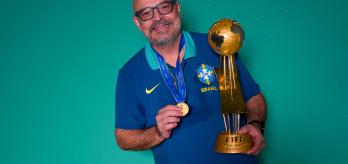
*Holds up medal* I’m not going to let go of it. It’s been in my bag since I won it, and I take it with me wherever I go. This FIFA medal will stay with me for the rest of my life. Many teams will go on to win the World Cup, but Brazil were the first to do it, and the first one is here, which is the most beautiful thing, a wonderful achievement of ours. You don’t win anything individually; you only win as a team. I told the girls that winning is important, but we needed to win ethically, respecting our opponents.
We won the FIFA Fair Play Award. We committed the fewest fouls and received the fewest cards. That’s fundamental. We respect our opponents in victory and defeat. That’s fundamental because it means we are always on the side of good people. I think that the essential thing, even though we got the result, is knowing how to win. There’s no point in winning just for the sake of it. I have to know how to win. I have to know how to lose, too.
So, wherever I go, I am proud to show, not my work, but the work of the Brazilian national team and the work of the organisations that have ensured women’s futsal keeps on growing. FIFA showed their vision in holding this first World Cup, and I am sure that others will follow. I’ll try to win the second one, but the first one is ours – it belongs to Brazil.
Rate your experience