Learning platform
 en
en 


In futsal, every technical action is intimately linked to a tactical intention. The tactical intention depends on the context of the game, and is influenced by aspects such as the location of the ball, distances, angles, opposition strengths and weaknesses, and much more. All factors are key to a goalkeeper’s perception and action cycle.
When their team is out of possession, play is in their defensive third, and there is a risk of an attempt on goal, a goalkeeper will typically need to navigate one of the following two types of situations:

Each situation is complex, demanding different goalkeeping behaviours and coordination with team-mates. Shots come from a wide variety of locations on the pitch. Additionally, the environment between the attacker making the shot and the goalkeeper is also complex, with some saves being made with direct pressure and others with no pressure at all. FIFA’s Performance Insights Team can categorise the pressure a goalkeeper faces at the time of their intervention (see figures below) into three types: direct pressure, where the attacker has a clear view on goal; indirect pressure, where a nearby defender can influence the shot; and no pressure, where a defender blocks the striker’s clear view of the goal.
At the first edition of the FIFA Women’s Futsal World Cup, most goalkeepers are showing their ability to scan, recognise and differentiate between these two crucial game situations. The following article reveals exemplary technical and tactical behaviours demonstrated by several of the goalkeepers at the tournament.
Defending the goal
A goalkeeper should defend the goal when the opponent takes a shot from medium or long range. To prevent goals being scored in these scenarios, an effective goalkeeper response consists of three aspects: optimal positioning, body orientation and posture.
Spain’s Cristina Garcia – positioning
The standout element of this clip is the positioning prior to the stop; the goalkeeper should manage their distance to the ball. Maintaining a sufficient distance (vertical positioning) gives them time to clearly perceive the ball’s trajectory and react accordingly. In this moment during Spain’s game against Canada, García initially anticipates a potential 1v1 situation with a Canada attacker, and comes out towards the edge of the D. Once it’s clear that there are Spain defenders between her and the opponent, she retreats backwards towards the goal line, where she has a solid view to make the save.
Portugal’s Ana Catarina – body orientation and posture
In this example from Portugal’s quarter-final against Italy, Catarina (1) uses exemplary body orientation and posture to perform an impressive double-save. Ahead of the first shot, the Portugal goalkeeper’s posture is balanced, with both feet firmly on the ground and parallel, allowing her to react quickly to the shot that goes through her defender’s legs. She directly thinks of the consequence of her save – a key phase in goalkeeper interventions – and gets to her feet quickly, orienting herself towards the ball and giving herself the best possible chance to make the second stop.
Defending the goal area
The opposition will often manage to break through a goalkeeper’s defence and find themselves one-on-one with the goalkeeper. In these moments of the game, where none of the goalkeeper’s team-mates can prevent the shot, the goalkeeper must act as the last line of defence and defend the goal area – commonly referred to as the “D”. There are two key aspects a goalkeeper needs to consider during these moments: distance management and blocking shape.
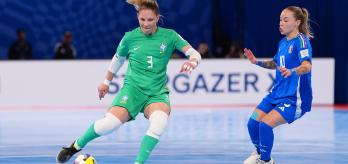
Brazil’s Bianca – distance management
In this clip, Brazil goalkeeper Bianca (2) offers a prime example of the importance of distance management when defending the D. Different from when defending the goal, the aim of the goalkeeper when defending the D is to be as close as possible to the ball in the moment the shot is taken. Bianca comes right to the edge of the D, reducing the angle and space available to the IR Iran player taking the shot and significantly increasing the goalkeeper’s chances of success.
Japan’s Nene Inoue – blocking shape
In scenarios when coming out to defend the D, the shot will typically be taken from a position close to the goalkeeper’s body. It’s unlikely the goalkeeper will have time to react because of this proximity. In this clip from her side’s tightly contested group-stage encounter with Portugal, Japan’s Inoue (1) demonstrates why a goalkeeper’s primary intention in these moments is to block rather than catch or deflect the ball.
As the Portugal attacker breaks through the defence, Inoue darts towards her with a knee-slide block. Japan’s goalkeeper keeps her arms close to her side, making her body silhouette as compact and large as possible, avoiding any gaps through which the ball can come through. She successfully positions her body between the ball and the goal line (as close as possible to the ball) to block the shot.
Developing intelligent goalkeepers
An intelligent goalkeeper isn't characterised by aesthetically pleasing technical actions or by performing textbook saves, but rather by analysing, interpreting and understanding each situation to give an appropriate, adapted and effective response. This is applicable when defending space inside and outside of the penalty area.
It is the responsibility of coaches to offer goalkeepers these scenarios rich in specific stimuli that arise from the game during their training and practice sessions, with the greatest possible similarity to the game, to encourage a level of adaptability that allows them to be effective when playing. This is instead of more repetitive, isolated technical training, which can lack relevance to the game.
Final preview
Rate your experience