Learning platform
 en
en 


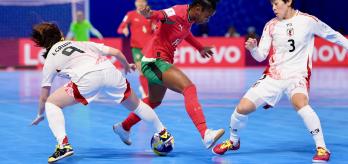
In this article, Technical Study Group (TSG) experts Rajaa Chatah and Tihana Nemčić Bojić explore why collective understanding and complete skill sets are essential to elite performance. Drawing on action from the FIFA Futsal Women’s World Cup™ – a tournament they are currently observing in the Philippines – the pair reveal how the two aspects provide the foundations for team adaptability.
Key take-aways
-
Players with complete skill sets, possessing advanced technical, tactical, physiological and psychological competencies, are impressing the TSG at the FIFA Futsal Women’s World Cup.
- In addition, teams that are harnessing various levels of tactical synchronisation are producing emphatic performances at the tournament.
-
Complete players and synchronisation form the basis for adaptability – a crucial trait of teams progressing deep into tournaments.
Developing complete skill sets through game-based training
In elite futsal, players require a level of technical ability to execute tactical actions on the pitch. At the Youth Olympic Futsal Tournaments in 2018 – the last time the TSG observed a female futsal competition – one of the main findings from the group was that teams were attempting to deploy tactical plans without the prerequisite technique. Now, in the Philippines, several participants are showcasing technical excellence, serving as an ideal standard for those striving to reach the pinnacle of the game.

What defines a complete player goes further than technique, explains Chatah, who is an AFC Futsal Elite Instructor and Women’s Futsal Development Supervisor at the Saudi Arabian Football Federation.
“The teams performing well as a collective are all similar in the sense that they possess complete players. These are players with all the ‘trainables’: the technical, tactical, physiological and psychological elements. They possess the essential physical and cognitive qualities, such as speed, strength, mobility, aggression, agility, reaction, decision-making and awareness. All these elements feed into their technical and tactical execution. The completeness of their players is how top teams differ from the rest of the field.”
How can players reach this level of ability? Adopting a training methodology that immerses players in game-based scenarios plays a crucial role in this holistic development, explains Nemčić Bojić, who is also currently the head coach of Croatia’s Women’s Futsal Team.
Training exercises aren’t put together in isolation – they always have a tactical, game-related context.
“Even with the warm-up protocols, you can see top teams like Japan and Brazil adopt exercises that are within the context of the game. The exercises selected by the coaching staff already expose their players to moments they will encounter in the upcoming match. This is also reflected in the way they train. Their training exercises aren’t put together in isolation – they always have a tactical, game-related context. In the broader picture of talent development, technical foundations need to be laid up until 10 or 12, but then after that, players need to apply their skills within the context of space and time witnessed in matches,” adds the Croatia manager.
Instilling different levels of synchronisation within a team
Shifting the focus from individual ability to awareness of cooperation among more than one player reveals another aspect of performance that the top teams at the FIFA Futsal Women’s World Cup are exhibiting.
For Nemčić Bojić, there are three levels of synchronisation within a team, in both the attacking and defending phases of the game. Each can help solve problems posed by the opposition in different ways:
-
Individual– what a player does by herself (e.g. a take-on to bypass a defender and shooting when in possession, and tackling, intercepting and proper marking when out of possession). Players with great individual skills are valued as they can resolve certain situations in the most efficient way.
-
Group – what two or three players do together (e.g. an underlap, overlap, block, parallel or diagonal pass). This level of synchronisation opens up numerous solutions to the problems encountered in a match.
-
Collective – what a team does (e.g. rotations depending on the attacking system, block or press defending, zonal or player-to-player marking). This is the highest level of cooperation – one that requires all players to be synchronised.
The Assistant Professor at Zagreb University goes on to explain, “Once players learn that these levels exist and the applicability of each in game-play, then they begin to understand how to recognise what the situation requires, and they carry out the action instinctively without further need to verbalise their intention. A coach won’t need to make the command; the players will see the opportunity to apply these solutions themselves. If players are not aware of these group-level solutions, they are destined to apply individual solutions to these problems, which is not easy.”
“When you look at the passing and receiving of the ball between two players. The way they pass is the way they say something. It’s their communication. Just like we communicate by speaking and listening, players communicate on the pitch by passing and receiving. I would say this communication between the two, who have a relationship, is a crucial one because once they learn this relationship, they don’t have to think anymore – it happens intuitively.”
Tactical flexibility – the outcome
What emerges when strong individual skills align with a shared collective framework? Together, these elements enable a team to do two things exceptionally well:
-
Operate within a clearly defined playing style.
-
Adjust that style in response to the specific challenges posed by each opponent.
This adaptability becomes even more valuable in major tournaments like the World Cup, where teams encounter opponents with vastly different tactical approaches from around the globe. As Chatah notes, deep progression in such competitions often depends on how effectively a team can handle this diversity.
“It comes down to the team’s creativity on the pitch and their capacity to generate new solutions when unfamiliar problems arise, both within a game and from one game to the next. In a tournament, you face a wide range of opponents, so the ability to adapt to every scenario is essential.”
Chatah and Nemčić Bojić both reiterate that the adaptability prized by coaches depends on a combination of individual skills and collective awareness. This combination allows players to read the game more deeply and more often, putting them a step ahead of the opposition. The best teams are synchronised to such an extent that every player sees the exact solution to a given situation without speaking – a shared, intuitive understanding built over time with game-based training.
Rate your experience