Learning platform
 en
en 


In the Philippines, the team of elite futsal coaches and experts that formed the Technical Study Group (TSG) worked closely with FPI to analyse the tournament. Below, the TSG present four key observations underpinning the futsal played at the inaugural tournament, highlighting areas for future player and team development. The observations cover the following areas: finishing efficiency, ball regains, powerplays and tactical periodisation. This piece forms part of a wider post-tournament analysis, featuring an FPI overview and an interview with the tournament’s winning coach, Wilson Sabóia:
-
Part 1. TSG’s key observations – In part one, the TSG list the key observations from the tournament, highlighting potential areas for development.
-
Part 2. The FPI overview – The second part branches out into an empirical overview of the competition, covering topics in and out of possession.
- Part 3. Interview with Wilson Sabóia – Finally, Brazil’s head coach answers several of the TSG’s questions on campaign preparation, squad management and tactics.
Observation 1: Shot‑on‑goal efficiency is integral to tournament progression

The four semi-finalists, plus Italy, each progressed as far as they did because of their shot-on-goal efficiency. It was a key component as to why they were so successful in the competition. Being clinical and capitalising on goalscoring opportunities when they arise, whilst carving out those chances that have a higher probability of success by careful possession and risk assessing the impact of lost possession in-play, is key to success. You not only need good technicians to achieve this, but players with sound game understanding and an innate ability to scan when holding the ball or creating the deadly passing line – and this is the key area for development. If possession in the attacking phase is surrendered too easily by a misplaced shot or an inaccurate intercepted pass, the outcomes will be very different.
Observation 2: Belief characterised diverse ball-regain behaviours
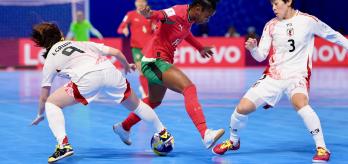
At the FIFA Futsal Women’s World Cup in the Philippines, ball regain felt like something you could sense rather than calculate. Watching the top teams, there was clear discomfort whenever possession was lost. No hesitation, no reset – just an immediate reaction, as if being without the ball was simply “unacceptable”.
Teams like Brazil and Spain turned this mindset into a real competitive edge. Brazil were calm and clever, often winning the ball back before the opponent even realised they were under pressure. They were ruthless in the way they regained the ball. They didn’t always sprint to press, but they closed passing lines early, read the next option, and forced opponents into mistakes. Very often, the ball was won back before the opponent even felt pressure. Spain expressed the same hunger in a different way. They hunted in packs, squeezing space, and forced rushed decisions, pressing higher and compressing space with collective movement.
The best teams don’t wait to defend – they hunt the next pass. When that hunger is collective, ball regain becomes inevitable.
Portugal were different. Their intention to regain the ball was clear, but they relied more heavily on tackles to regain possession. This made their regains more physical and sometimes less efficient, arriving later in the action. Still, the readiness and collective reaction after losing the ball were always present, underlining how strong this mindset has become at the top level, even when execution varies.
What linked these teams was belief. Losing the ball triggered a shared response. The best teams don’t wait to defend – they hunt the next pass. When that hunger is collective, ball regain becomes inevitable.
Observation 3: Powerplay is a key area for development
Teams at the FIFA Futsal Women’s World Cup scored a total of six goals during power play and conceded 10, suggesting that these moments are key areas for development. Five of the six goals from these situations, and many of the attempts (65), were generated by close-range finishes within the final third. Long-range shots (<10m) did not achieve the desired result for the attack, and only one goal was scored from the 40 long-range attempts.
The powerplay’s use was practically limited to moments in matches where the team was losing, and the opposition did not have an urgent need to recover the ball, allowing them to simply focus on defending the spaces in the final third of the pitch. These contexts significantly reduce the chances of success. Defence prevails over attack, and no team managed to come back and win a game through a power play.
Faster is not always more effective. Sometimes attracting a defender’s attention is as important – or even more so.
To exploit the power play, teams should first understand the game state (time remaining and the scoreline), as it conditions the power play’s tactical behaviour. When in a power play, teams should position themselves with width and depth to stretch the opposition and create space. Precise and patient search for numerical and/or spatial advantages is then needed to exploit weaknesses in the opposition. Faster is not always more effective. Sometimes attracting a defender’s attention is as important – or even more so – than circulating the ball with speed. In addition, teams in power play need to use overloads to open passing lines and destabilise the defensive block. When done effectively, these situations become indefensible.
Then, to score, it’s crucial to create different finishing options, with multiple passing lines in each attack. This both increases the probabilities of scoring and decreases the risk of conceding, as having more genuine passing options means there’s less need to execute a riskier pass. If a team loses possession during a power play, good pressing over the ball and even a tactical foul can help deny a long-range shot on goal.
Observation 4: Warm-up protocols and tactical periodisation support clear playing styles
Several teams, especially the ones that progressed far into the competition, had clear warm-up methodologies that corresponded to their game model in all the phases of the game. It is important that all teams in elite futsal have these warm-up protocols, designed within a tactical periodisation framework, to help contribute to the unified, clear and consistent playing style. By integrating technical, tactical, physical and cognitive elements specific to the game model, warm-up protocols become not just physical preparation but an extension to the tactical training.
By integrating technical, tactical, physical and cognitive elements specific to the game model, warm- up protocols become not just physical preparation but an extension to the tactical training.
These structured warm-ups reinforce collective principles of play, decision-making patterns, and team coordination, ensuring players enter competition already aligned with the intended style of play. Consequently, tactical periodisation-based warm-ups enhance tactical coherence, game identity and performance consistency at the elite level. In the modern era of sports performance, this is the only logical way of training philosophy, considering the game itself is never in isolation from different factors, but always a fusion of everything at the same time. Thus, in training and during the warm-up before the game, the contents should always include elements of tactical periodisation.
Rate your experience