Learning platform
 en
en 


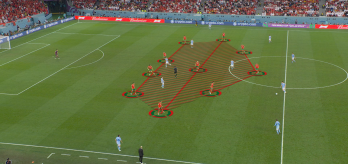
France finished runners-up at the FIFA World Cup Qatar 2022™, losing on penalties in the final after a dramatic 3-3 draw, in which Mbappé scored a hat-trick. The France forward ended the tournament with eight goals, securing the adidas Golden Boot, and provided two assists, underlining his importance in France’s attacking output. Les Bleus head coach Didier Deschamps set out to maximise the impact of his most decisive player in Qatar by designating Mbappé with a specific ‘rest attack’ role. While the more commonly known term ‘rest defence’ refers to how teams structure their players in possession to anticipate and control defensive transitions, France applied the same principle in reverse, preparing their counter-attack threat before regaining the ball, using Mbappé as their primary reference point in attacking transitions.
By design, Mbappé maintained a high and wide position during France’s out-of-possession phases, with limited defensive responsibility. This designated rest attack role provided France with a clear, immediate outlet on regains, increasing the speed and clarity of counter-attacks while also creating favourable attacking conditions tailored to Mbappé’s key attributes, such as his acceleration and deceleration, 1v1 prowess and shooting ability. His advanced positioning allowed him to receive against disjointed backlines and isolated defenders, often closer to goal or with space to exploit, conditions that are more difficult to generate during possession phases against organised defensive structures. At the same time, it posed a constant dilemma for opponents, who had to balance committing players forward with maintaining defensive cover against the persistent threat of Mbappé in transition.
Key Insights
-
Collective preparation supports faster and more efficient counter-attacks: Mbappé’s role ensured France were collectively prepared for attacking transitions while opponents were typically disorganised defensively, allowing quick progression either through direct passes into Mbappé or space created by his advanced positioning.
-
Enhance counter-attacking momentum through wide, forward-facing positioning: As teams prioritise central protection in defensive transitions, more space is often conceded wide. Mbappé’s role exploited this through wide orientation, allowing him to receive forward-facing and accelerate directly towards goal.
-
Impose a strategic dilemma on opponents with a constant counter-attacking threat: Mbappé’s advanced positioning out of possession forced opponents to balance committing players forward with maintaining defensive cover. This resulted in either reduced attacking numbers or increased vulnerability in transition.
Example 1: Engineering high-quality (counter-)attacking situations
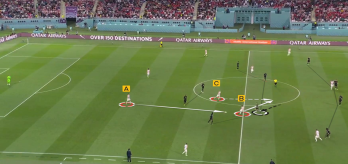
This first example, from France’s group stage match against Australia at the FIFA World Cup Qatar 2022™, shows how Mbappé’s rest attack role engineered a 1v1 opportunity within 30 metres of goal, a scenario that would be more difficult for France to generate during a settled possession phase. With limited defensive responsibility, Mbappé maintains a high and wide position out of possession.
This positioning means that when France regain the ball, he is ready to exploit exposed space in attacking transitions, creating favourable conditions suited to his strengths. The France forward receives forward-facing and in space, as opponents prioritise central protection, allowing him to counter-attack with momentum against a retreating and disjointed opposition defensive line.

Example 2: Counter-attacking threat from any defensive phase
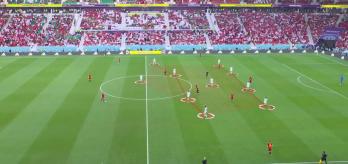
Our second example, from France’s 2-1 group stage victory over Denmark, highlights how Mbappé’s rest attack role provided France with a counter-attacking threat from any defensive phase. In this instance, even when defending deep, Mbappé’s advanced positioning created two key advantages for France.
Nearby opponents were forced into a dilemma: advance to support the attack or stay back to maintain defensive cover, which also limited Denmark’s counter-pressing effectiveness due to fewer players being able to compress space around the ball. At the same time, it created space for a team-mate to carry forward following the regain and exploit gaps created by opponents’ preoccupation with Mbappé.
Like in the previous example, when the France forward receives the ball, his wide and forward-facing orientation gives him a full view of play, allowing him to assess his options and increase the speed and efficiency of the counter-attack, ultimately leading to a goal.
Example 3: Purposeful counter-attacking actions towards a pre-defined target
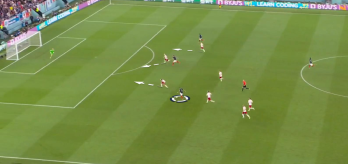
This example, also from France’s match against Denmark, illustrates how Mbappé’s rest attack role gave France a consistent reference point when regaining possession. Deschamps’ tactic went beyond providing an outlet for pressure relief; it focused on collective intent in attacking transitions, creating opportunities to move from defending their own box to generating a shooting opportunity within moments.
With Mbappé maintaining a high and wide position out of possession, defenders were able to clear more purposefully rather than aimlessly, directing the ball towards a target area, with the added benefit of reducing the risk of central turnovers from longer clearances due to Mbappé’s wider positioning. This transformed defensive recoveries into the first action of a coordinated counter-attack, allowing France to act proactively in typically chaotic transitional moments.
Example 4: Prioritising defensive security over counter-attacking potential
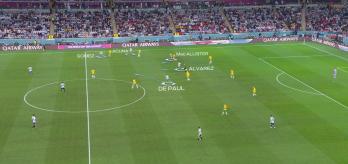
This final example, from France’s 3-1 round of 16 win over Poland, highlights an alternative approach to the rest attack role and the trade-offs it presents. With France protecting a 1-0 lead, Mbappé drops deeper to support left-back Theo Hernández, helping to prevent a potential overload. This defensive action, however, comes at the expense of France’s immediate counter-attacking threat.
Without Mbappé as an advanced reference point, progression is instead directed through central areas, where centre-forward Olivier Giroud receives under pressure with his back to goal, while Mbappé’s deeper positioning increases the distance he has to cover to support the counter-attack; together, these factors slow the attacking transition and allow opponents time to recover.
Final note
France’s use of a designated rest attack role demonstrates a more nuanced and strategic approach than simply leaving a player high out of possession. France accepted the defensive trade-off of committing fewer players behind the ball in order to prepare their counter-attacking threat before possession was regained.
By pre-organising their attacking transitions through a clearly defined rest attack role and shared intentions, France reduced hesitation in typically chaotic moments. Mbappé’s wide, forward-facing positioning contrasted with centre-forwards receiving under pressure with their back to goal, often requiring a backward pass before progressing. This allowed France to counter-attack more quickly, either through direct passes into Mbappé or team-mates exploiting the space his advanced positioning created, while also generating favourable attacking conditions suited to Mbappé’s strengths.
Crucially, this approach also imposed a constant dilemma on opponents, shaping how they balanced risk and protection throughout the game and influencing their behaviour even when transitions did not occur, offering further potential advantages for France.
Rate your experience