Learning platform
 en
en 


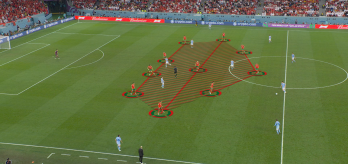
While third-player combinations are a familiar concept – often described as ‘up, back and through’ – Croatia’s interpretation under Zlatko Dalić included important distinctions and situational variations that made their execution particularly effective. Rather than relying on automatic patterns, their midfield unit adapted each action based on pressure, spacing and opponent behaviour.
Central to this approach was the experienced midfield trio of Luka Modrić, Marcelo Brozović, and Mateo Kovačić. Within this structure, Modrić frequently assumed the role of the second player, moving deliberately towards the ball to attract pressure and, crucially, to create space behind him. The primary objective was not simply to connect passes, but to exploit the space created and progress play.

In a traditional ‘up, back and through’ sequence, Modrić would receive and set the ball back to a supporting team-mate, who would then play forward. However, Croatia often eliminated this additional pass. Instead of laying the ball back, Modrić would look to flick the ball on first time – or after a minimal touch – to a supporting team-mate (typically Brozović or Kovačić) advancing beyond him. This allowed Croatia to access the space behind the midfield line more directly, with the third player already receiving on the move, facing forward and able to immediately carry or progress play.
Crucially, the execution of these combinations depended on the behaviour of the defender marking Modrić. When tightly pressed, he would use a first-time flick; when given slightly more space, he would take a controlling touch to draw the opponent in before releasing the third player. This highlights the importance of perception, timing and coordination – the action was not pre-determined but continuously adapted.
As such, Croatia’s third-player combinations should be understood less as a passing pattern and more as a principle-based tool for creating and exploiting space under pressure.
Key Insights
-
Deliberately attract pressure to create space for progression: Croatia use movements towards the ball to draw opponents in and create space beyond the pressure.
-
Adapt the second action to accelerate or control tempo: By choosing between setting the ball back, flicking first time, or taking a touch, Croatia adjust the tempo and effectiveness of the combination.
-
Solve problems collectively when the third player is denied: When opponents block access to the third player, Croatia’s midfield adapts through movement and positional rotation to create alternative solutions.
Example 1: Traditional solution within the structure
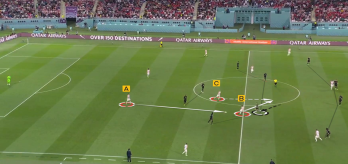
Our first example, from Croatia’s group stage match against Belgium at the FIFA World Cup 2022™, illustrates how Croatia use a third-player combination in the build-up phase to break the opponent’s first line of pressure and initiate progression.
By playing short from the goalkeeper towards one side, Croatia draw Belgium’s high block forward and across before finding Modrić in central midfield. Dropping from a higher position, he receives under pressure, deliberately attracting his marker and creating space behind him.
In this instance, Croatia opt for a more traditional solution, with Modrić laying the ball off to Brozović before progressing forward. This provides control of possession while still enabling them to exploit the space created.
Example 2: First-touch flick under tight pressure
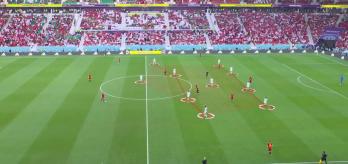
In this second example, from Croatia’s 4-1 group stage victory over Canada, we see a more dynamic variation of the combination.
As Lovren steps forward to play into midfield, Modrić again drops towards the ball, attracting a tightly marking defender and creating space behind him. This space is immediately attacked by Brozović.
With the defender fully committed, Modrić plays a first-time flick into the path of the advancing third player, bypassing the need to set the ball back. This allows Croatia to break the midfield line immediately and accelerate the attack, with Brozović receiving on the move and already facing forward.
Example 3: Delayed execution to manipulate space
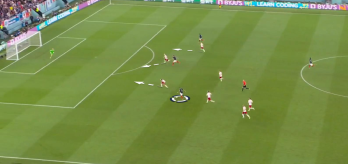
In our third clip, also from Croatia’s win against Canada, we see how the same principle is applied in the final third, with a variation in execution.
Against a deeper defensive block, Croatia circulate possession to draw the midfield line forward while the back line holds, creating space between the lines. Modrić again moves towards the ball, but this time his marker applies less immediate pressure.
As a result, rather than playing first time, Modrić takes a controlling touch, drawing the defender in before releasing the third player into the space beyond. This delayed action improves the timing of the combination and allows Croatia to attack the defensive line more effectively.
Example 4: Collective adaptability in the moment
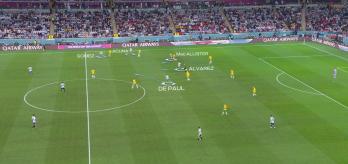
This final example, from the second half against Belgium, demonstrates Croatia’s ability to adapt when the third-player option is not available right away.
The sequence begins in a similar way, with Croatia building short and finding Modrić between the lines. However, Brozović – the intended third player – is tightly marked, preventing the direct continuation of the combination.
Recognising this, Brozović vacates his position, drawing his marker away and creating central space. This movement allows Modrić to turn and progress play through an alternative route, illustrating how Croatia maintain the underlying principle of creating and exploiting space even when the original option is blocked.
Final note
Across all four examples, the unifying principle is clear: Croatia use Modrić’s movement to attract pressure and create space, but how they exploit that space depends on the specific defensive situation they face.
This ability to combine shared principles with situational flexibility is what makes their use of third-player combinations both distinctive and highly effective. Crucially, Croatia’s midfield quality, particularly Modrić’s awareness and execution under pressure, was central to the effectiveness of these actions.
Rate your experience