Learning platform
 en
en 


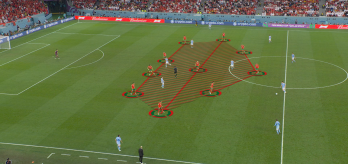
Morocco became the first-ever CAF nation to reach a World Cup semi-final at Qatar 2022, defeating both Spain and Portugal in the knockout rounds before finishing fourth. Central to the Atlas Lions’ success under Walid Regragui was their ability and willingness to consistently control games without the ball. Despite having less possession in six of their seven matches, Morocco kept four clean sheets. Their tactical approach was built around a highly organised mid-block, and of the 32 teams at the tournament, they spent the greatest proportion of out-of-possession time in this phase. Through their defensive structure, Morocco consistently restricted access to central areas, preventing direct progression towards goal and guiding opposition play into areas where they could apply pressure on their terms.
Key Insights
-
Dictate opposition attacks by denying central progression: Morocco prioritised blocking central passing lanes, screening receivers between the midfield and defensive lines, and maintaining compact distances between units. This funnelled opponents towards wider areas or into more difficult central progression attempts, slowing their tempo and increasing predictability. This enabled Morocco to anticipate, prepare, and coordinate their defensive actions.
-
Coordinate ball-side defensive actions to maintain central protection: By funnelling opponents wider, Morocco increased the frequency of defending sustained attacks on the flanks, demanding coordinated actions from the ball-side winger, central midfielder and full-back. This unit adjusted continuously in response to the ball, opponent positioning, and available cover, applying pressure while prioritising central protection, with roles interchangeable to maintain team structure.
-
Maintain an active mid-block through conditional pressure on the ball: Morocco managed the defensive trade-offs of their out of possession approach by maintaining an active mid-block. They engaged the ball only when unit support and cover were in place, using shared cues to determine when to press, and doing so only when it did not risk exposing central channels. When these conditions were not met, they prioritised maintaining their defensive shape.
Defining a mid-block
A mid-block involves a team without the ball compacting its defensive lines both horizontally and vertically, while holding a collective position in the middle third of the pitch. The primary intention is to deny central progression, forcing opponents into lower-risk wide or deeper areas or into congested central areas. From these situations, pressure can be applied to regain possession or limit forward progression. The accepted trade-offs of this out of possession strategy include conceding space elsewhere, often in front, behind and outside the team’s defensive shape.
Example 1: Dictating opposition build-up
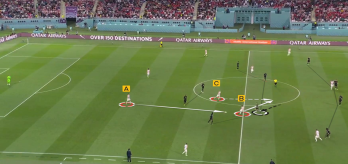
Our first example, from Morocco’s group stage match against Croatia at the FIFA World Cup Qatar 2022™, illustrates how Morocco use their mid-block to dictate opposition build-up and control where the game is played. By allowing Croatia centre-backs Dejan Lovren and Joško Gvardiol to progress into the middle third before engaging, Morocco establish their 4-1-4-1 defensive structure, with coordinated unit roles directing possession away from central areas through screening passing lanes and applying pressure.
This clip highlights how central access is prioritised and protected, funnelling play towards the flanks, while coordinated movements within the ball-side unit ensure pressure can be applied without compromising central coverage. It also demonstrates how this approach creates favourable conditions for regaining possession in advanced areas and initiating counter-attacks into space.

Example 2: Territorial control without possession
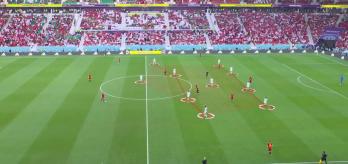
This example, from Morocco’s 2-0 group stage victory over Belgium, highlights how their mid-block enables them to gain territorial control without possession. By consistently prioritising central protection, Morocco direct Belgium to recycle play backwards and wide through sustained pressure on the ball, pushing them further from goal and reducing their attacking threat. The clip demonstrates how coordinated pressing, supported by compact team movement and cover, dictates the direction of play, allowing Morocco to control territory and game momentum without needing to win the ball immediately. We join the action following a prolonged spell of Belgium possession in front of the Morocco mid-block.
Example 3: Coordinated ball-side unit defending
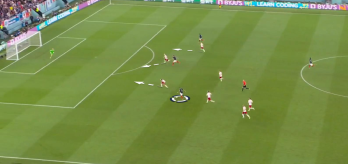
This clip, from Morocco’s round of 16 match against Spain, illustrates a recurring pattern in their defensive system: the coordinated pressing scheme of the ball-side unit against wide attacks. As Spain are guided towards the flanks, the ball-side central midfielder, winger and full-back apply coordinated pressure while maintaining central protection. This is initiated by the centre-forward, who uses his cover shadow to block access into the opposition’s deepest midfielder, before the ball-side central midfielder jumps to press the centre-back in possession, limiting central progression, while the winger holds a deeper, narrower position to provide cover inside. When the ball is played wide, the winger engages and the central midfielder recovers to restore central protection, ensuring pressure does not expose central spaces.
This unit is supported by the wider team, with the centre-forward, defensive midfielder, and ball-side centre-back shifting across to provide cover, allowing Morocco to consistently defend the ball-side half with up to six players, while the four remaining far-side players maintain horizontal compactness and coverage against switches of play. This example highlights how unit-level organisation and wider team support sustain Morocco’s control through coordinated, anticipatory defensive actions.
Example 4: The importance of pressure on the ball
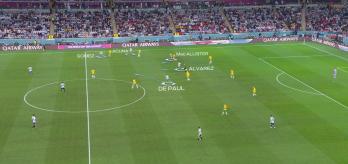
This example, also from Morocco’s match against Spain, highlights the importance of pressure on the ball within their defensive system. While their mid-block maintains compactness and protects central areas, it concedes space in front and behind and therefore relies on timely engagement from the ball-side unit to limit the opponent’s ability to play forward. When this pressure is delayed or absent, the intention is for Morocco’s defensive line and goalkeeper to recognise this trigger and prepare to respond by limiting space behind the defensive line, with defenders dropping deeper and the goalkeeper prepared to sweep if necessary. Here, delayed pressure allows Spain to play over Morocco’s defensive line, illustrating how reduced pressure increases the likelihood of the mid-block being exposed. This contrasts with Morocco’s usual approach, where conditional pressure limits time and space, forces rushed decisions and technical errors, and restricts progression through or beyond the block.
Final note
Morocco’s defensive approach at Qatar 2022 demonstrated that conceding possession does not mean a team is passive; when structured and intentional, it can be used to impose control on the game. Their mid-block was highly organised, designed to deny central progression, direct play into wider areas, and create the conditions to apply pressure in situations they are prepared for. Rather than engaging constantly, Morocco used coordinated positioning and selective, well-timed pressure to reduce the opponent’s time and space, increasing the likelihood of errors and regains in advanced areas, creating favourable conditions to transition quickly into attack. This collective discipline and clarity of roles allowed them to anticipate and manage opposition attacks, maintaining defensive stability while dictating the game on their terms.
Rate your experience