Learning platform
 en
en 


Argentina were victorious at the FIFA World Cup Qatar 2022™, defeating France 4-2 on penalties following a 3-3 draw in the final. Head coach Lionel Scaloni was credited for adapting his side’s tactics throughout the tournament, changing systems and personnel depending on the opponent and game state. One tactical aspect which remained a consistent feature, however, was Argentina’s utilisation of ball proximity in possession. During attacking phases, Argentina players frequently moved towards the ball carrier. This collective intention to approach the ball created favourable conditions for a range of advantages to emerge in possession, allowing players to adapt their actions based on both team-mate and opposition behaviour and reducing reliance on predetermined attacking patterns.
Key Insights
-
Use ball proximity as an organising principle in possession: Argentina players frequently used the ball location as a primary reference point for support movements and positioning in possession, rather than strictly maintaining predefined positions within their attacking structure or relative to the opposition’s defensive formation.
-
Create emergent advantages in possession through proximity-based interactions: Through proximity, Argentina increased the frequency and quality of player interactions, enabling a range of attacking actions and combinations to emerge while drawing opposition attention and forcing defensive decisions that could be exploited.
- Ball proximity provides a platform for immediate regains: Argentina’s ball proximity functioned as both an attacking and defensive mechanism. When possession was lost or became contested, players were already close to the ball, allowing an immediate and coordinated reaction to regain quickly without significant structural adjustment.
Example 1: Using team-mate proximity as a platform for coordinated interactions
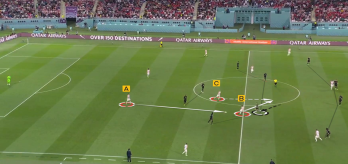
Our first example, from Argentina’s group stage victory over Mexico at the FIFA World Cup Qatar 2022™, shows how ball proximity created the conditions for coordinated interactions between nearby team-mates, leading to an emergent advantage in possession. While some players maintained width and depth, Argentina’s midfield trio and Lionel Messi, who at times formed a fluid central diamond, moved both individually and collectively towards the ball.
This reduced distances and created multiple passing angles around the ball carrier, drawing opposition pressure and facilitating quick pass-and-move combinations in tight central areas. This provided the platform for players to combine in the moment, with Messi timing a forward run to exploit space beyond the Mexico midfield line and Alexis Mac Allister recognising it to play into his path, allowing Argentina to bypass pressure and create an attacking situation.

Example 2: Establishing control through close connections
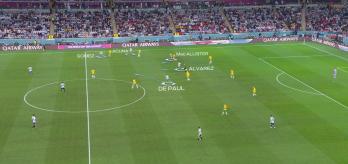
Our second example, from Argentina’s group stage match against Australia, illustrates how ball proximity supported periods of control through sustained possession and close player connections. As Argentina switch play to their left flank, multiple players move towards the ball-side to provide the ball carrier with immediate nearby passing options. When the initial aerial duel is lost, Argentina’s proximity to the ball and each other reduces their recovery distances. This allows Argentina to immediately win the second ball, sustaining the attack and maintaining pressure in Australia territory.
Argentina’s ball-side concentration then draws the opposition across in numbers, creating space on the far side. Rather than exploiting the weak-side, however, Argentina play back inside, where more players are positioned in close proximity, creating greater opportunities for faster ball circulation and stronger counter-pressing security. Through quick one- and two-touch combinations, Argentina retain possession, manipulate opposition positioning, and ultimately win a free-kick in Australia’s half.
Example 3: Influencing opposition behaviour through ball proximity
This third example, from Argentina's 3-0 semi-final victory over Croatia, highlights how ball proximity influenced opposition behaviour and created opportunities to exploit resulting spaces. Following a high regain, Argentina players moved towards the ball to secure possession after the turnover, establishing close passing connections around the ball carrier and enabling quick one- and two-touch combinations under pressure.
The speed of Argentina's play, combined with frequent changes in direction and angle, encouraged Croatia players to shift towards the ball, helping disrupt their defensive organisation. Argentina then progressed through central areas before attacking a retreating defensive line with a quick pass-and-move combination involving diagonal actions, played against the momentum of opposition pressure, to generate a close-range shooting opportunity.
Example 4: Creating attacking advantages through deliberate positioning and spacing
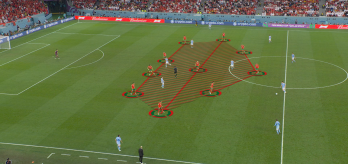
This final example, from Argentina’s group stage victory over Poland, demonstrates the tactical flexibility within their possession phase. Previous examples highlighted how Argentina used ball proximity in possession to create close passing connections and coordinated interactions around the ball. In this sequence, however, Argentina players maintained more fixed positions relative to their own attacking structure and Poland’s 4-4-2 defensive formation.
Argentina’s left-back advanced high and wide, their advanced midfielders occupied spaces between the lines, and their forwards pinned the opposition backline high and narrow. While this asymmetric shape was a recurring feature, the more deliberate and fixed player positioning within the team structure, alongside frequent movements away from the ball carrier, posed different defensive dilemmas for the opposition and added further variation and unpredictability to Argentina’s attacking play.
Final Note
At Qatar 2022, Argentina demonstrated how ball proximity can function as an additional organising principle in possession. With players frequently moving towards the ball carrier, Argentina reduced distances between team-mates and increased nearby support around the ball. This created favourable conditions for combination play, coordinated off-ball movements, and adaptable attacking interactions to emerge in response to both team-mate and opposition actions, reducing reliance on predetermined attacking patterns.
Ball proximity also helped Argentina sustain attacks through quicker circulation and opportunities for immediate regains. Alongside periods of more deliberate player positioning and spacing, Argentina's flexibility and variation increased the unpredictability of their attacking play, making their actions more difficult for opponents to anticipate and defend against.
Rate your experience