Learning platform
 en


The session commences with the skill development phase, where he focuses on the core skills and behaviours that will become the golden thread throughout the session, focusing on high repetitions in small-sided, focused exercises. He then moves into larger playing areas with more players in the progression phase, where the skills and behaviours remain the focus, but scenarios become more realistic and decision-making oriented. Finally, they move to the game phase where the players test how their learning transfers to the game.
Key coaching points of defensive organisation
-
Speed of approach
-
Slow down/deceleration
-
Body shape to make opponent predictable
-
Touch tight (close enough to win the ball)
Key coaching points of attacking transition
-
Look forward
-
Play forward
-
Run forward
SKILL DEVELOPMENT PHASE

The session is multi-faceted, moving from one game phase (defending) into another phase (attacking transition). As a result, Jennings introduces players to early concepts of the skill development phases before the session starts to build clarity and understanding. He starts by focusing on defensive organisation skills and behaviours, as players need success here before they can learn the attacking transition phase.
The skill development phase has three evolutions (or variations) and focuses on high repetitions with constraints that restrict problem-solving, realism and decision-making.
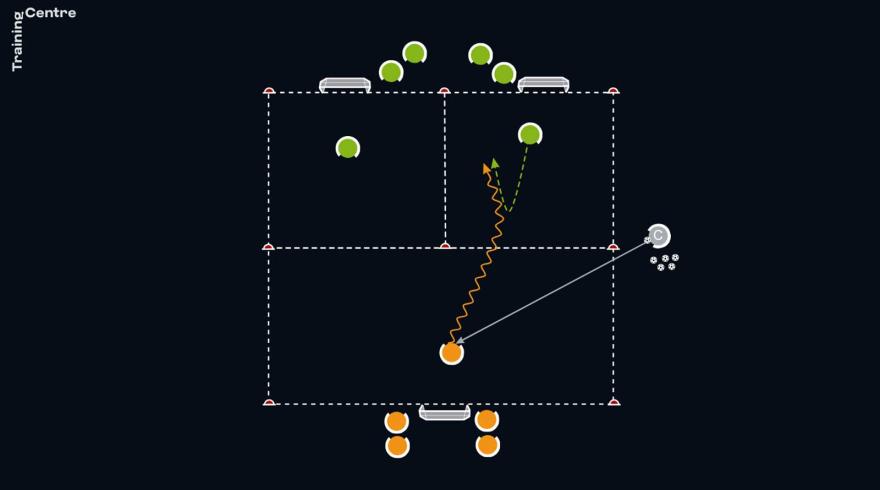
In the first variation, an attacking player (orange in graphic) receives the ball and tries to beat the defender and score in either of the two mini-goals. The defender meanwhile tries to stop the attack, win the ball back and score in the opposite goal. In this exercise, the coaching focuses on how the defending player presses.
Constraint:
The attacking player receives the ball from the coach and chooses their 1v1, attempting to score in the mini-goal.
Incentive:
The defending player tries to stop the attack, win the ball back and score in the opposite goal.
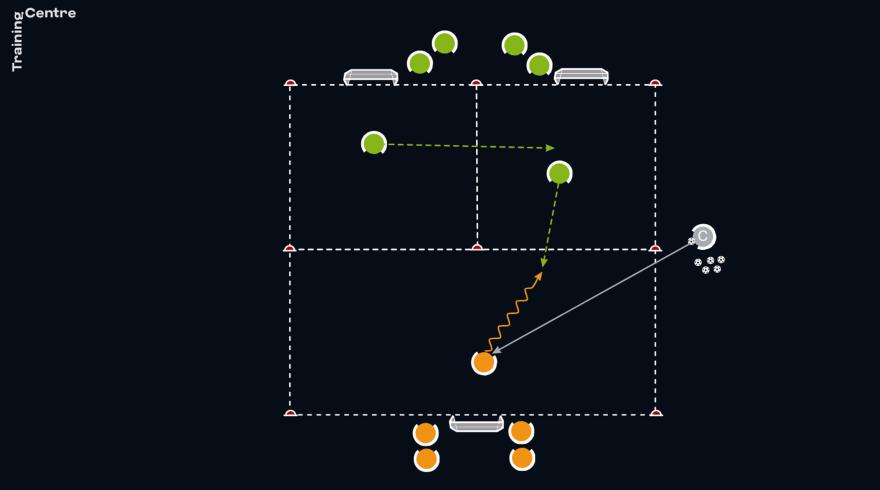
In this variation, a fast approach to press is rewarded with the introduction of a second covering defender. The coaching focus is on pressing and covering.
Constraint:
The attacker must dribble past the defender to score. The defending player tries to stop the attack, win the ball back and score in the opposite goal.
Incentive:
If the defender presses quickly enough to pressure the attacker before the attacker crosses the white line, a second covering defender is introduced.
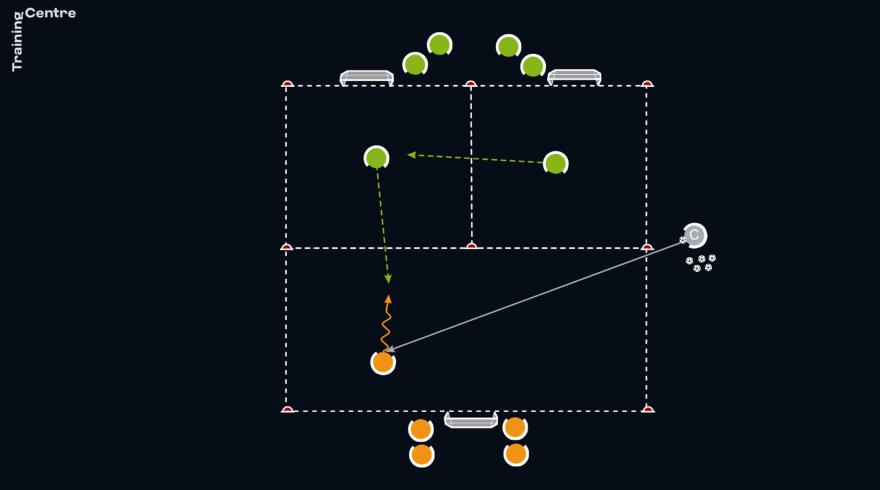
This variation introduces decision-making, as players must choose who presses and who covers based on where the attacking player engages with the ball.
Constraint:
As the session develops, the constraints change. The attacking player attacks the defender on the side of the pitch where they receive the ball, so defenders must decide who presses and who covers based on where the ball is received.
Incentive:
-
Attacker dribbles and scores = 2 pts
-
Defender wins ball and scores = 3 pts
Viewing the exercise through the four lenses
This phase of the session focused on the key skills of pressing, covering and transitioning to attack for the defenders. For the attacking player, the task of going 1v1 against one defender with a second covering defender made it difficult to succeed, but they had the incentive to counter-press if they lost the ball and score themselves. The repetitions were high, while the third part of this phase introduced an element of decision-making.
Coach’s reflection on skill development phase
The skill development phase had three evolutions, firstly focusing on the defensive organisation before the transition to attack was added. The exercise commenced in 1v1 scenarios before becoming a 1v2, with defenders focused on pressing and covering in order to win the ball back and score. This part of the session involved high repetitions to develop the skill and behaviours in constrained conditions, with less problem-solving, realism, and decision-making.
PROGRESSION PHASE
The progression phase introduces players to scenarios with more players and a larger (constrained) playing area, increasing problem-solving, decision-making, and realism. The constraints of players being restricted to their zones help to ensure that players continue to be exposed to scenarios that demand the execution and behaviours required when pressing and covering in defensive organisation in order to win the ball back and score. In this phase, repetitions decrease, but the complexity of the scenarios increases.
The progression phase of this session features two variations. The first is an 8v3 where the three defenders press from the direction attackers are facing. The second is an 8v5 introducing two extra defenders that press from behind attackers, increasing the challenge for the players on the ball.
This phase builds relationships and communication between players as they navigate the decision-making processes of who is the nearest player to the ball who must press, while also solving the problem of who must cover and at what distance and angle.
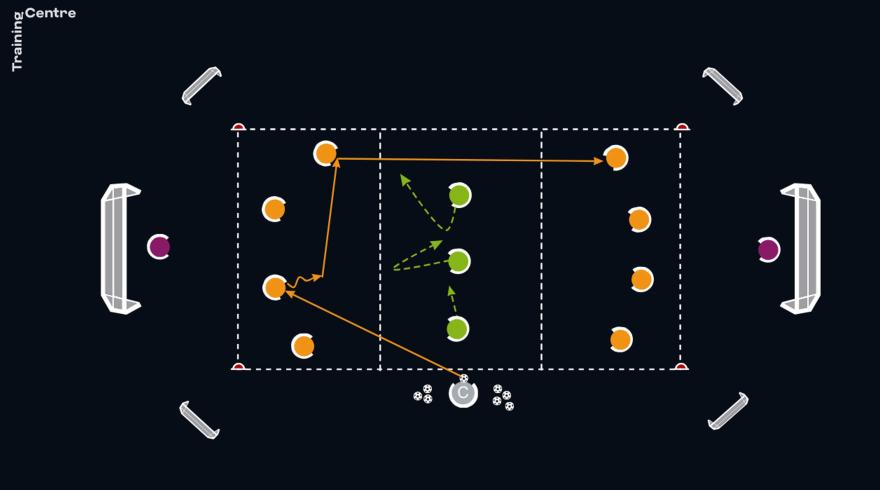
Rules:
The orange team passes through to the opposite orange team while the green team press and cover, practising defensive organisation to win the ball back and transition to attack by attempting to score in one of the mini goals or the large goals.
Constraint:
All players must stay in their zones unless they win the ball and advance to score.
Incentive:
-
Score in mini goal = 1 pt
-
Score in big goal = 3 pts
This phase increases realism, problem-solving, and decision-making by adding end-zone green players. It helps build relationships and communication as players navigate decision-making about who is nearest the ball and must press, while also deciding who must cover and at what distance and angle.
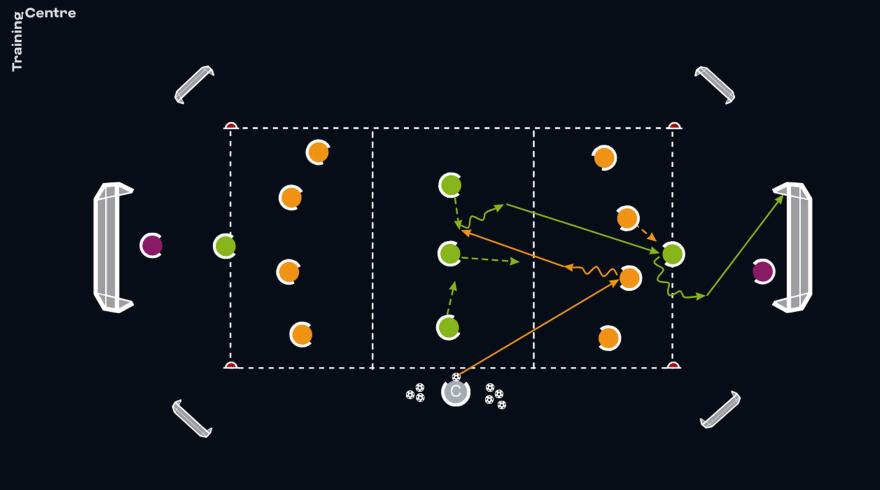
Rules:
The orange team passes through to the opposite orange team, while the green team presses and uses defensive organisation to win the ball back and transition to attack by attempting to score in one of the mini goals or the large goals.
Constraint:
End zone players are released and can pressure orange players from behind, increasing realism. Other players must stay in their zones unless they win the ball back and initiate a transition to attack.
Incentive:
-
Score in mini goal = 1 pt
-
Score in big goal = 3 pts
Viewing the exercise through the four lenses
This exercise increased the emphasis on problem-solving and decision-making for the defending players, while it was lower for the attacking players, who had higher levels of unrealistic repetitions. The defending team's repetitions also remained quite high, creating multiple opportunities for coaching.
Coach’s reflection on progression phase
The progression phase focused on defensive organisation between three players, challenging them to decide who was nearest the ball and responsible for the press. Once a player initiated the press, the others needed to assess threats and provide cover and/or balance at the right distance and angle to prevent the ball from being played through or around them. As repetitions decreased, the intention in this part of the session was to increase problem-solving and realism.
Game phase
As constraints around restricted zones are removed and the playing area increases, the game phase becomes more realistic while staying aligned with the session’s golden thread of transitioning from defensive organisation into attack. In this part of the session, defending players’ decision-making and problem-solving are in the spotlight, as they face multiple roles and responsibilities in defensive organisation within quick succession. However, winning the ball back or stopping the attack is not enough; they must immediately switch focus to scoring as soon as they turn over possession.
This level of cognitive training closely matches in-game scenarios and aligns with the principles the coach wants the team to play. The conditions were also demanding for the players, which is good exposure for their development.
The orange team tries to play through from one goal to the other and score. Green team work collectively and in a defensively organised unit to prevent the ball from progressing through the lines by pressing, covering and balancing in their defensive organisation. If/when they win the ball back, the immediate focus is on playing forward to score.
Constraint:
All in, but the middle three defenders must stay connected as a unit when defending.
Incentive:
-
Score in mini goal = 1 pt
-
Score in big goal = 3 pts
Viewing the exercise through the four lenses
This part of the session is closest to the game and demands a higher level of decision-making, realism, and problem-solving than the previous two phases.
Coach’s reflection on the game phase
With increased decision-making and problem-solving demands, this level of cognitive training closely matches in-game scenarios and aligns with the principles the coach wants the team to exhibit. The conditions were also demanding for the players, increasing physical fitness and game conditioning.
Rate your experience