Learning platform
 en
en 


The session starts with the “skill development” phase, moves into the “progression” phase, and finally into a “game” phase. The three components are intentionally designed to create multiple learning opportunities for players to practice the skill in constrained conditions before increasing their exposure to realistic, game-like scenarios. Each exercise encourages the development and execution of skills and/or behaviours that relate directly to the team’s key playing principles.
Key coaching points
In the session, Jennings targets three actions that help players receive the ball under pressure. Although the environment that players execute these actions in changes, the emphasis on the actions remains consistent throughout:
-
Scan early – to understand where the pressure is coming from
-
Body shape to receive – that allows protection of the ball
-
Angle/movement to receive – that creates space to turn forward and attack the goal
SKILL DEVELOPMENT PHASE

At the outset, Jennings clearly outlines the session objectives to the players, gaining buy-in by explaining why receiving under pressure and retaining possession leads to winning more games. Crucially, he also sets expectations, giving players licence to try until they learn how to succeed.
“I want to have you in a stressful but supported environment. We want creative players, we want risk takers. So receive the ball, try it; if it doesn’t work, no problem. You will get another chance to keep trying it, that’s how you will develop.”
The skill development phase has three evolutions (or variations) and focuses on high repetitions with constraints that restrict problem-solving, realism and decision-making:
In the first variation, players receive the ball under pressure, before turning and beating the defender in 1v1.
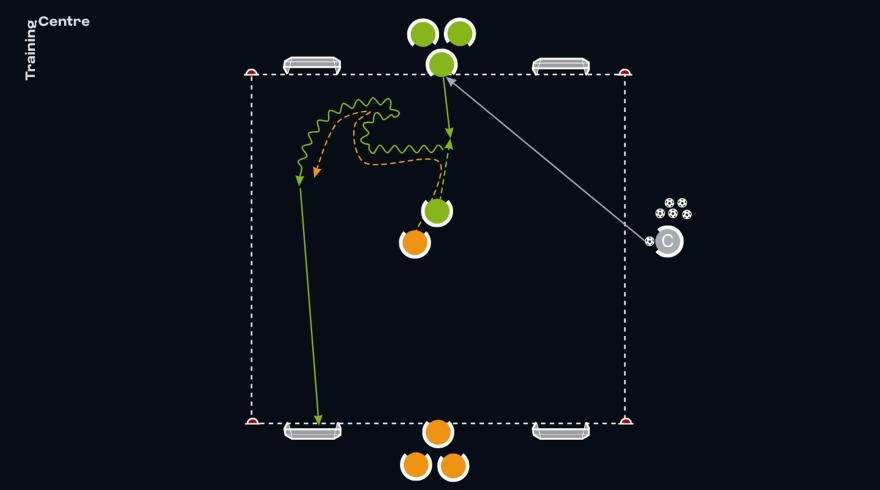
Constraint:
- Must turn to score
Incentive:
-
Attacker turns and scores = 2 pts
-
Defender wins ball and scores = 3 pts
In variation 2, players receive under pressure, before turning and scoring in a mini-goal for 1 point or the big goal with a goalkeeper for 3 points.
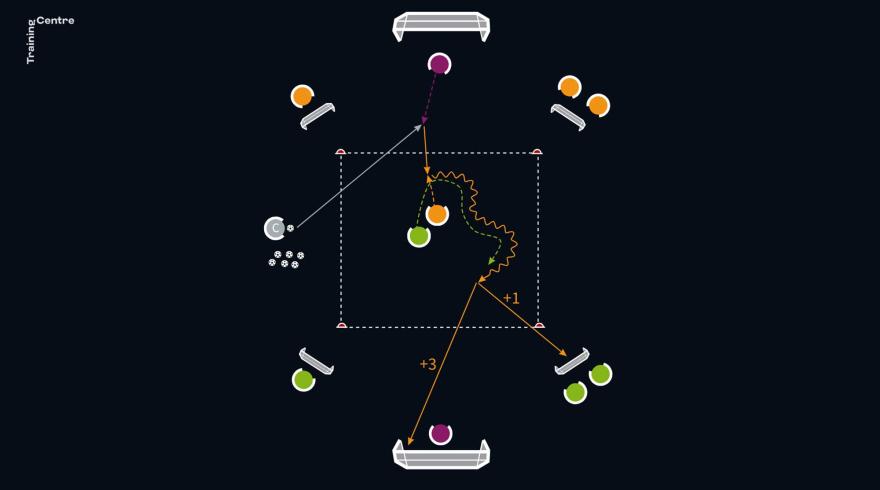
Constraint:
The playing area increases for 1v1, and players have more scoring options, increasing decision-making. Play starts with the coach playing the ball to a goalkeeper, who plays it to the attacker. They must receive under pressure and attempt to score in one of the mini goals or the big goal. The increased options give them more learning opportunities about how to receive, recognise where the pressure is and decide how and where to score.
Incentive:
-
Attacker scores in mini goal = 1pt
-
Attacker scores in big goal vs goalkeeper = 3pts
-
Defender wins ball and scores = 3pts
In the last variation of the skill development phase, players receive under pressure before deciding to go 1v1 or utilising the option of bringing in a second attacker (which triggers a second defender) to create a 2v2 scenario.
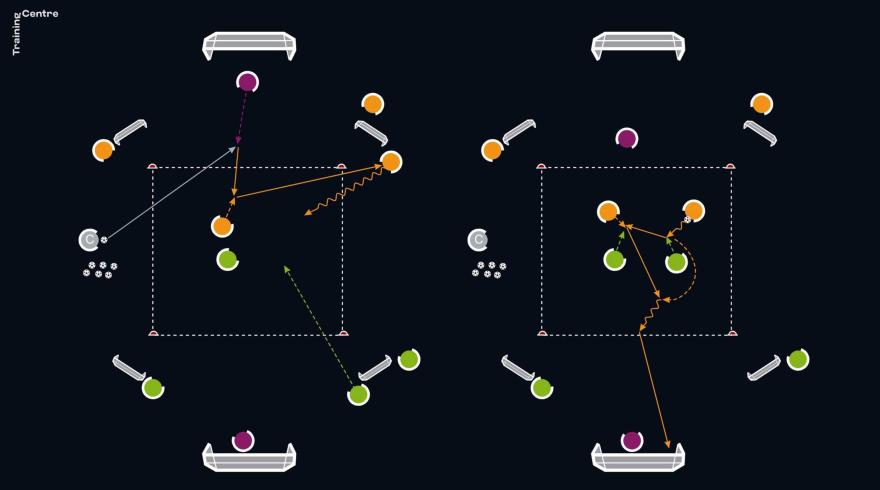
Constraint:
The play starts with the coach playing the ball to a goalkeeper, who plays to the attacker. They must decide between receiving under pressure and staying 1v1 when attempting to score in one of the mini goals or the big goal. Or, when they first receive from the goalkeeper, they can bring a second attacker into the game by playing back to them, which also triggers the release of a second defender ahead of the ball. The increased options give them more learning and decision-making opportunities about whether to progress in a 1v1 or bring in a second player. Repetitions remain high, but decision-making and realism are starting to increase.
Incentive:
-
Attacker scores in mini goal = 1pt
-
Attacker scores in big goal vs goalkeeper = 3pts
-
Defender wins ball and scores = 3pts
Viewing the exercise through the four lenses
This phase focused on the skill itself. For the attacker, the skill being honed is receiving under pressure and taking on the opponent. For realism, defenders are incentivised to mark tightly, win the ball back and score. The attacker is repeatedly exposed to receiving under pressure in constrained circumstances, but in exercises that start to introduce scenarios that involve problem-solving and decision-making. Repetitions are high throughout.
Coach’s reflection on skill development phase
The skill development phase had three evolutions and focused on high repetitions to develop the skill and behaviours, with constraints that restricted problem-solving, realism and decision-making.
PROGRESSION PHASE
The progression phase introduces the group to scenarios involving more players, increasing problem-solving, decision-making and realism. However, this part of the session still includes deliberate constraints that create the desired learning opportunities. The narrow grid and zonal restrictions condense the space, therefore ensuring that when players receive the ball, they are likely to be under pressure. In this phase, repetitions decrease, but the complexity of the scenarios increases.
This phase focuses on building trust between players so they can confidently play into a teammate under pressure, while also building confidence in receiving players to show desire and willingness to receive the ball under pressure.
Constraint:
The playing area is intentionally narrow to ensure that, as players attempt to progress the ball through the thirds, the receiving player is under pressure. They will have the option to turn after receiving and go 1v1 to progress the ball into the final third, or they can opt to play back, retaining possession like in the 2v2 scenario of the skill development phase.
Incentive:
-
Attacking team plays through thirds without playing backwards = 5pts
-
Defenders win ball back and score = 5pts
Viewing the exercise through the four lenses
This exercise increases the emphasis on problem-solving and decision-making as players attempt to play through the thirds in tight spaces under pressure. Repetition naturally decreases for players with the larger-scale set-up and increased number of players.
Coach’s reflection on progression phase
The progression phase focused on building trust between players to play to a team-mate receiving under pressure, and on building confidence in the receiver to show willingness and appetite to receive the ball when marked or pressed by an opponent. While repetitions decreased, the intention in this part of the session was to start to increase problem-solving and realism.
Game phase
The game phase sees realism and decision-making increase as most constraints are removed. This brings the game back to the players and allows them to evaluate, think and decide about how best to respond when receiving under pressure in different game scenarios that occur more organically. While repetitions decrease further in this phase, their cognitive processes and game awareness increase, which in turn should start to transfer into their performance on match day.
-
The pitch remains narrow to ensure players receive under pressure
-
When a team is without the ball, its players are confined to their zones.
-
Players on the in-possession team are free to move through all zones.
-
Additional players could also be added (positioned outside the grid, on the halfway line and conditioned to one-touch) to increase decision-making
-
The wide players can only receive the ball in the attacking half.
-
If a team scores through central penetration (not using the wide players) = 3pts
-
If a team scores through central penetration (using the wide players) = 1pt
-
If a team scores through central penetration (without playing back or wide) = 5pts
Viewing the exercise through the four lenses
The final exercise is closest to the game. Problem-solving and realism are higher than in the previous two exercises. Naturally, with a freer playing environment (and more players where applicable), this game-related scenario places the least emphasis on repetition of all three exercises in the session.
Coach’s reflection on the game phase
The coaching intention behind the game phase was to create a game scenario that would increase the demands on the players to make decisions and problem-solve in more authentic game-like situations. Repetitions decrease further in this phase, but realism should increase.
Rate your experience