Learning platform
 en
en 


Having developed outplaying through technical work and non-directional positional games, Beale now introduces small goals to give players clearer attacking and defending direction.
This Box Game brings many of the qualities developed throughout the series into a competitive small-sided environment. Inspired by the freedom and spontaneity of street football, players are encouraged to express themselves, compete, and find their own solutions to the problems presented by the game.
PLAYING THE SMALL GAMES WITHIN THE BIG GAME
For Beale, football is made up of countless smaller games constantly unfolding within the match. Rather than viewing football simply as 11v11, he breaks the game down into situations, such as 1v1s, 2v1s, 2v2s, 3v3s and 4v3s, that players must learn to recognise and solve.
Beale describes this as “learning the maths of football”. Players experience different numerical relationships, orientations and types of pressure, but without technical limitations prescribing how each problem should be solved. Instead, technique is continually linked to decision-making, encouraging players to become what Beale calls “solution-based players”.
As players progress, the challenge also evolves from having the confidence to play 1v1, to combining with others, performing different roles and, ultimately, developing the ability to read what the game requires. The objective throughout is “maximum expression, linked to decision-making”, a phrase Beale frequently uses.

Practice design
The Box Game has a special place in Beale’s coaching journey. He first played it while working in Chelsea FC’s academy, where it began as a simple pick-up game for players arriving before training. Two players from each team would compete inside a small area, with coaches positioned between the mini-goals as supporting players.
As more players arrived, the game grew, but its essential qualities remained the same: competition, skill, creativity and what Beale describes as the feeling of the playground.
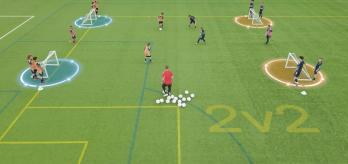
Beale has since taken the Box Game into every environment in which he has worked. The original 2v2+2 format can be adapted into different numerical configurations, but the basic principle remains: short, high-intensity bouts in which players attack two mini-goals, defend two others, and continually find ways to outplay their opponents.
The introduction of goals represents an important change from the previous outplaying practices in this series. The playing area becomes more directional and rectangular, giving players a clearer reference for where to attack and defend, while still providing multiple goalscoring options. Before moving into the full Box Game, Beale uses the existing setup to expose players to some of the individual actions they will need later in the session.
Key coaching tips
-
“Feel it before you receive it”, “roll in”, and “twist and turn”. Reinforce the technical habits developed earlier in the series, while allowing players to select the most effective solution for each situation.
-
“You don’t have to turn with your first touch.” Encourage a vertical mindset without rushing the action; the first touch should help players recognise pressure and determine how quickly they can attack.
-
“The more touches you take, the more chance you have of losing the ball.” Encourage players to be efficient once they have identified the opportunity to outplay or finish.
-
Use the competitive format and scoring system to maintain intensity and engagement throughout the practice.
-
Keep bouts short and transitions immediate to maintain intensity and challenge players to execute their actions under fatigue.
- Encourage players to recognise when an advantage has been created and finish the attack quickly. Exploit the route to goal before the opposition can recover, even if this requires using the non-dominant foot.
-
Encourage players to recognise when an advantage has been created and finish the attack quickly. Exploit the route to goal before the opposition can recover, even if this requires using the non-dominant foot.
Practice 1 – 1v1 Actions
Before introducing the full Box Game, Beale uses the same setup to work on individual outplaying actions in a directional 1v1.
The four mini-goals create multiple attacking possibilities, challenging players to receive under pressure from behind, recognise the space available, and manipulate their opponent before selecting the most effective route to goal. As the practice develops, different starting positions change the angle of the pass and pressure, exposing players to receiving and outplaying on both sides of their body without altering the basic organisation.
Organisation
-
Set up a rectangular playing area of approximately 18×15 yards in size, with two mini-goals positioned at each end.
-
Players initially start behind the goals, with one attacker and one defender entering the playing area for each repetition.
-
Play into the attacker, who is allowed a first touch before the defender can challenge for the ball.
-
The attacker can score in either of the two goals they are attacking.
-
If the defender regains possession, they can immediately transition and attack the opposite pair of goals.
-
Progress the practice by changing the players’ starting positions so passes and pressure arrive from different angles.
-
Use the same playing area and goals throughout, allowing the session to progress without reorganising the equipment.
-
Variation 1 – Bounce pass: Maintain the same setup but introduce the ball with a bounce pass to challenge the player’s control and ability to deal with a different type of delivery.
-
Variation 2 – Different receiving angles: Start from the side of the playing area. Players receive a pass from the coach on the opposite touchline before attempting to outplay their opponent and score in either goal at the opposite end. Repeat from both sides.
Coaching points
Practice 2: The Box Game — 2v2+2
The original Box Game brings two teams of two into direct competition inside the same rectangular area, supported by two neutral players positioned between the goals.
Each bout begins with players entering from behind their own goals and immediately competing to score in either of the two goals at the opposite end. The multiple scoring options encourage players to read the behaviour of defenders and decide whether to outplay individually, combine with a team-mate or use the neutral support to find another route to goal. The actions are deliberately short and intense.
Organisation
-
Use an approximately 18×15-yard rectangular area with two mini-goals positioned at each end.
-
Two teams play 2v2, with players starting behind their respective goals.
-
Position one neutral player between the two goals at each end; Beale suggests coaches or goalkeepers can also perform this role.
-
The neutrals support the team in possession, allowing the ball to be played backwards or forwards to create additional combinations.
-
When the ball goes out, the four active players leave immediately, and the next two players from each team enter.
-
Keep score between the teams; Beale uses a first-to-10 format to reinforce the competitive nature of the game.
Coaching points
Practice 3: 3v3+2: USING WIDTH TO OUTPLAY
The Box Game is then progressed by adding an extra player to each team to create a 3v3 inside the playing area, while repositioning the two neutral players on the outside of the longer sides.
The key principles explored in the previous practices remain equally important. However, the additional players and the wider position of the neutrals inevitably create new relationships within the game. Players must now recognise how width and the additional passing options can help stretch and shift defenders, create space, and open new routes to goal.
Organisation
-
Maintain the same rectangular playing area and four mini-goals used in the previous practice.
-
Two teams compete 3v3 inside the playing area, with each team aiming to score in the four mini-goals.
-
Reposition the two neutral players on the outside of the longer sides of the playing area, where they support the team in possession.
-
Maintain the same short, high-intensity format, with new players entering immediately when the ball goes out.
-
Continue to use the competitive scoring system established in the previous practice.
Coaching points
Coach interview
Rate your experience