Learning platform
 en


Through a range of small-number finishing practices, he explores how players can recognise and exploit numerical advantages to create goalscoring opportunities. Beale also uses examples from elite players to illustrate how individual technique and decision-making can help attackers make the most of numerical advantages.
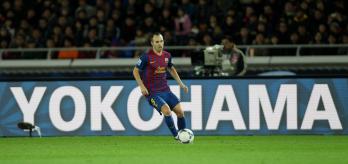
One such example is the legendary striker Luis Suárez, whose ability to disguise his intentions made him particularly difficult to defend against. Renowned for his powerful, accurate finishing, Suárez could shape to shoot and force defenders to commit, then change direction to create a better angle. His exceptional technique and instinctive decision-making let him do this in a split second.

PUTTING THE PRINCIPLES INTO PRACTICE
In the first two practices, the larger playing distances allow the attacking action to develop before the finish. Within these exercises, players learn how individual actions and relationships with a second or third attacker can manipulate defenders, create an overload and, ultimately, produce an advantageous situation from which to attack the goal. As Beale explains, the “rule of 3v2 is to make it 2v1”, while within the 2v1 the objective is to use the relationship between the two attackers to eliminate the defender and release a player towards goal.
The third and fourth practices bring the focus closer to the finishing action. With fewer players and reduced distances, participants work on creating the final advantage required to get a shot away. This might involve preserving and exploiting a 2v1 to release a team-mate or dealing with different types of pressure in isolated 1v1 situations.
Key coaching points
-
“If you can do it yourself, do it yourself.” A numerical advantage does not automatically mean the ball has to be passed. Beale encourages players to assess the situation and recognise when they have a genuine opportunity to outplay the defender and attack the goal themselves.
-
“The rule of a 3v2 is to make it a 2v1.” Beale uses simple principles to exploit numerical advantages. In a 2v1, the ball carrier manipulates the defender while the second attacker creates space. In a 3v2, the aim is to create a 2v1 within the larger overload.
-
Manipulate the defender before exploiting the advantage. Outplaying is not simply about seeing the free player. Beale repeatedly asks attackers to consider the defender’s feet, shoulders and body orientation.
-
Connect movement with the quality of the pass. Timing, distance and the weight of the pass are closely connected. Supporting players must recognise when to overlap, underlap or move closer to the ball, while the ball carrier must judge when to pass and whether to play the ball to a team-mate’s feet or into their path.
-
Apply the offside rule as a restriction. As players become more familiar with the practices, greater emphasis can be placed on the timing and precision required to execute the final pass.
Practice 1 – 2V1 FINISHING: THE RULES OF 2V1
This practice explores what Beale calls the “rules of 2v1”, focusing particularly on the relationship between the ball carrier, their supporting team-mate and the defender.
Starting near the centre circle, the player in possession drives towards a defender, who is initially positioned centrally near the edge of the penalty area. The aim is to manipulate the defender’s body position before releasing the ball, creating more time and space for the supporting player to attack. At the same time, the second attacker can overlap, underlap or offer a supporting angle for a one-two, creating additional problems for the defender.
-
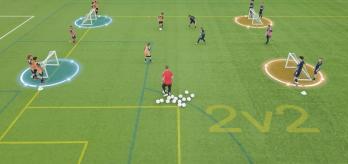
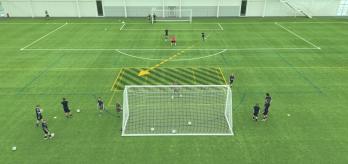
Set up a 2v1 attacking situation towards a full-sized goal with a goalkeeper. The playing area should be twice the length of the penalty area, with the same width.
-
Position one defender centrally, initially around the edge of the penalty area.
-
The player starting the action drives towards the defender while their team-mate provides a supporting run with an overlap.
-
The attackers combine to eliminate the defender and create a goalscoring opportunity.
-
Apply the offside rule, challenging the supporting player to coordinate the timing of their movement with the ball carrier.
-
Variation 1 – Underlap/blind-side run: The supporting player attacks inside the defender, using a blind-side run rather than the outside overlap.
-
Variation 2 – Give-and-go: The supporting player provides a close angle for a one-two, allowing the attackers to combine around the defender and continue towards goal.
-
Variation 3 – Free choice: Players are free to use any of the previous solutions, requiring them to read each other’s movement and intentions before deciding how to combine.
Coaching points
Practice 2: 3V2 ALLEY
This practice develops the principles explored in the previous 2v1 by adding a third attacker and asking the players to overcome two successive defensive lines on their way to goal.
Starting with the goalkeeper, three players build the attack against two lines of two defenders, with each pair restricted to their designated area. The attackers must solve each 3v2 while maintaining the speed and momentum of the attack. After breaking the first line, they must apply the same principles against the second pair before exploiting the space in the final third to create a goalscoring opportunity.
-
Set up a playing area approximately half the length of a regular pitch, with the width restricted to that of the penalty area.
-
Position a full-sized goal and goalkeeper at each end.
-
Divide the area into three zones, with two defenders positioned in each of the two defensive lines. Each pair is restricted to defending within their designated zone.
-
The goalkeeper starts the action by playing to one of three attackers.
-
The three attackers attempt to overcome the first pair of defenders before progressing to face the second defensive line.
-
Once a defensive line has been broken, the attackers continue forwards at speed, maintaining their 3v2 advantage against the next pair.
-
After overcoming the second line, the attackers look to create and finish a goalscoring opportunity.
-
The next attack starts in the opposite direction.
-
Rotate defenders after a set period.
-
Note: Once the practice begins flowing, allow defenders to finish at goal if they win possession back.
Coaching points
Practice 3: 2v1 choice
This practice retains the 2v1 relationship but gives the players greater responsibility for creating and solving the situation themselves.
The central player begins the action with a choice. As Beale explains, “Whoever you pass to is your team-mate. Whoever you don't pass to is the defender.” That first decision immediately establishes the roles. After passing, the central player can overlap or underlap, and the two attackers are then free to find their own route to goal.
The key challenge is to preserve the 2v1. Beale repeatedly warns players against releasing the ball simply because the pass is available. If the defender is already facing the intended receiver, the pass may merely transform the numerical advantage into a 1v1. Instead, the ball carrier can keep drawing the defender towards the ball until their body is committed to that direction. Only then might the supporting player become the more effective solution.
-
Position one player centrally between two possible receiving players.
-
The central player passes to either side to start the practice.
-
The player receiving the pass becomes the attacker's team-mate; the other player immediately becomes the defender.
-
After making the first pass, the central player can overlap or underlap.
-
The attacking pair play freely from that point and attempt to score against the goalkeeper.
-
Rotate the players after each action.
Coaching points
Practice 4: 1v1 finishing in reduced groups
These finishing practices expose attackers to different types of pressure close to goal, challenging them to recognise how a defender's position and recovery angle affect the space available. For Beale, outplaying an opponent does not necessarily mean beating them completely; creating “half a yard” can be enough to shoot, pass or release a team-mate in front of goal.
The defender starts by playing the ball through either side of a central gate before running through it to recover towards goal. This creates what Beale describes as a “random angle” of recovery, forcing the attacker to recognise the space available and decide how best to exploit it.
Organisation
-
Position the attacker and defender around a central gate in front of goal.
-
The attacker passes to the defender to initiate the action.
-
The defender returns the ball to either the left or right of the gate.
-
The defender then runs through the middle of the gate and recovers towards goal.
-
The attacker reacts to the direction of the pass, collects the ball and attacks the goalkeeper.
-
Play the resulting 1v1 to a finish before rotating roles.
This practice exposes the attacker to a different form of recovering pressure close to goal. After combining first time with the coach, the attacker makes an overlapping run to receive the ball with a maximum of two touches to score. The decision is deliberately simple: if the opportunity is available, finish first time. Alternatively, the attacker can disguise the shot and use the additional touch to manipulate the recovering defender and create the space required to score.
Organisation
-
The attacker plays first time into the coach and immediately makes an overlapping run.
-
The defender recovers around the designated player before attempting to disrupt the finish.
-
The coach returns the ball into the attacker’s path.
-
The attacker has a maximum of two touches to score.
-
Rotate the roles after each repetition.
Coach interview
Rate your experience