Learning platform
 en
en 


The first part of this series on Beale’s methodology focused on developing a player’s technical hard drive, which provides them with the tools to receive, move, and release the ball effectively. However, this second article explores how those same tools can be applied to outplay in game situations.
Rather than prescribing solutions, Beale designs practices that allow players to discover them, developing progressively the individual qualities required to become, in his own words, “difficult to play against”.
This next layer is introduced through a progressive series of positional practices, moving from 1v1+2 to 2v2+2 and 3v3+2.

Outplaying a direct opponent
Beale describes outplaying through the “law of the playground”, where the players who earn respect are those who are skilful, tough and fast — not only in their movement, but also in their decision-making and speed of action. For Beale, this is not limited to just dribbling; it also includes protecting the ball, creating space, breaking defensive pressure and gaining an attacking advantage over the opponent.
Beale encourages the players to become expressive problem-solvers, capable of adapting to each situation, which is an important aspect of player development. His practices are designed to develop players with the confidence to take initiative, show personality and make effective decisions under pressure, recognising that creativity is most valuable when combined with intelligent decision-making.
Practice design
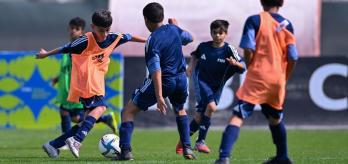
Across all three practices, players are challenged repeatedly to outplay a direct opponent with the help of two neutral players. From all the aspects that involve outplaying, practice designs such as this constrain the game to force players to scan continually, receive under pressure, manipulate defenders, and select the most effective solution based on the defender’s behaviour.
Beginning with individual outplaying in a 1v1+2 possession game, the session progressively develops into 2v2+2 and 3v3+2 practices, increasing the number of players, relationships and decision-making demands, while maintaining the same core objectives throughout.
Coaching tips
-
Encourage players to scan before receiving, allowing them to recognise the most effective way to outplay their direct opponent.
-
Promote an open body shape and good body orientation to maximise forward passing and dribbling options.
-
Encourage constant movement off the ball, helping players to create passing angles and provide effective solutions for the player in possession.
-
Encourage players to vary the point of attack, mixing short combinations with longer forward passes to avoid becoming predictable.
Practice 1: 1v1+2 skill box
The first practice introduces individual outplaying in a simple positional game. Although the practice is built around a 1v1 inside the playing area, the two outside neutral players create a constant numerical advantage for the team in possession. Players are encouraged to receive, protect possession and manipulate their direct opponent, while deciding how to best use the outside support to maintain possession.
Organisation
-
Set up a 10 x 10 metre playing area, with two target players positioned on opposite sides of the box.
-
Play 1v1 inside the area, with the target players supporting the team in possession using one touch only.
-
Begin without allowing active pressure on the neutral players, progressing to greater defensive realism where appropriate.
-
Restrict the neutral players to one touch to increase the speed of play and encourage quicker decision-making.
-
Rotate the players participating inside after 25 seconds.
Coaching points
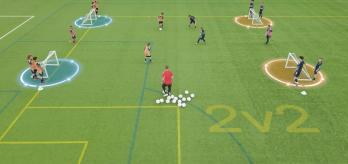
Practice 2: 2v2+2
Introducing a second player for each team expands the range of outplaying solutions available. Maintaining the same playing area increases the demands on players’ positioning, timing, and awareness, requiring them to coordinate their movements more effectively to create passing lanes and exploit numerical superiority in a denser area.
Organisation
-
Use the same 10 x 10 metre playing area, with two target players positioned on opposite sides of the box.
-
Play 2v2 inside the area, with the target players supporting the team in possession.
-
Progress neutral participation from one touch to two touches, if required, to adjust the level of challenge.
-
Begin without allowing active pressure on the neutral players, progressing to greater defensive realism where appropriate.
-
Rotate the players participating inside after 30 seconds.
Coaching points
Practice 3: 3V3+2
The final progression increases both the number of players and the playing area, creating a 3v3+2 game with more complex relationships and greater decision-making demands.
With neutral players positioned on the touchline, the practice encourages teams to use the full width and continually reassess where the next advantage may emerge. Players must coordinate movements, create passing lines and adjust their positioning, while the constant numerical advantage in possession encourages wider combinations, switches of play and more balanced space occupation.
Organisation
-
The spatial organisation builds naturally on the previous practices, requiring only minimal adjustments to the playing area, while progressively increasing the tactical demands of the game.
-
Expand the playing area to 10 x 20 metres, with two neutral players positioned on the touchline.
-
Play 3v3 inside the area, with the neutral players supporting the team in possession to encourage width, directional play and effective occupation of space.
-
Begin without allowing active pressure on the neutral players, progressing to greater defensive realism when or if appropriate.
-
Rotate the players participating inside after 30 seconds.
Coaching points
Reflection: Coach interview
Rate your experience