Learning platform
 en
en 


In Part 3 of ‘10 tips to make your goalkeeper training more effective’, FIFA futsal technical expert and Black Pearl United goalkeeper coach, Antonio Garcia, delivers the final 3 tips which provide a coach with a solid basis for their training methods.
Below you can find Tips 8-10 and gain an understanding of how these effective aspects can help to create more effective training sessions.
TIP 8: CONTINGENCY CONTROL
Regardless of the level of the goalkeeper being coached, throughout the training process ‘controlling contingency’ is essential. Chaotic play can lead to risk, therefore the fundamental safety of the players must always be prioritised, and an effort must be made to reduce the risk of injury. Here are some suggested rules that can be implemented to help prioritise safety;
-
Stop play if hazardous: When hazardous situations occur, such as a loose ball that can be stepped on, presenting an injury risk, halt play and remove the ball.
-
Safety over loss of time: It is better to lose seconds removing a ball from the court than deal with an injury to a player. Remove hazards immediately.
-
Clean up spillages: Players can drop sweat or water, focus on cleaning up any spillages on the court before continuing play.
-
Manage risks effectively: Because real game scenarios are created, action can get out of control, pay attention and be alert to potential hazardous situations to avoid them.
TIP 9: TRAINING MATERIALS
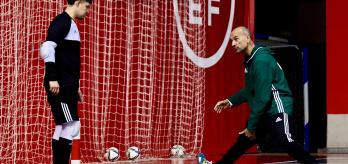
The high methodological quality of a goalkeeper session should always trump the introduction of innovative equipment. The use of material or equipment should always be assessed on whether it helps to enhance or disrupt the exercise and must always be representative of real-game scenarios. Antonio provides a list of equipment that can be used as follows;
Essential equipment
-
A ball
-
A goal
-
A space
-
Players in different roles.
Acceptable equipment
-
PVC marker cones (to provide reference points).
-
Volleyballs (occasionally) to resemble powerful and unpredictable shots.
-
Tennis balls sometimes (do not misuse).
TIP 10: FEEDBACK
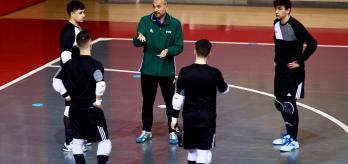
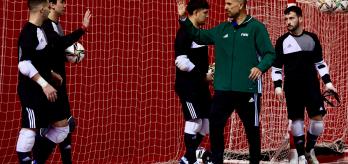
It is the responsibility of the coach to promote learning through various methodological strategies and one mode of this is the use of feedback. Coaches must not overlook the importance of technical components and how goalkeepers must receive feedback to help them improve. Here are some tips on providing feedback as follows;
-
Precise and good timing: Feedback must be precise and given at the right moment. Don’t give too much or provide too little, quantity must be sufficient and appropriate.
-
Being quiet: Learn when to be quiet and allow the goalkeeper to process the consequences themselves, as they are better positioned to experience their actions.
-
Focus on consequences: Help goalkeepers to understand the consequences behind their decisions or actions so they can make better decisions in future.
-
Encouragement self-feedback: If goalkeepers can self-reflect and understand their actions themselves, they can correct themselves without input.
Effective feedback
-
Learn through practice: Goalkeepers learn better through practice and varied repetition, which enhances experiences and resolutions.
-
External focus: Instead of telling goalkeepers where to position their legs or body postures, create scenarios, adjust the environment or add obstacles so they must learn to adapt themselves to achieve better results. For example, position an obstacle in front of the goal, so goalkeepers know they must lift the ball over the obstacle.
-
Evaluate: The quality of feedback given can be improved if a coach can reflect and understand what is and is not working.
Rate your experience