Learning platform
 en
en 


In Part 2 of ‘10 tips to make your goalkeeper training more effective’, FIFA Futsal Technical Expert and Black Pearl United FC Goalkeeping Coach Antonio García delivers four more tips that focus on the intricacies of an efficient and effective goalkeeper session in futsal.
Let’s take a look at Tips 4-7 and understand how these tips can help to create more effective training sessions.
TIP 4: GAME LOGIC ‘IF……THEN’ RULES
Every drill begins with a recognised scenario, yet must be played out naturally so that goalkeepers can improve decision-making and their actions. The complexity of the drill will depend on the skills of the goalkeeper, the stage of the season or the training week — these factors must always be considered. Antonio shares some tips on how to create this environment:
-
Create a known scenario: Start the drill with a known scenario and one that can take several different paths, so that goalkeepers must weigh up every scenario before deciding the action needed to be taken.
-
Mimic realistic gameplay: Every scenario should resemble a real-game situation so that the goalkeeper has to react and perform actions they would likely face in a real game.
-
Avoid choreographed moves: Choreographed moves tend to have nothing to do with the dynamics of the game and make goalkeepers ill-prepared for scenarios that happen in a real game. Allow for unpredictability and an open game.
-
Enhance the goalkeeper’s cognitive abilities: The objective must be to improve a goalkeeper’s ability to analyse and respond to a diverse range of situations. They must be able to scan, read and interpret constantly to try and understand what may happen in a real-game scenario.
TIP 5: TRAINING PARAMETERS
During a game, goalkeeper interventions tend to have fewer repetitions than during practice. Therefore, quality must be prioritised over quantity in the drills. Focus on scenarios and actions that are often repeated more frequently in real-game scenarios to improve matchday performance. Antonio presents some aspects that should be considered to improve the effectiveness of training:
-
Duration of intervention: Focus on short, explosive actions that can be performed intensely, as goalkeepers tend to perform in short durations.
-
Density: Balance the moments between work and rest periods and avoid giving goalkeepers excessive loads that do not reflect real-game scenarios. Tailor density to the demands a goalkeeper would normally face in a game.
-
Complexity or level of difficulty: Adjust the difficulty per exercise per the level of the goalkeeper. An elite goalkeeper must be challenged more and have to make decisions in difficult circumstances, whereas a youth goalkeeper must focus on the basics.
-
Symmetry: Work on both sides of the body. Replicate exercises on different sides of the court so the goalkeeper can adjust to performing actions on their left and right sides in equal measure.
-
Tactical density: Analyse the number of game actions involved in the drill. For example, if a goalkeeper performs a save, they may be able to throw the ball out or carry it to simulate a transition from defence to attack.
TIP 6: COACH
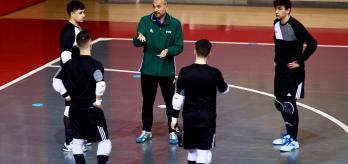
The goalkeeper must be the focal point of the training session, whether it is youth players or those at the highest level. Their continuous development and improvement must be prioritised, and a coach should provide the correct environment for them to achieve this. Here are several ways a coach can prepare themselves to provide the best environment for a goalkeeper:
-
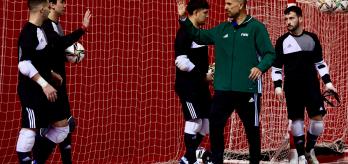
Guidance and support: The role of the coach is to provide guidance, support, points of reference and encouragement throughout every session for a goalkeeper.
-
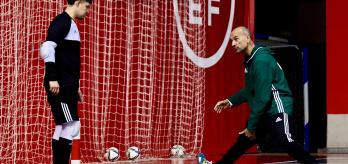
Design quality drills: The coach must create drills that are full of stimuli, are genuinely demanding and challenge goalkeepers so they can improve. Creating scenarios that help them to perform, while providing feedback, gives the goalkeeper the best platform to develop.
-
Integrate strategies with the head coach: The goalkeeping coach must not treat the goalkeeper as a separate entity from the team and must consider their link to their team-mates and opponents.
-
Study the game: Knowing the game in-depth and analysing modern tactical aspects will help a coach to adapt their training sessions to the demands of the game.
TIP 7: INTERACTIONS
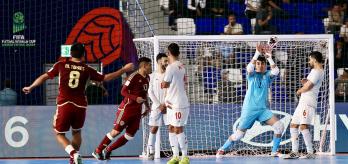
Goalkeepers do not operate in isolation. They rely on interactions, and their actions depend on the decisions of team-mates and their opponents. Antonio presents some solutions to help increase these interactions in training, as follows:
-
Promote training with team-mates and opponents: Work and train in conditions where there is interaction with team-mates and opponents to get used to reading and reacting to the tactical intentions.
-
Communication: Both verbal and non-verbal communication are crucial to a goalkeeper’s performance. They must be able to talk and interpret body movements or a change of body movements as they have an intention behind them that must be understood and reacted to.
-
Smaller setup sessions: Set up specific scenarios in training using reduced numbers and smaller spaces to focus on immediate interactions a goalkeeper faces in a real game.
-
Unpredictability in training: Chaos cannot be avoided in real-game scenarios. Therefore, training must match this and performing drills with team-mates and opponents increases that unpredictability.
Rate your experience