Learning platform
 en
en 


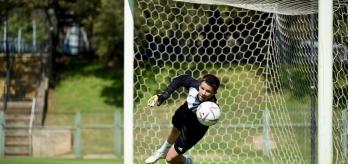
Once a goalkeeper has defended their goal, they must immediately prepare themselves for an offensive transition with actions such as rolls, throws or long kicks. However, and just as importantly, they must be prepared for another defensive action should their team lose possession quickly. They can do this by knowing the correct body posture, positioning and orientation to adopt.
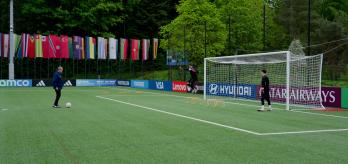
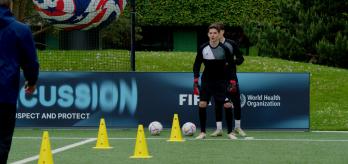
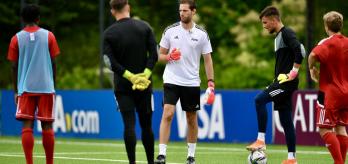
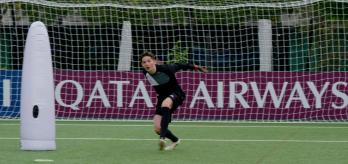
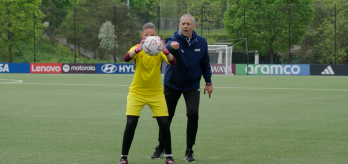
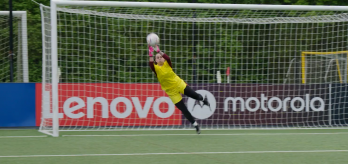
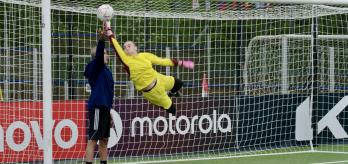
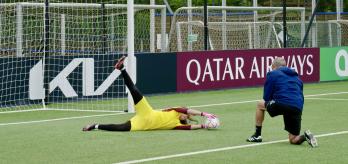
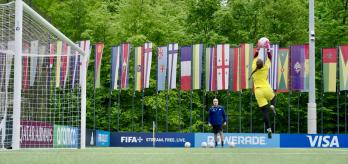
In this session, FIFA Goalkeeping Expert, Dean Santagelo puts a pair of young goalkeepers through the paces with a series of ‘defensive to offensive to defensive’ scenarios. In each exercise, the goalkeeper starts by catching an aerial ball and must start an attack with a variation of actions and directions. From there, the goalkeeper will switch into a defensive transition and face shots and 1v1 scenarios from different angles.
Key coaching points
-
Always face the shoulders toward the ball and follow it.
-
Perform catches, throws and kicks in motion to ensure that offensive transitions can be started more effectively.
-
Quickly readjust the body posture and orientation when play goes from an offensive to a defensive transition.
-
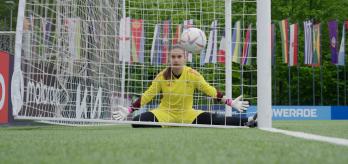
Keep legs slightly bent, an upright posture with arms down by the side and hands close to the chest to be prepared for all defensive actions.
-
Aim for depth and length when kicking the ball out to start offensive transitions so that there’s less risk of an immediate defensive transition.
Exercise 1: Aerial catch and shot from the right side

This first exercise prepares the goalkeeper for the transition from defence to offence and back to defence again. In this scenario, they must reposition themselves to face a final offensive action from their right side.
-
Use 1 half of a full-size pitch.
-
Use 1 full-size goal and position Goalkeeper 1 inside it.
-
Position a mannequin 8m from the centre of the goal.
-
Position Coach 1 10m to the right of the goal with some balls.
-
Position Goalkeeper 2 20m from the centre of the goal.
-
Position Coach 2 20m adjacent to the left side of the goal.
-
The sequence starts with Coach 1.
-
They must throw the ball high in front of Goalkeeper 1.
-
Goalkeeper 1 must move forward and jump to collect the ball.
-
They must run toward the mannequin and perform, and quickly roll to Goalkeeper 2.
-
Goalkeeper 2 takes 2 touches forward, mimics a turnover of possession and then plays the ball out to Coach 2.
-
At the same time, Goalkeeper 1 must reposition their stance and retreat to the centre of the goal.
-
Coach 2 will then take a touch and fire a shot toward the goal.
-
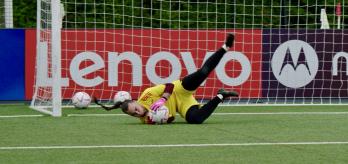
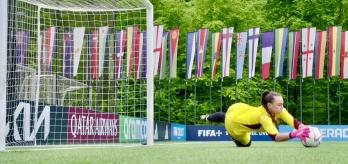
Goalkeeper 1 must save the shot and secure the ball.
-
The goalkeeper catches the aerial ball and quickly throws it to the coach on the right-hand side. The coach then plays the ball to Goalkeeper 2, who takes a shot on goal.
-
Move with speed and execute actions while in motion to stay efficient.
-
Stay connected to the ball: keep your shoulders and body facing forward toward the ball so you can track it for catches and shots.
-
Maintain an athletic set position: knees slightly bent, upper body upright, feet apart, arms down with forearms raised to around chest height.
-
Transition quickly from attack to defense when possession is about to be lost: shift from an open, wider attacking stance to a narrower defensive stance (one foot leading), and retreat backward toward goal to be set for the shot.
Different scenarios
The final exercise presents goalkeepers with different scenarios in both offensive and defensive transitions. The goalkeepers must recognize and stay aware of where to play the ball, reacting to cues and making quick decisions. They face a mix of defensive transition situations, including 1v1s, as well as offensive transitions such as executing long kicks to start attacks.
• Same organisation as in exercise 1
-
The drill starts with the same sequence as in Exercise 1.
-
The goalkeeper must now recognize where to play the ball.
-
Coach 2 and Goalkeeper 2 signal with their hands whether they are available to receive:
-
Arms crossed = not available
-
Arms open = available
-
-
Goalkeeper 2 and Coach 2 then create and play out different attacking scenarios towards goal.
-
If both are signalling “not available,” the goalkeeper plays a long ball into the opposite half.
-
The goalkeeper must recognize the signal quickly to identify where to play and then execute the distribution decisively and accurately.
-
During the defensive transition, react and readjust positioning and posture accordingly to be prepared for shots or 1v1 scenarios from multiple angles.
-
Focus on length and depth when kicking long so that offensive transitions are more effective.
-
Always face the shoulders toward the ball and track its movement.

Rate your experience