Learning platform
 en
en 


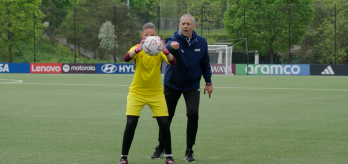
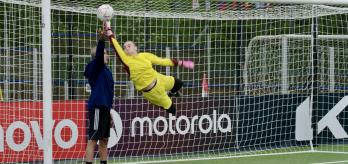
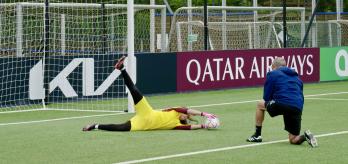
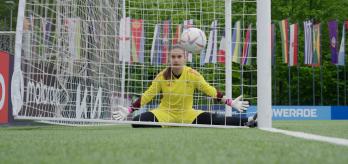
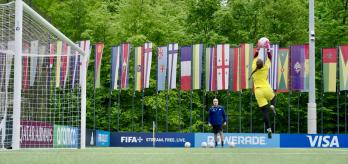
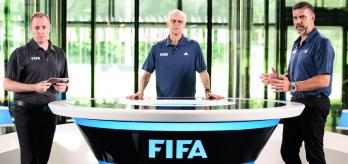
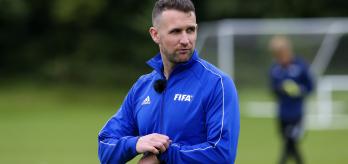
In this session, FIFA Goalkeeping Coach Thierry Barnerat presents a series of drills that will help goalkeepers establish a strong technical foundation when dealing with high balls. They can be better prepared for aerial balls by:
-
reading the speed, path and height of the ball to meet it at the right moment;
-
focusing on effective footwork by taking considered steps towards the ball so that the front foot goes up first underneath the ball’s path, leading with the knee raised;
-
working on a solid footing by pushing the back foot into the ground and using it to generate power in the jump;
-
maintaining a strong and stable upper body whilst keeping the elbows parallel when raising the arms;
-
raising the hands simultaneously with the jump and keeping them close together; and
-
meeting the ball with strong fists, forearms, elbows and shoulders to gain more distance on the punch.
Introduction
Exercise 1: Jumping with the ball

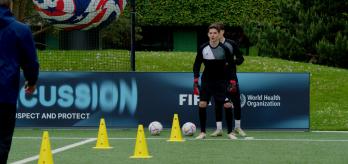
This first exercise works on the solid footing required to make a high jump. Therefore, a moving ball is not used in this exercise, and the goalkeeper holds it instead whilst making three forward steps so that they can focus on the correct technical aspects, such as leading with one leg and a high knee, solid footing on the back foot, a stable upper body posture, and keeping elbows parallel when raising the hands to meet the ball.
Exercise 2: Aerial jump in three zones
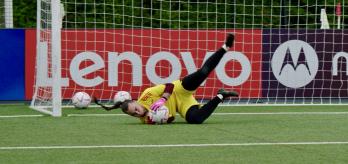
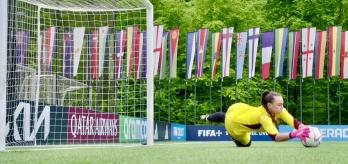
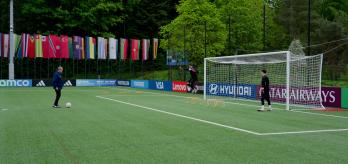
This practice introduces a challenge in terms of movement as the goalkeeper must operate in three zones when claiming a high ball — the near post, the centre of the goal and the far post. Goalkeepers have to change their run and coordinate their feet to judge the flight of the ball whilst maintaining solid footing, stability of the upper body and the position of their hands and elbows.
Exercise 3: High jump with punch
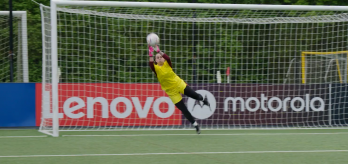
This drill focuses on the quality of a goalkeeper’s handling and punching. The first part works on handling and keeping hands firm when jumping and performing punching actions, whilst applying the fundamentals previously worked on. The second part works on the punching aspect and maintaining an upper-body structure to be able to gain distance on the punch.
Exercise 4: One-handed punch
This final exercise works the single-handed fist whilst applying the same principles with the jump — solid footing, lead leg and upper-body stability. Hand-eye coordination is imperative to ensure that the timing to connect the punch with the ball is effective. A strong fist, forearm, elbow and shoulder must be maintained to gain distance on the punch.
Rate your experience