Learning platform
 en
en 


In Part 2, these same competencies are taken one step further. The focus shifts from maintaining possession in isolation to applying those skills with purpose — playing out from the back, breaking the press and progressing forward in realistic match scenarios. The problems remain familiar, but the context becomes more game‑like, the consequences more meaningful, and the decisions more clearly connected to performance on match day.
One Objective, Two Games, Increased Reality
The second part of the session is built around a clear and consistent objective:
playing out from the back against a high press. To serve this objective, Gilberto uses two contrasting game formats:
-
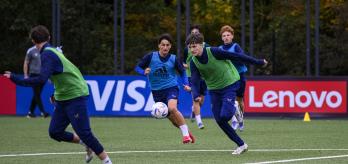
a 6v6 game in a stretched field
-
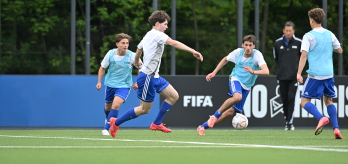
an 11v11 game in a short, condensed area
While the numbers and dimensions differ, both games share the same intentional rule design. The offside rule is active, and the defending team is encouraged to push up, tighten space and press high from the goal kick. Players are limited to three touches in their own half, with no restriction in the attacking half.
These rules shape the players’ behaviour in simple, direct ways. The offside rule compresses the field and brings pressure closer to goal, creating frequent, realistic build‑up situations.
The three‑touch limit speeds up decisions: players must scan early, know their options before receiving and play with purpose. It discourages holding the ball too long and encourages smart positioning and quick combinations to break the first line of pressure.

As in Part 1, Gilberto Silva intervenes sparingly. Rather than prescribing solutions, he relies on the game itself to present the same problem again and again, allowing players to adapt and learn through experience.
Game 1: 6v6 in a Stretched Field
The first game deliberately exaggerates depth while limiting width, creating repeated individual exposure under direct pressure. It is played 6v6 from the goal line to the halfway line, using the full width of the penalty area. The extended length creates space to exploit, while the restricted width reduces lateral options and encourages more vertical, central progression.
Each team is split into two groups, which take turns playing. Every team completes three rounds of 3 minutes, keeping the intensity high while allowing brief recovery between repetitions. The short, high‑tempo rounds place strong physical and cognitive demands on the players.
Learning focus
With fewer players on the pitch, individual involvement increases significantly. Players are exposed more frequently and more directly to decisive actions. The relative area per player is large, which raises the physical load and demands repeated high-intensity actions.
Although there is space to dribble or play into, pressure arrives quickly. Exploiting the available depth therefore requires:
-
Perceptual awareness – recognising where space emerges
-
Tactical understanding – identifying the most effective solution
-
Technical precision – executing actions cleanly at full tempo and under pressure
The competencies developed in the possession practices of Part 1 — such as early positioning, recognising the free player and remaining composed under pressure — now become essential foundations before players are exposed to the greater structural complexity of the full-team game.
Game 2: 11v11 in a Condensed Area
Having stabilised individual behaviour under pressure in the 6v6, the second game increases structural complexity by adding more players and full pitch width. It is played 11v11 from the goal line to the halfway line.
In contrast to the 6v6, teams can now build through the centre or via the wings, stretch the opposition and switch play strategically. Despite the larger dimensions, the relative space per player is smaller. This creates a more congested environment: time on the ball decreases, spaces close more quickly, and individual solutions become harder to execute consistently.
Learning Focus
In this environment, breaking the press becomes a collective task rather than an individual one. Teams are challenged to:
-
Establish a balanced team structure with short and deep options
-
Create width and depth simultaneously
-
Use combinations, rotations and third-man movements to progress
-
Recognise when to circulate patiently and when to accelerate or switch play
On an individual level, direct involvement is reduced significantly and explosive actions occur less frequently. However, the perceptual load increases: situations evolve rapidly, multiple options appear and disappear quickly, and players must constantly adjust their positioning in relation to teammates, opponents, and the ball.
While the 6v6 stresses the individual’s ability to cope with pressure, the 11v11 tests whether these individual qualities can be integrated into a coordinated team structure.
Coaching Through Conditions, Not Instructions
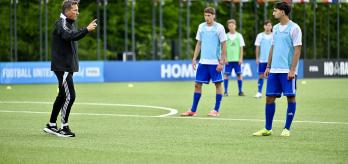
A defining feature of the session is Gilberto Silva’s minimal intervention. Stoppages are rare, coaching points are concise, and the games flow at high intensity.
Rather than telling players how to solve the problem, Gilberto trusts the constraints of the game — pitch size, numbers, rules and repetition — to guide learning. Through repeated exposure, players begin to recognise patterns, refine their positioning and improve their timing and decision‑making organically.
This approach reflects both his playing career and his coaching philosophy:
game intelligence is developed by experiencing the game, not by over‑coaching it.
Take-aways for coaches
-
Game formats become powerful learning tools when they faithfully reflect match demands
-
Rules such as offside can be used deliberately to shape pressing behaviour and recreate specific build‑up scenarios
-
Using contrasting formats with the same objective deepens players’ understanding and adaptability
-
Limiting intervention allows players to develop calmness, awareness and decision‑making through experience
By designing sessions in which the environment does the coaching, practitioners can help players become calmer, smarter and more adaptable — qualities that defined Gilberto Silva’s career and remain essential in the modern game.
Rate your experience