Learning platform
 en
en 


In the second part of this series, Sydney FC Technical Advisor Kelly Cross explains how the club’s game-based philosophy comes to life on the pitch — through a simple training structure, a shared “games menu,” and a redefined role for coaches.
Simple Structure, Shared Menu
Every training session from U13 to U16 follows the same format:
-
Activation / warm-up
-
Two 40-minute blocks of game play
The entire weekly plan is based on a small menu of representative games. These games are designed to maintain key football principles: opponents, goals, transitions, and consequences. “In every exercise,” Kelly notes, “one team is trying to score, and the other is trying to stop them.”
This simplicity, Kelly argues, liberates coaches. With the “what” already defined, they can focus on the most important aspect — the individual players and their development needs.

The shift to a game-based model fundamentally changes what it means to coach. Instead of designing drills, coaches now prepare by thinking about:
-
Which players to focus on in each game
-
What targets or challenges to set for them
-
How to give feedback before, during, and after play
Tailored Team Practice
Kelly illustrates the idea of individualized learning within a team game through a four-quadrant framework:
At Sydney FC, every session sits above the horizontal line of this model — meaning all activities are team-based and representative of real football. There are no isolated dribbling drills or passing exercises.
Some sessions focus on broader team objectives, but the real game-changer lies in the top-right quadrant: team practices that replicate match conditions while embedding individualized challenges for each player.
Each player follows a personalized development plan with specific targets. The coach’s role is to integrate these into the session — using cues, questions, and small incentives that allow players to pursue their priorities within the flow of team play.
Learning Through Competition and Bonus Points
Learning is driven by a cycle of competing, reflecting, and competing again. Varied scoring systems guide this process by rewarding the behaviours coaches want to encourage. These include:
- Traditional match score: Maintains realism and emotional engagement through standard goals scored.
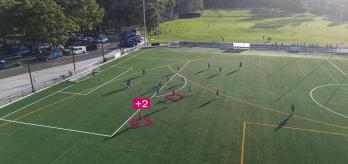
- Bonus points for team actions: Extra points for collective behaviours like quick ball recovery or effective build-up play. This shifts focus from outcome to process: “You can lose the game and still perform really well.”
- Bonus points for individual actions: Players earn points for behaviours linked to their development plans — e.g., a killer pass, a give-and-go, or a key defensive action.
Coaches can mix these methods or use only bonus points, separating performance from results. This prompts deeper reflection: “Your team may have won the game — but what did you contribute?”
Interventions and Coaching Behaviours
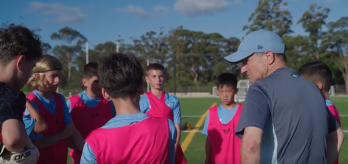
Coaching interventions are deliberately minimal to keep the game flowing and let players learn through real football situations. Coaches rarely stop the game. Most interactions happen during rest intervals, where coaches:
-
ask guided questions,
-
challenge players on their targets,
-
prompt quick peer or team discussions.
These conversations are concise and purposeful. As Kelly notes, “A quick question can shift a player’s focus more than a minute-long explanation.” Players often review bonus points during breaks and discuss what went well or needs improvement. This builds ownership: “They start coaching themselves. That’s what we want.”
Proof of Concept and Key takeaways
Does it work? The results speak for themselves:
-
Over half of Sydney FC’s first team are academy graduates.
-
Academy players are regularly selected for national youth teams.
-
The club’s youth teams consistently rank among the best in their leagues — despite prioritizing development over winning.
And perhaps most importantly, Sydney FC’s approach shows that you can prioritize individual learning and still achieve team success.
Key Takeaways
-
A small, consistent set of representative games simplifies planning and frees coaches to focus on player development.
-
Individual development goals can be pursued within realistic, team-based game scenarios.
-
Bonus points reward performance-oriented behaviours, not just outcomes.
-
Guided questioning, peer discussion, and team reflections build ownership and accountability.
-
Individual development within the game context drives stronger team performance and better results.
In the next article, we’ll step onto the pitch with Sydney FC to explore a sample training session — examining the points system in action and how the coach’s interactions drive individual development within the team context.
Rate your experience