Learning platform
 en
en 


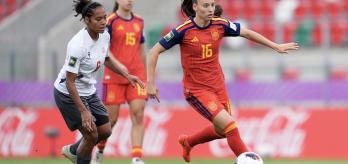
Operating in a 1-4-3-3, Spain’s midfield fluidity and the clever, intentional movements of their wide-left forward during their FIFA U-20 Women’s World Cup Poland 2026™ opener created interesting overloads and strongly supported ball progression.
In this article, FIFA TSG expert Gemma Grainger explains the key features of Spain’s midfield rotations and the movements that captured the TSG's attention.
“The fluidity of Spain’s midfield three, combined with the interesting and effective movements of wide left forward Rosalía Domínguez (16), meant their rotations and positional awareness really stood out. Everything they did was intentional; when someone moved out, someone else moved in, and these consistent, fluid movements caused overloads and real problems for Nigeria.”
Key take-aways
-
Intentional movements designed to create unexpected overloads
-
Clear understanding of roles and intentions by all players
-
Technical proficiency to receive under pressure
KEY FEATURES OF SPAIN’S ATTACKING STRATEGY
Spain’s used coordinated movements to manipulate individual defenders and open pockets for central progression.

-
Spain’s full-backs maintained width, allowing the remaining midfield and attacking players to occupy and move into narrow central positions.
-
Rosalía (16) frequently moved inside from the left wing and positioned herself between Nigeria’s midfielders and defenders, contributing to a five-player central structure.
-
With centre-forward Marísa García (9) occupying Nigeria’s defensive line, Spain could overload the midfield while maintaining a threat in behind.
-
The positioning of multiple players between Nigeria’s midfield and defensive lines created several short passing options and made it difficult for their midfield two to control the central spaces.
-
Spain’s midfield five rotated fluidly, with players alternating between playing high to stretch or pin Nigeria’s defenders and dropping deeper to draw defenders out of position, rather than remaining within fixed roles.
-
At times, right-forward Daniela Agote (11) played closer to García (9), temporarily creating a front two and increasing Spain’s central presence.
These coordinated movements allowed Spain to manipulate individual defenders and open pockets for central progression, as Grainger explains.
“The tactical understanding in their formation and technical ability was so high. Whether they were in 1v1s or functioning as a team, the different patterns they executed were at a very high level. Their ability to receive under pressure is exceptional, and their awareness of where the pressure is coming from when they receive is very impressive.”
KEY PLAYER: Rosalía (16)
In their opening match against Nigeria, the role of wide left-forward Rosalía (16) was particularly impactful, earning her the Player of the Match award. Her positioning and movement to combine with team-mates and create intentional overloads were very fluid, clearly understood and not always typical of movement expected from a player starting in that position.
As Grainger notes, “She was very influential in their progression and final-third entries, operating effectively in both central and wide areas. Her technical quality under pressure allowed Spain to retain possession and progress through compact spaces. Her positional awareness and understanding of where pressure was coming from helped her identify space, support team-mates and find forward solutions. She consistently contributed through forward passes and progressive runs, both with and without the ball.”
Key metric rankings for Rosalía
Throughout Spain’s 2-0 win over Nigeria, Rosalía stood out across a number of key performance metrics. She was the:
-
top-ranked player in the game for offers in behind the defensive line with 23 (11 more than any other player);
-
top-ranked for receptions of the ball from line breaks (20);
-
top-ranked for receptions between opposition’s midfield and defensive line (33);
-
top-ranked player in the match for final third entries with the ball (16);
-
top-ranked player in the game for receptions in the final third with 35 (13 more than any other player); and
-
top-ranked Spain player for number of sprints in the game (46).
In the clips below, Grainger highlights some of the movements by Rosalía and draws attention to the impact they have on her team’s ability to progress the ball, and the disruption they cause to the opposition’s defensive plan.
Positioning and movement
Clip 1 below is an example of Spain’s build-up where Rosalía (16) recognises the opportunity to move across the pitch into the opposite pocket. Her initial movement attracts the defensive midfielder, leaving her team-mate Celia Segura (18) free in space. Rosalía then adjusts her own position to become the free player during the second phase of the attack.
Receiving between the lines
Clip 2 highlights an example of Rosalía’s awareness and timing to move between the opposition’s lines. As soon as she recognises that possession will be regained, she intentionally advances into the space between Nigeria’s midfield and defensive lines. She receives in space before executing a well-weighted forward pass, demonstrating her ability to accelerate attacks through the quality and timing of her actions.
Supporting progression
Finally, clip 3 highlights the intentional variety in how Rosalía supports Spain’s progression. She drops down in the wide area, dragging Nigeria’s full-back with her, while her team-mate, left-back Carla Julià (17), pushes high in a counter-movement that also draws an opposition midfielder out of position. Once she receives the ball, Rosalía drives into the area vacated by that midfielder and uses a quick one-two combination to isolate and overload the ball-side defensive midfielder, play through pressure, and advance possession. She continues her attacking run, creating movement and offering to receive in behind the defensive line, occupying defenders and leaving space for her team-mates in the space behind her.
Summary
There was clear maturity in the technical and tactical approach of Spain’s U-20 women in this match. Their alignment with the identity of how their senior women’s national team plays was very apparent. For our TSG, the standout component was the players’ depth of knowledge of the tactical solutions available to them and their understanding of what they were trying to achieve. Their football actions were executed with purpose and patience as they actively created and solved problems.
Spain’s technical proficiency in executing their ideas, especially when under pressure, was a notable feature in this performance, especially for U-20 level players.
Rate your experience