Learning platform
 en
en 


During FIFA U-20 Women’s World Cup Poland 2026™, our Technical Study Group’s (TSG) goalkeeping experts have been analysing the tournament. In this article, they discuss key moments of 1v1 pressure for goalkeepers and break down the actions that led to goalkeeping success in these scenarios.

KEY PRINCIPLES OF THE 1v1 SITUATION
The following framework provides a clear sequence for understanding the goalkeeper’s actions as a 1v1 situation develops:
READ → CLOSE → SET → WAIT → ATTACK
The goalkeeper continuously assesses:
-
the ball position and quality of the attacker's touch;
-
the attacker's speed and direction;
-
distance from goal;
-
angle of approach;
-
position of defenders and supporting attackers; and
-
available space behind and around the goalkeeper.
The goalkeeper should actively reduce the distance to the attacker when appropriate. The objective is not simply to get as close as possible, but to:
-
reduce the shooting angle;
-
reduce the visible target;
-
reduce the attacker’s time; and
-
increase psychological pressure on the attacker.
As the goalkeeper approaches the attacker, they must control the finishing angle, taking into account the ball position, the attacker’s body orientation and the goalkeeper’s position relative to the goal, particularly their relationship with the near post and far post. Then they must get set by:
-
controlling their speed;
-
taking small adjustment steps;
-
maintaining a stable body position;
-
keeping a controlled centre of gravity;
-
preparing their hands; and
-
remaining able to move in all directions.
The goalkeeper should avoid committing too early. The objective is to make the attacker:
-
take an additional touch;
-
move away from the optimal finishing line;
-
shoot from a less favourable position;
-
make the first decisive movement; and
-
decide first.
Recognise the trigger and act decisively. The goalkeeper must identify the moment when intervention becomes possible. Typical triggers include:
-
a heavy touch;
-
the ball moving away from the attacker’s foot;
-
the attacker losing control;
-
the attacker’s body position becoming unstable;
-
the attacker preparing to finish; and
-
the attacker exposing the ball.
For Senior FIFA TSG expert Pascal Zuberbühler, the 1v1 situation in goalkeeping is critical.
“Goalkeepers must be able to read, assess and respond to these scenarios at great speed. There is a lot of information to take in very quickly, including where their own defenders are in relation to the situation. The relationship between goalkeepers and their defenders is vital, and because they play so close together, defenders can help or add pressure. Attacking players are also more aware of goalkeepers’ movements, and they watch what the goalkeeper is doing. They now analyse the goalkeeper as they approach with the ball, and the actions of the goalkeeper can influence the decisions of the attacker before they decide to strike at goal.”
In the clips below, Zuberbühler highlights the key principles detailed above and how current U-20 female goalkeepers are excelling in these dangerous situations.
Timing
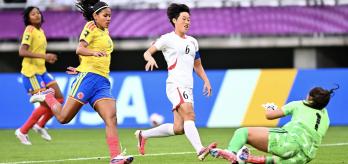
In clip 1, timing is a standout factor for success in this 1v1 situation. Against Spain, China goalkeeper Liu Chen (1) initially advances to close the attacking player down. She recognises that her defender can still apply pressure, so she slows down and stops her forward movement, holding her position approximately four metres from the attacker. She elevates her posture to take up space and does not commit too early, as doing so would allow the attacking player an opportunity to dribble the ball around her. Instead, she waits for the attempt at goal and reacts mid-height to make the save. This is a very good example of the connection between the goalkeeper and the defender, but especially of patience, positioning and excellent timing from Liu.
Furthermore, in clip 2, England goalkeeper Katie Cox (1) displays a strong sense of situational awareness and timing in a similar 1v1 scenario. As Nigeria’s attacker advances with the ball, a defender applies pressure from behind, which Cox recognises and stops to hold her position around three metres from the attacking player. Her posture is upright, taking up space and reducing angles to score, while keeping her arms in a low position. She responds to the attempt at goal with an explosive X-block, saving with her left leg. Again, this is a very good example of excellent timing, patience and the connection between the goalkeeper and her defender in a 1v1 situation.
Staying patient
In clip 3, Korea Republic goalkeeper Kim Chae-been (18) is faced with a dangerous 1v1 situation after Ghana’s attacking player gains territory on her defender following an excellent first touch. Kim is positioned around five metres from goal as the attacker approaches from an angle. This gives the defenders behind her a chance to continue applying pressure, and this impacts Kim’s thinking. She must factor the defender’s ability to get pressure on the ball into her timing, making her decision-making process more complex. At exactly the right time, Kim stops, holds her upright position, stays patient and waits for the finish. She is perfectly set to react, and because she is well balanced on the front of her feet, she can immediately react to the rebound, which is extremely important in this situation. Excellent decision-making, positioning and patience were really well applied by the goalkeeper.
Quick decision-making and actions
In clip 4, Japan goalkeeper Iwasaki Uruha (1) demonstrates quick decision-making and sharp reactions to successfully defend a dangerous 1v1 situation after a back pass that is played too short. Starting in a good position, around 11 metres from goal, she recognises the danger and the clear 1v1 scenario. She quickly assesses how the attacking player controls the ball, her speed and the quality of her touches to decide when she can close the space.
Iwasaki notices that the attacker’s final touch before entering the penalty area gets slightly too far away from her and immediately recognises this as her moment to attack the space. She takes a couple of quick steps forwards and reduces the angle before executing the X-block and saving.
Key coaching points
When a coach is observing and analysing 1v1 situations for goalkeepers, there are a number of key components that should be considered before the scenario develops. Does the goalkeeper:
-
recognise the developing 1v1 early?
-
adjust their starting position?
-
communicate with defenders?
-
understand the available space?
-
anticipate the potential through ball?
SCAN → ANTICIPATE → POSITION
-
Can I prevent the 1v1?
-
Can I control the space behind the defence?
-
Can I communicate early?
CLOSE → CONTROL → BALANCE
-
Reduce space.
-
Reduce the angle.
-
Maintain balance.
-
Do not commit unnecessarily.
READ → WAIT → REACT
-
What does the ball tell me?
-
Has the attacker committed?
-
Is the ball exposed?
Summary
High-speed, dangerous 1v1 situations demand timing, patience, fast decision-making and reactions from goalkeepers. During FIFA U-20 Women’s World Cup 2026, TSG experts noted how goalkeepers at this level are excelling at reading the game, closing the distance to their opponents, and holding their positions rather than committing too early, effectively limiting attacking players’ options.
READ → CLOSE → SET → WAIT → ATTACK
-
Read: Read the ball, attacker, goal, space and time.
-
Close: Reduce space and angle.
-
Set: Arrive balanced and ready to react.
-
Wait: Do not commit before the attacker commits.
-
Attack: Recognise the trigger and act decisively.
Rate your experience